

Hello Georgios! You are based in Greece, Athens, right? Since when?
Hello Katia! Yes, I live in Athens, Greece. I moved here back in early 2014.
You were born in Patras in 1989, and grew up there, can you tell us something about your childhood?
We spent a lot of time playing football, and I was lucky to discover Hip Hop at a young age (and graffiti as part of it). There was a lot of freedom back then, just roaming around the streets with very few restrictions. I tried many different things as a kid, like breakdancing and skating, but in the end painting was always the thing I kept coming back to. Football is probably the main reason my legs are still strong.
Are there any artist in your family?
No, not at all. I noticed art around the age of 19 or 20, when I attended a few design lessons for the first time.
Did you draw as a child, and if, what did you draw?
When I discovered that I liked drawing, we started doing logos with markers. The Iron Maiden-logo was the first thing I remember drawing on a wall. After that, we painted with markers for almost two years all around our neighbourhood and school.


How and when did you discover style writing/graffiti?
Older kids in the neighbourhood were already painting the streets, and we started noticing that everyone had their own name. That is when the need to find a name started. We learned about the term graffiti through Hip Hop music, video clips and videos games. It was around 2000. On our first wall piece, we were just a bunch of kids. An older guy came up with a specific idea. He paused the game Tomb Raider 1 on PlayStation 1, and we copied a piece from the background of the game using paper on an old TV. We all put some money together, bought a few spray cans, and painted it on a wall. Unfortunately, I do not have a photo of that piece.
When did you start writing graffiti? After 2000? What names did you use?
My first graffiti piece with the tag Bran was in 2001. Before that, we had a few early attempts with friends using spray cans, writing words like TRIBAL, PEACE, and stuff like that.
Were you active in any crews and if so which ones?
The name of my first crew was PBG, which later became TCB. After that, I teamed up with my good friend Trojo, and we formed SRS, which later turned into Plan B. After that I was part of several crews like SSF and 10F, but I think I am the only one who kept painting, and none of those crews exist anymore. They were all local crews, just a bunch of good friends hanging out and having fun.
Any particular style or writers influenced you in the beginning?
Not a particular style, but mostly people. A big shoutout to a legend and a great friend from my hometown of Patras, TEK. He helped us a lot when we were getting into the scene, since he was older and already an active writer. He showed us movies, brought us magazines, and took us out to paint. Back then, information in our city was really hard to access, and he was a key figure to it.
There was also a festival that took place all around Greece called Chromopolis, and when it came to Patras it was really inspiring. Great international and Greek artists like OsGemeos, Stormy, VasilisMarkosian, Ino, and many others painted there, and I was lucky to witness that at the age of twelve.
My best man, Ondo, was and still is an inspiration in life. We have been painting together for more than twenty years and still do to this day.


How important was tagging for you? And what about throw ups?
Tagging was always fun for me, but painting was always the first priority though.
I love throw ups, and I really appreciate a good one.


Where did you like to paint most outdoor?
In the early years we painted in our neighbourhood, at schools, and under highway bridges. After that, it was everywhere. I wanted to explore the whole city from a writer’s point of view and paint as much as possible. Train lines, streets, abandoned places, halls of fame, literally everywhere. For me, it felt natural to start painting commissioned walls at a young age, at first mainly to get free cans and support this activity. I also organized a graffiti festival in 2007, along with exhibitions, concerts, and other events, because I wanted (and still want) to contribute to the scene in any way I can and help to push it further.
I read you studied graphic design at Vakalo Art & Design College? When was this?
I studied after I moved to Athens, from 2014 to 2017.
Did these studies influence your graffiti practice on walls afterwards?
Yes, absolutely. 2015 was the year I started painting abstract. During my studies I realised a lot about myself, and I am really glad I went through that process.
Are there any modern or contemporary artists/movements that inspire you?
Yes, some of the pioneers like Kandinsky, Klee, Malevich, Franz Kline, Mondrian, and many others. I also appreciate movements such as Bauhaus, Cubism, Constructivism, Dada, De Stijl, just to name some.
Any other sources of inspiration?
When I was younger, I read an interview from Smash137, a graffiti writer from Switzerland. If I remember correctly, he said he did not want to follow traditional graffiti rules, and that somehow clicked with me. At the same time, coming from a city without many writers and without a strong competitive traditional scene, we always focused on enjoying painting. We never really cared about what you painted, as long as we could hang out and paint together. I was a style writer back then, and since many of my friends were also painting characters, there were no strict rules to follow. Experimenting felt like the only way.
How important is sketching for your work?
Sketching is very important to me. When I sketch, I feel better, and I know it is a big part of the process. I am definitely a sketchbook type of person. I cannot go painting without one. I love sketchbooks so much that I even created my own. (https://www.instagram.com/p/DA5x-p0Ok3E/?igsh=bDBvbnB1N3VoZTlw ).The second edition will be available soon…


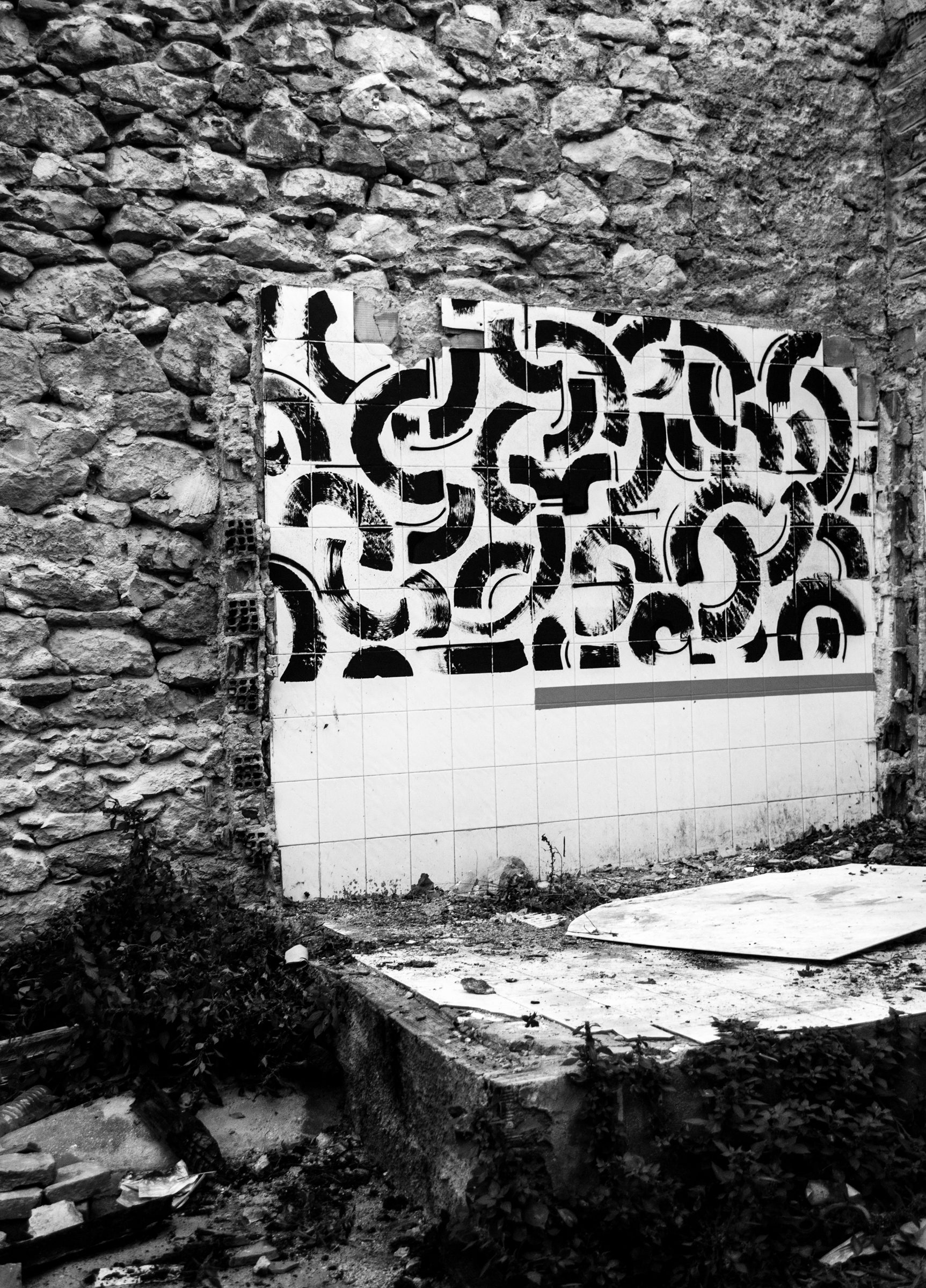
In 2015, you started painting geometric elements leaving letters behind. Can you explain this phase, and what challenges you had back then?
The shift to abstract happened during a session when I was painting alone in a quiet spot in my hometown and the piece did not work out. I started painting over it with random lines and spraying, without any intention, just trying to cover it. Then I stepped back and realized that l liked it. I tried to repeat it on another wall, this time without letters, and that was it. A completely new world opened up in front of me. Looking back at the progression of my work, it feels like it was already moving in that direction, just without a clear endpoint. Since then, strong abstract pieces really fascinate me, just like how it happened that day.


From 2017 until 2021 on, you started to experiment with very different forms of abstraction on walls. Can you describe this phase, and your research?
It was a really creative period. Many of my friends were also very active at the time, and that energy pushed us to try new things. I was also inspired by the rise of abstract works across Europe. A lot of artists were visiting Greece then too, and there was a great exchange of ideas and influence.
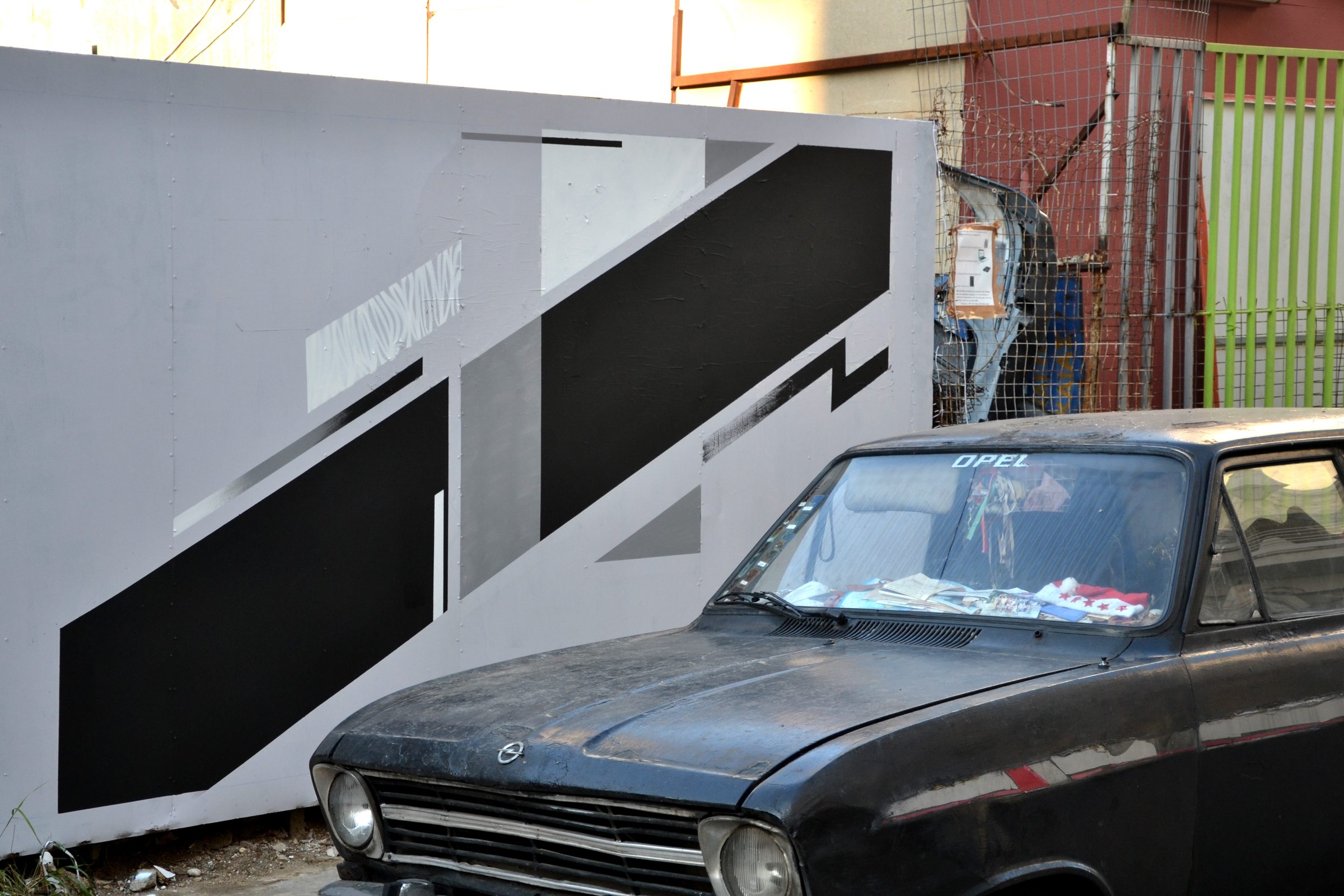
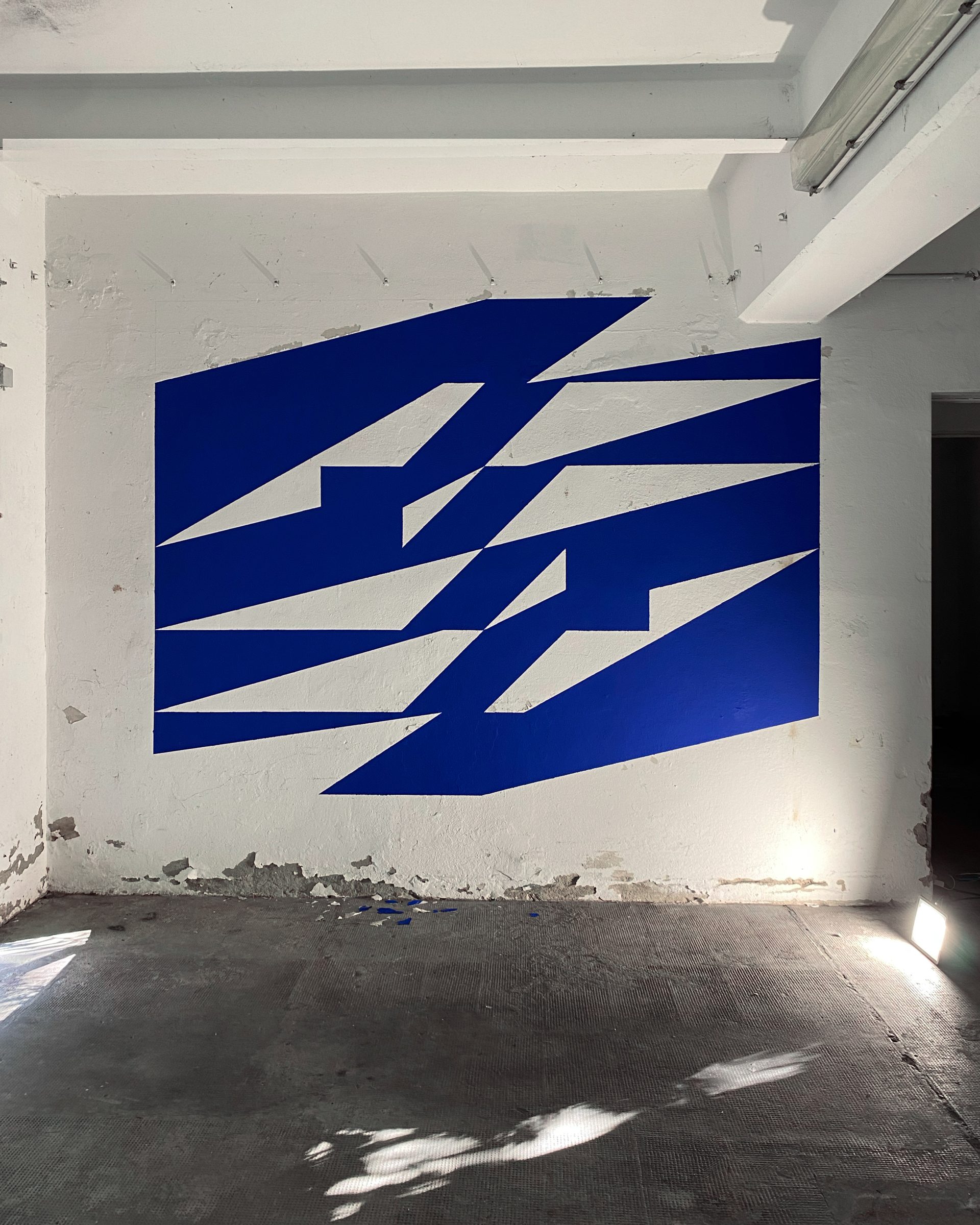
Since 2021 until now, you are painting reduced geometric shapes, integrating positive and negative spaces in the composition, also creating repetitive motifs like patterns along a wall. How did you evolve towards this visual language?
The repetitive geometric patterns as a visual language started in the last two years. It is a conceptual approach based on repetition in life. There is an overall theme, and I try to visualize it in different ways. As you get older, you start noticing the same patterns repeating in life, just at different times. It is a large ongoing project called Epanalipsis, which in Greek means repetition.
What are the challenges or difficulties working with simple geometric forms?
When the shapes are very strict and the composition is built on a clean grid, there is no room for mistakes. It is a mathematical work that requires focus, preparation, and a lot of patience.
Do letters still play a role ? Is your name ONEBRAN still a structure, the base for an evolving composition?
My name is no longer the main structure in my work, but letters are still important to me. I love good typography, and many times you can still find letters hidden in my pieces. I always study letter forms, including ones that were part of my tag in the past.
Are you still calling your abstract works outdoor „pieces“?
Yes of course. The process and the result changed a lot, but painting is still painting.


What do you like the most in abstraction?
One thing graffiti taught me is that you always have to improve. For me, abstraction came naturally as an evolution, and it really makes me think. In abstraction, you can see the pure expression, since it is not based on a reference but comes directly from someone’s mind.
Some people repeat the same thing for ever because it made them famous or because it sells, but that is not my approach. I believe artists should go through different phases, experiment, sometimes stop, and allow themselves to change.
You seem to like lost places, what kind of places do you prefer (old ones or modern ones) and how do you discover those?
I have always painted in abandoned places. I love exploring and painting locations that no one will ever find. Sometimes you notice a spot while walking or driving, sometimes a friend shows it to you, and other times you go out with the purpose of exploring. What excites me is giving new life to a forgotten place, even if no one will ever see it in person. You just need to keep your eyes open.
Are you constructing your own tools or using special techniques?
I make my own colours. If you look closely in big cities in Greece, especially during renovations, people often dump old paint on the streets. I collect those paints and bring them back to the studio. There I mix them together and combine them with other materials. It is a process that allows me to create colours that are unique and personal.
You mainly paint with one, two or three colours. Why? How do you choose the colours besides black and white?
Following up on my previous answer, many of my pieces have a dark blue, green or grey-ish type of colour palette. Almost all of it comes from the trash. One man’s trash is another man’s treasure. Upcycling is important to me. There is so much material that can be reused again and again. I mostly paint with rollers now and much less with spray paint. I also believe that working with simple colour choices, sometimes even just one colour, can be very powerful and communicate the idea directly.
How are the steps for your painting process on walls and how long does it take?
It depends on the size of the project. Measuring the wall and setting up the grid are always the first steps, and sometimes that part takes more effort than the actual painting. After that, taping and painting follow.


Are you doing a sketch before?
Yes, based on the location, I choose a design from my sketchbook. When it comes to commissioned work, there is always a finished design before.
How important is freestyle in your work?
I painted freestyle for about twenty years, but not anymore. Some things still get adjusted on the wall depending on the space, but there is always a sketch guiding the work. Also, there are so many things in my head now that it is harder to come up with something new on the spot.
How do you work to find new forms/shapes?
New shapes come from many different sources of inspiration, like architecture, photography, light and shadow, and then they develop further through sketching. While sketching, new ideas appear, and sometimes I combine different ideas to create something new. It is a never ending process.
What kind of architecture or photography are you enjoying?
I believe that every type of architecture is interesting in its own way. You have to find beauty in things, or you can feel trapped, especially in the strange times we are living in. When it comes to photography, I am drawn more to abstraction, such as light and shadow, textures, still life and close-ups. As a nostalgic person, I continue to run a photoblog. https://onebran.tumblr.com/
Do you often collaborate with others artists, and what are the positive effects on your own work?
Yes, I always did, and I do enjoy collaborating. It takes me out of my comfort zone, and helps me see the artwork as a full composition. I also get inspired by others, and the result is always something new.




How important is your studio work?
It is very important. It is an essential part of my evolution and helps me work in a different way. Taking more time, making more adjustments, and having the chance to really observe the work can lead to different directions compared to painting walls, where you usually paint in one day and then leave.
Which techniques do you use in the studio?
I try to use everything I have gathered in the studio. I enjoy working with materials that I would not normally use on a wall. Even though I sometimes follow the same visual lines, I like to experiment and present something different through my studio work.
What other materials do you use?
I mostly reuse materials such as old papers for collage artworks, wood or cotton, old frames, and random objects found on the street, giving them new life. When a painting has not sold for a long time and I can no longer stand seeing it in my studio, I paint over it, sometimes creating something completely new and sometimes recreating it in a different way.
How often do you exhibit those works?
It depends on the phase I am in. Recently, we also started curating projects with Aenea Matter, which is our latest project, and there are more coming. ( https://www.instagram.com/aeneamatter/ )
You are working as a graphic designer as well. What kind of designs do you create?
I do a few projects selectively as a graphic designer. It is not my main work anymore like it used to be. Now it is more about using that knowledge within my own projects and adapting it to a more creative level of my work.
Is there a link to your actual wall paintings?
Yes, there is. Many people ask for commissioned paintings based on murals from abandoned buildings.
Thank you for your time!


Leave a Reply