

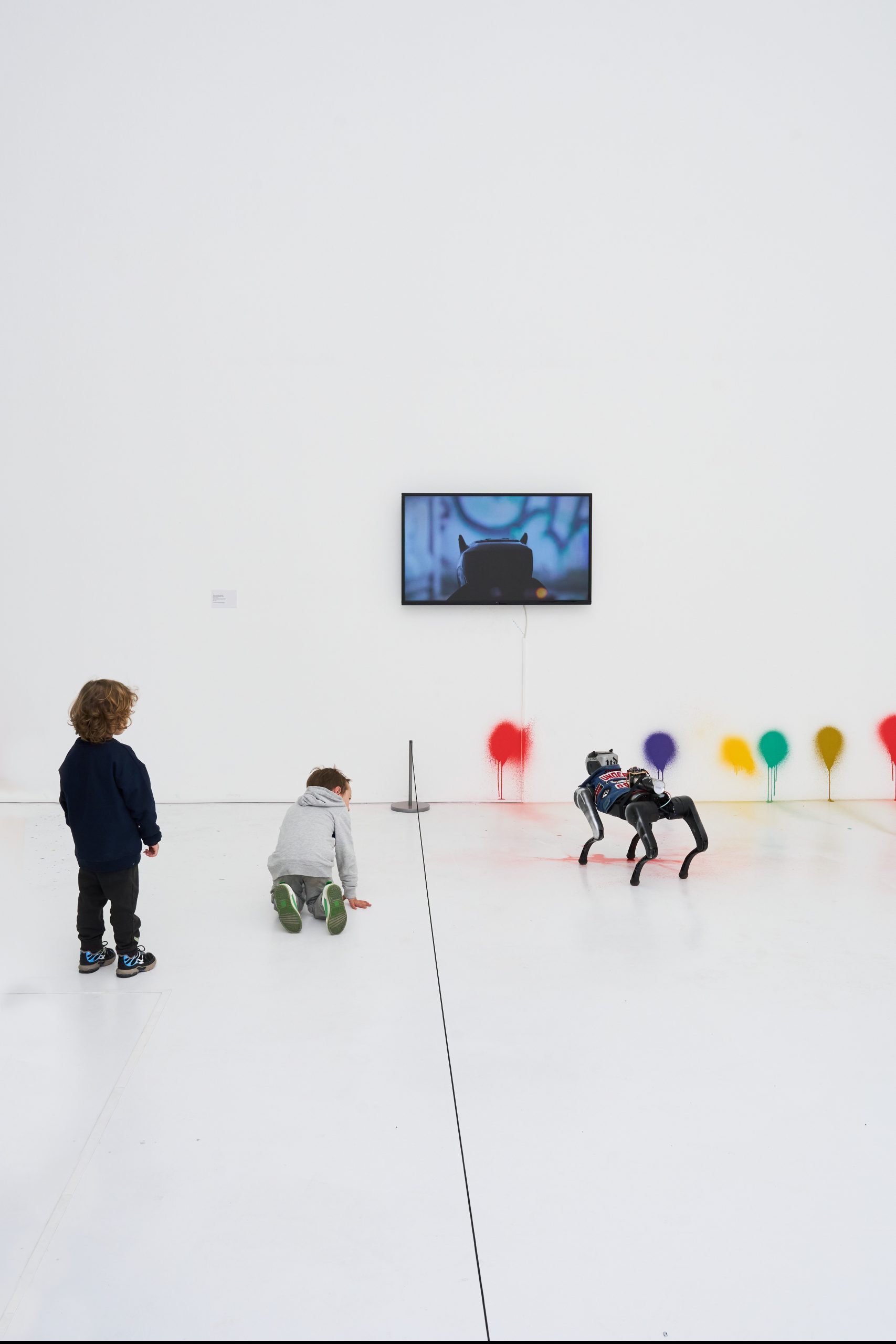
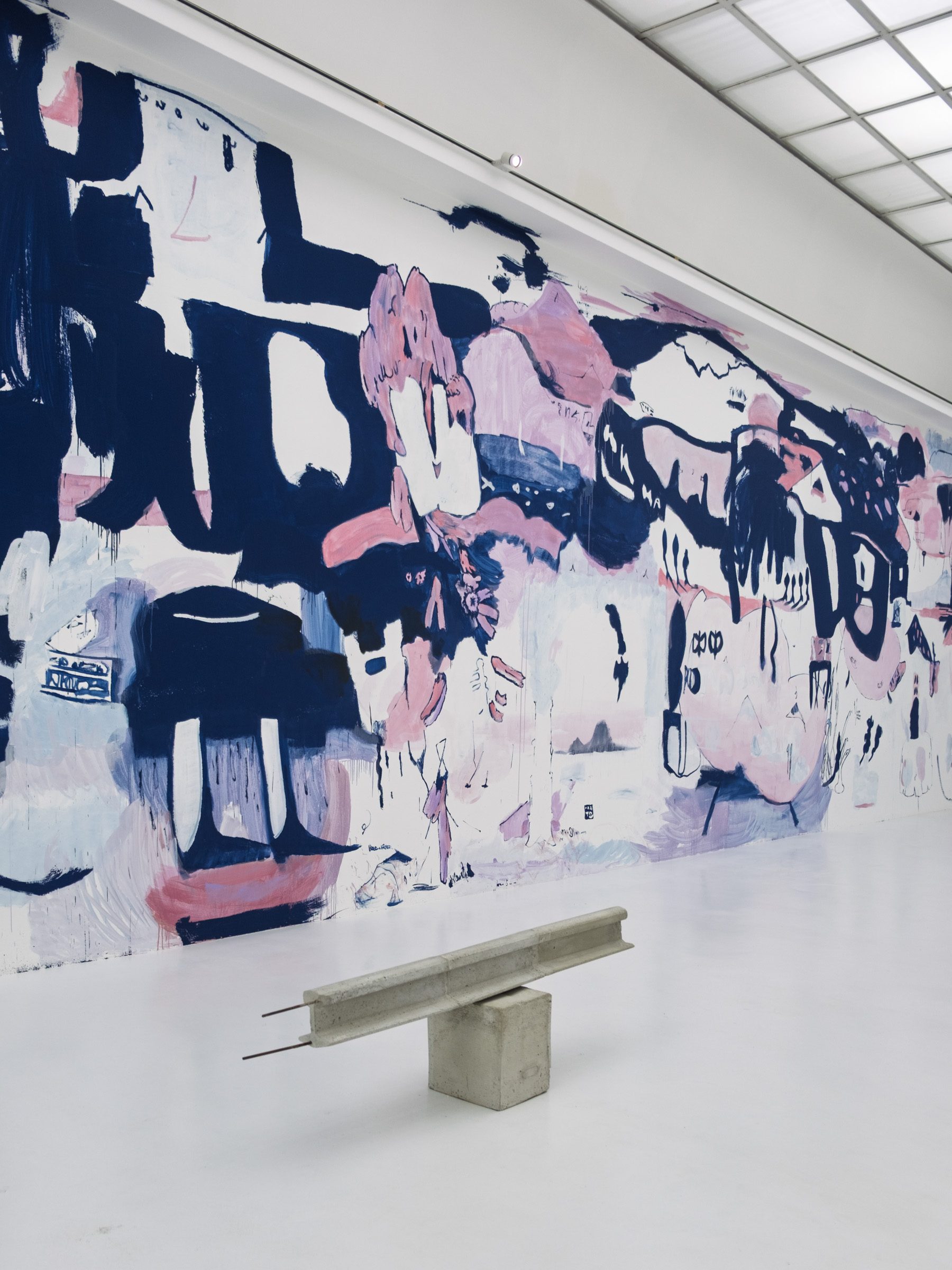
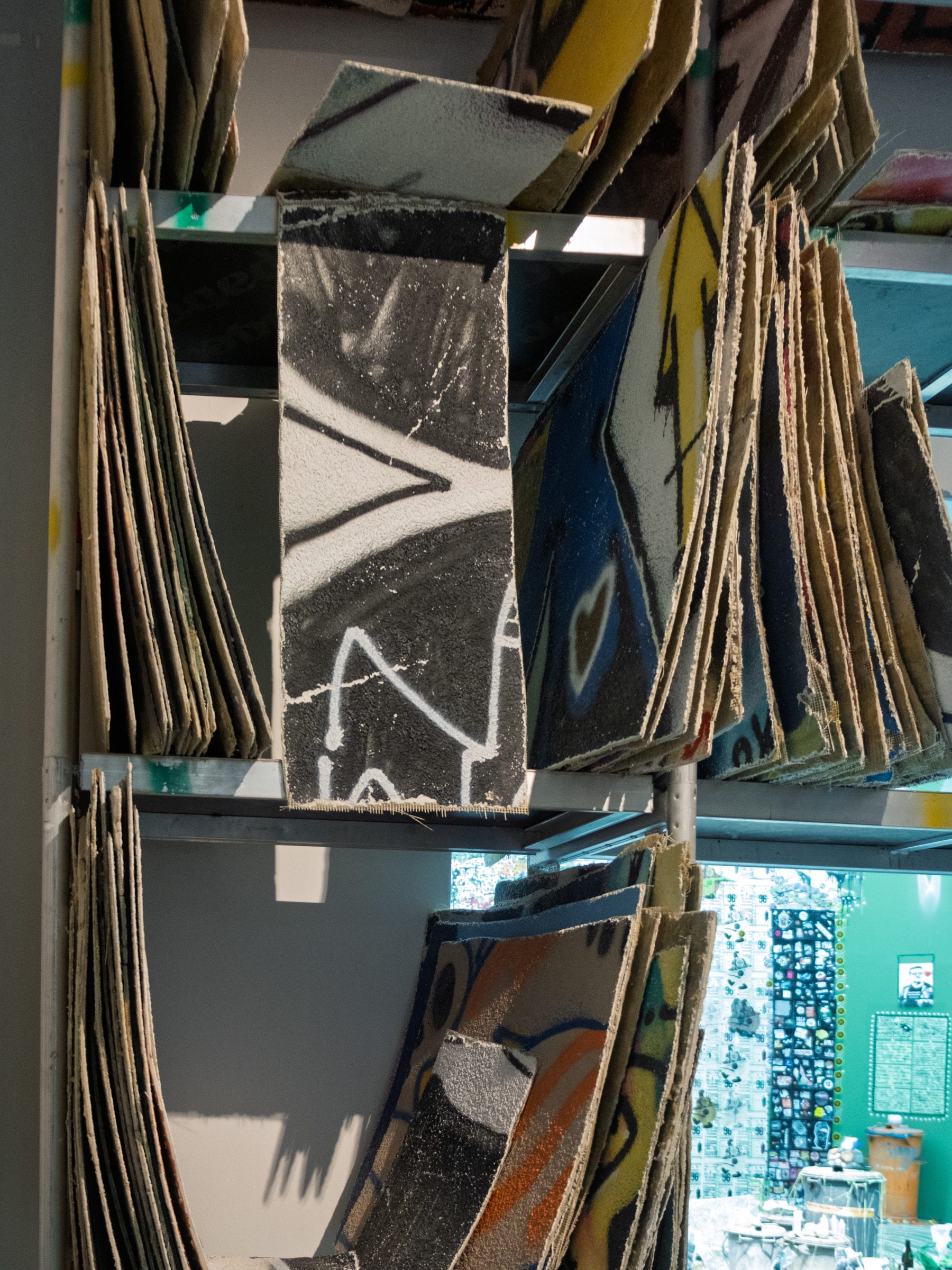
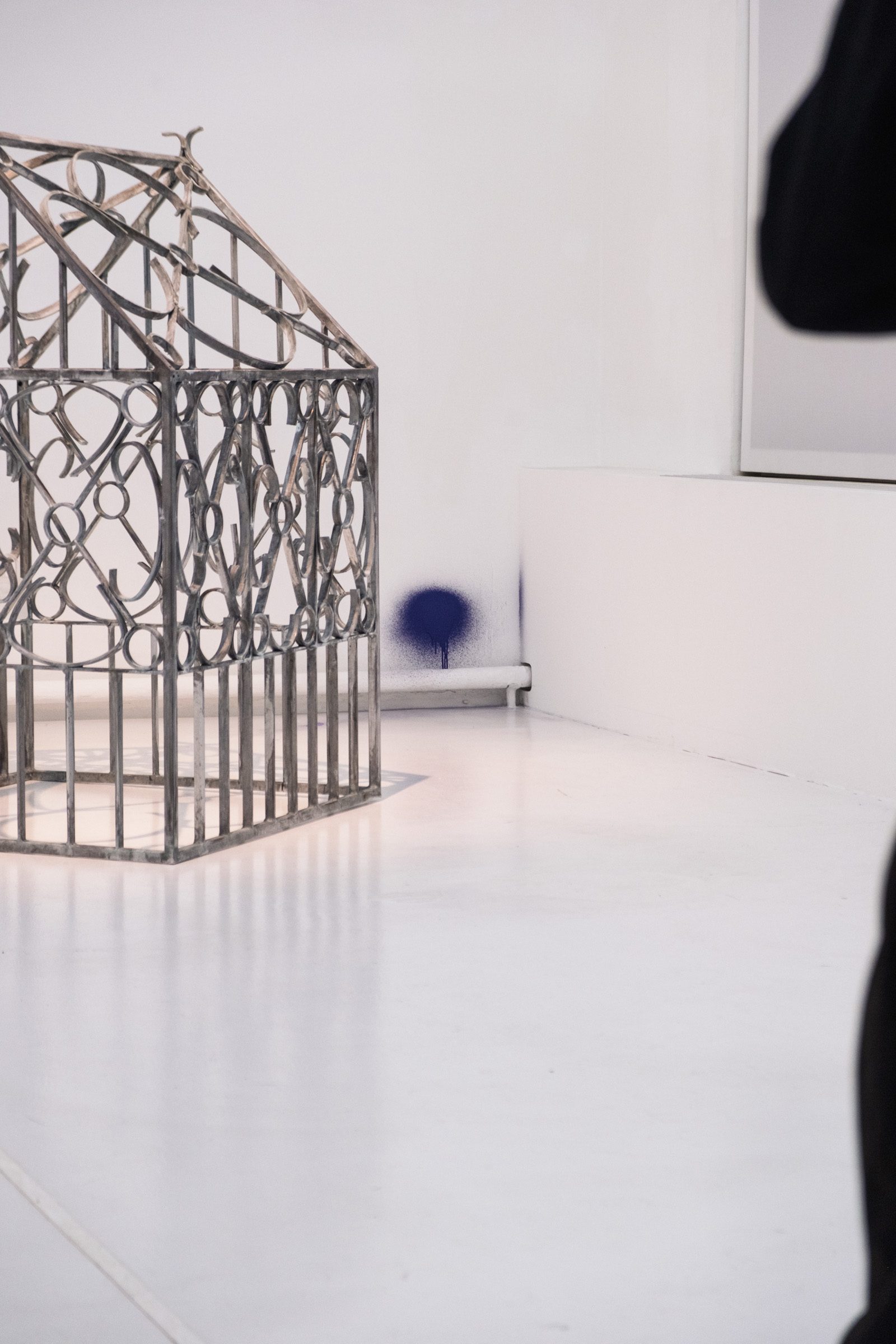
In the group exhibition “Under the Milky Way – Abstraction, Autonomy and Post-Vandalistic Tendencies in Contemporary Art” at the Kunstverein Hannover, the collective Rocco and his Brothers are presenting a striking new work. The exhibition, featuring 21 artists, runs until 19 July 2026.
We asked Rocco and his brothers a few questions about their installation “The Hoodhound”:
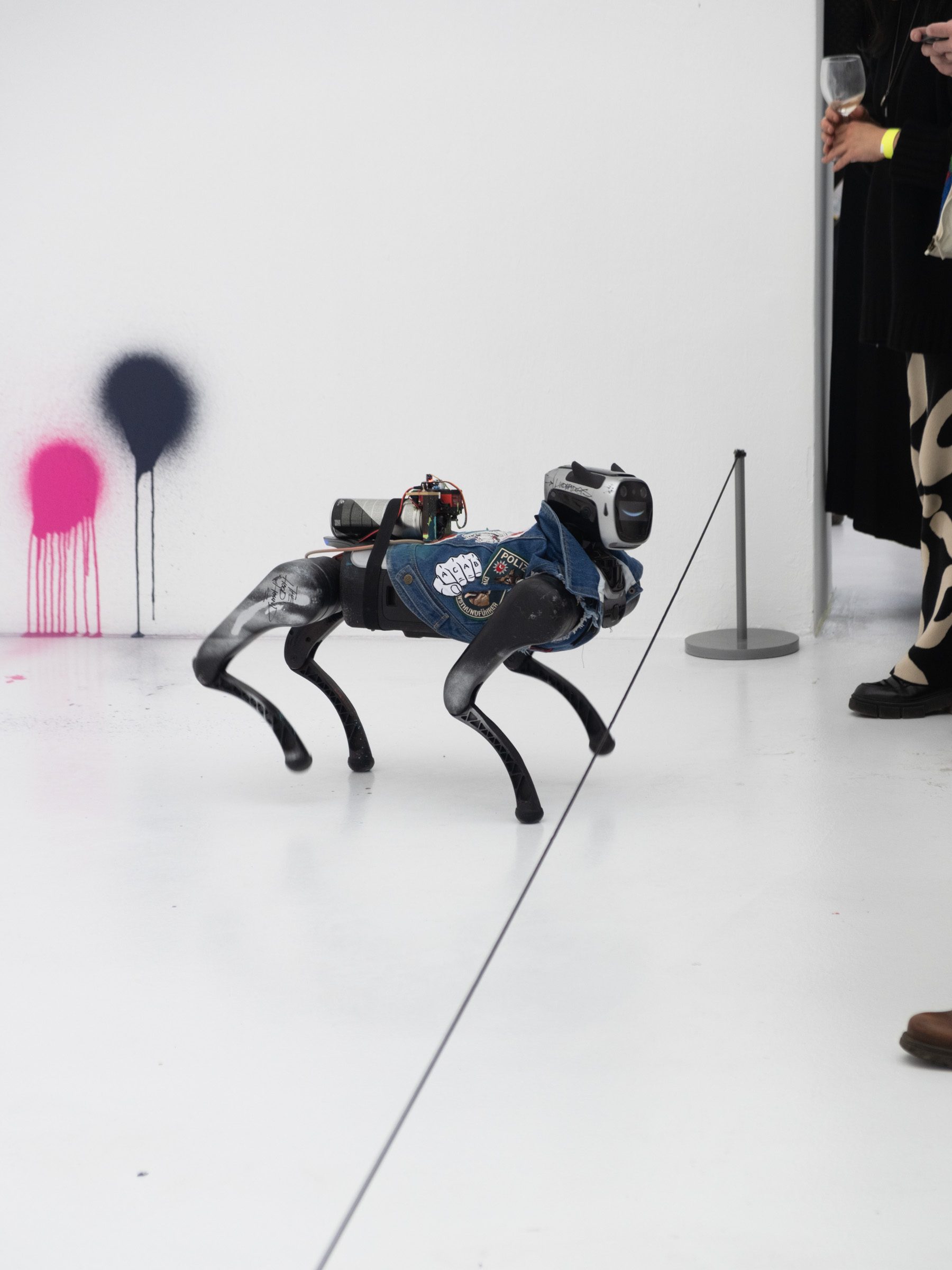
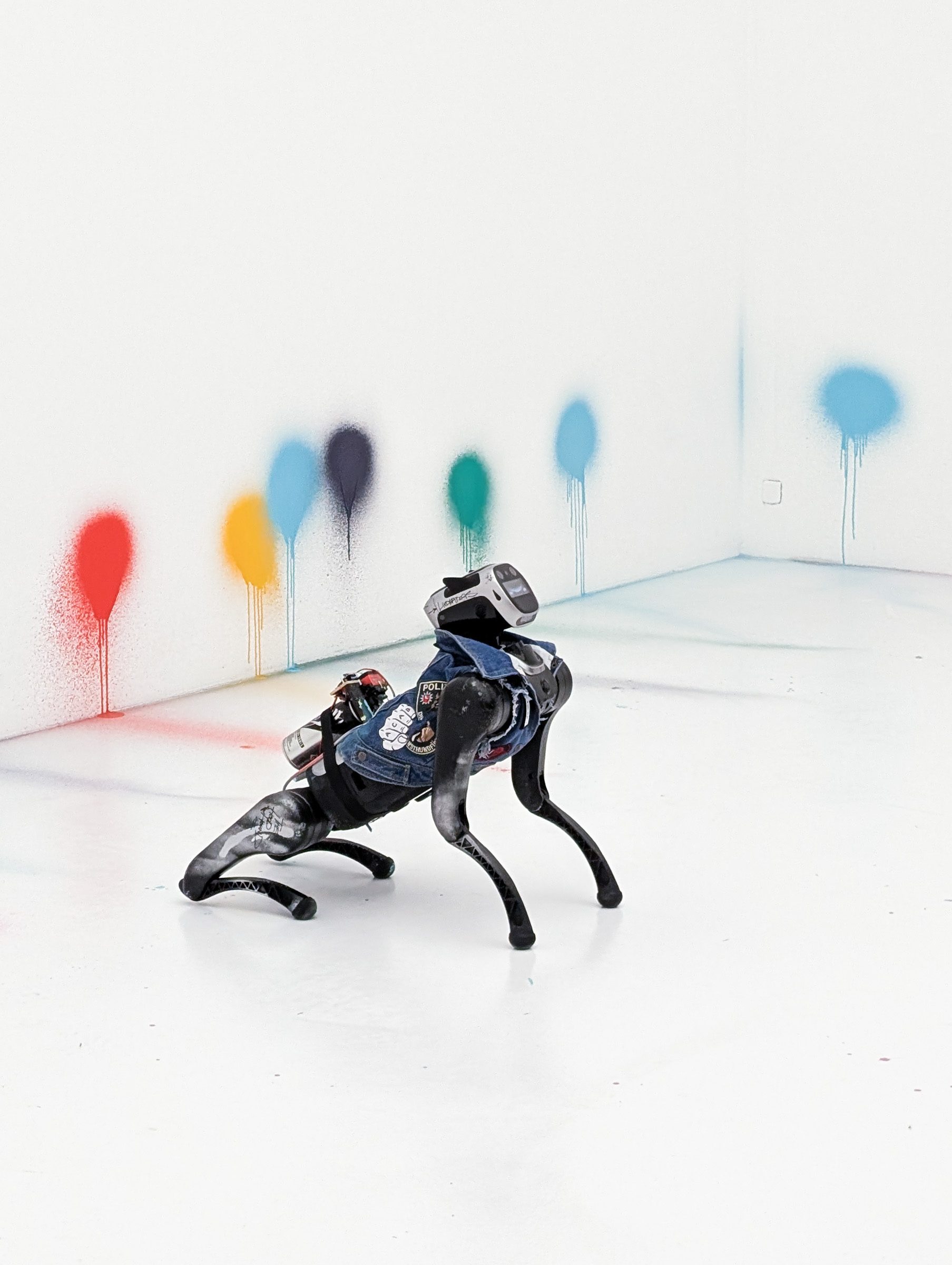
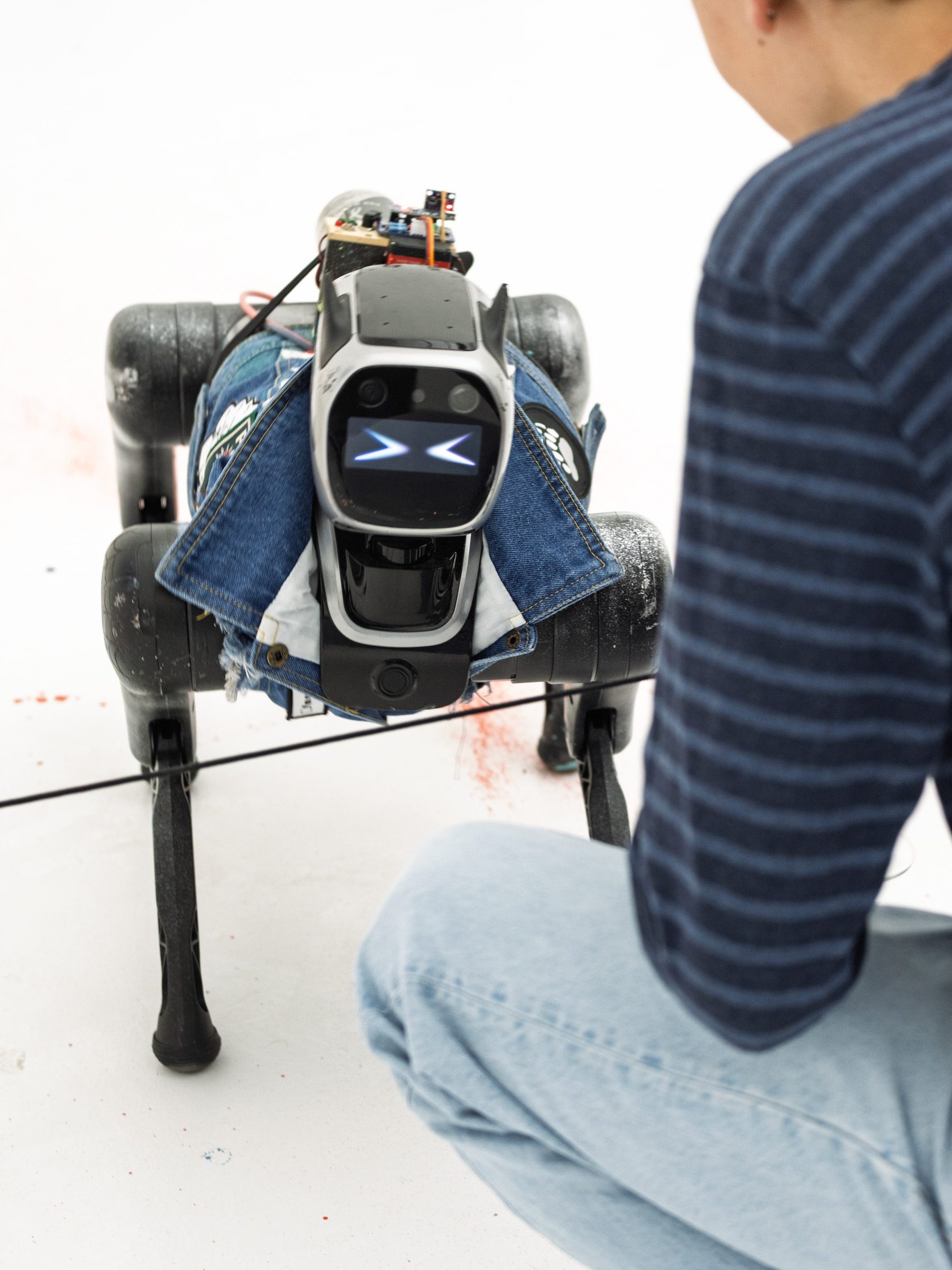
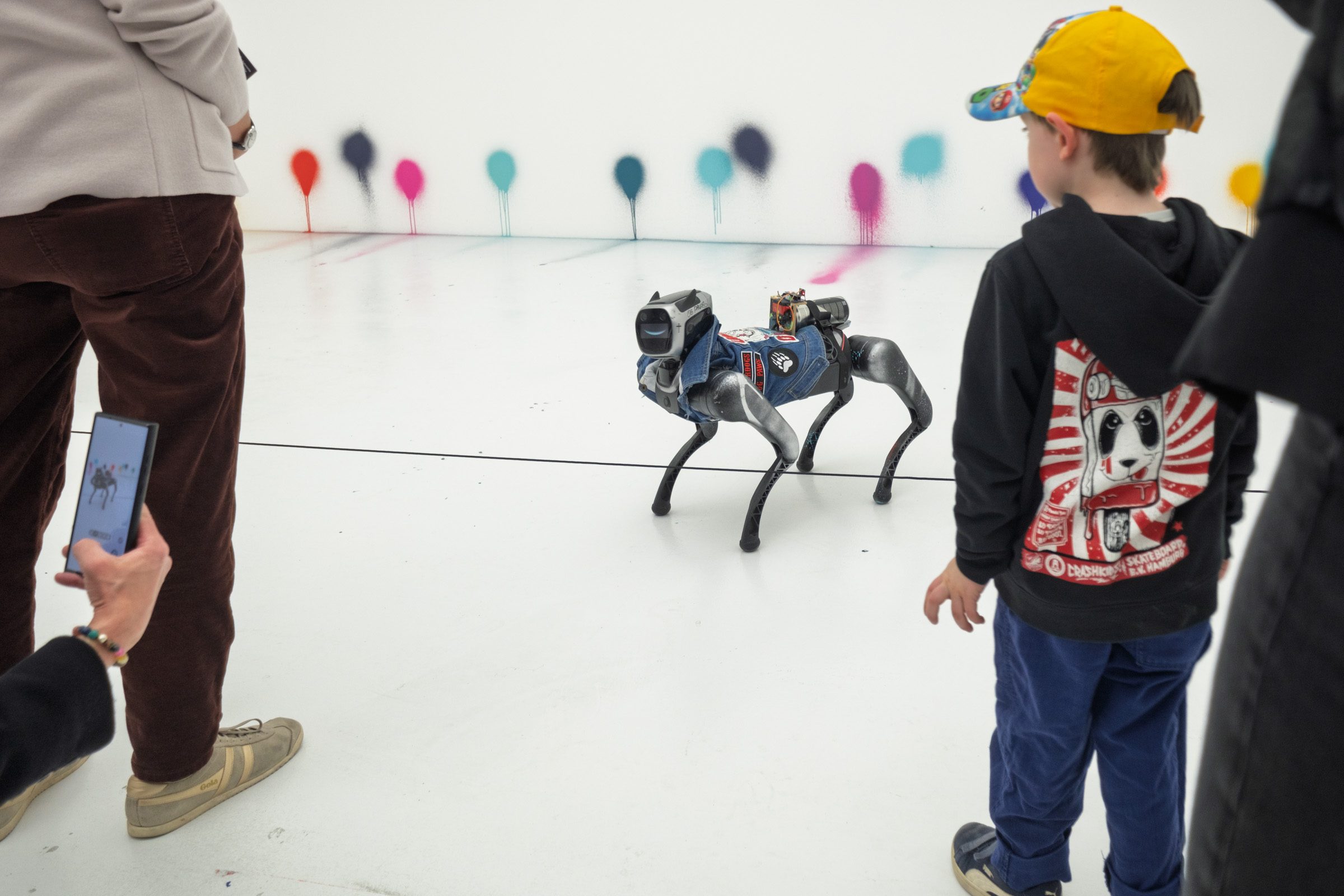
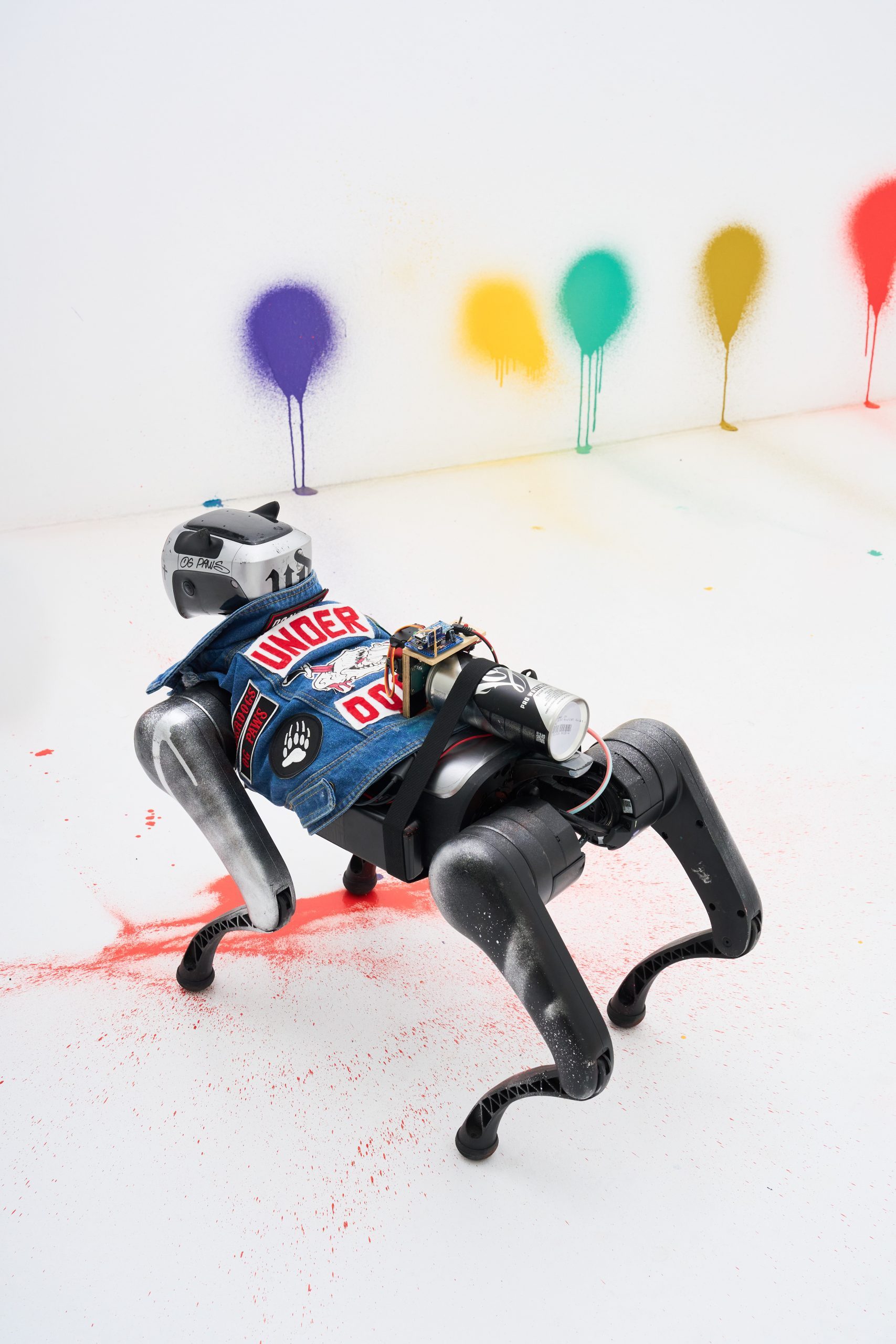
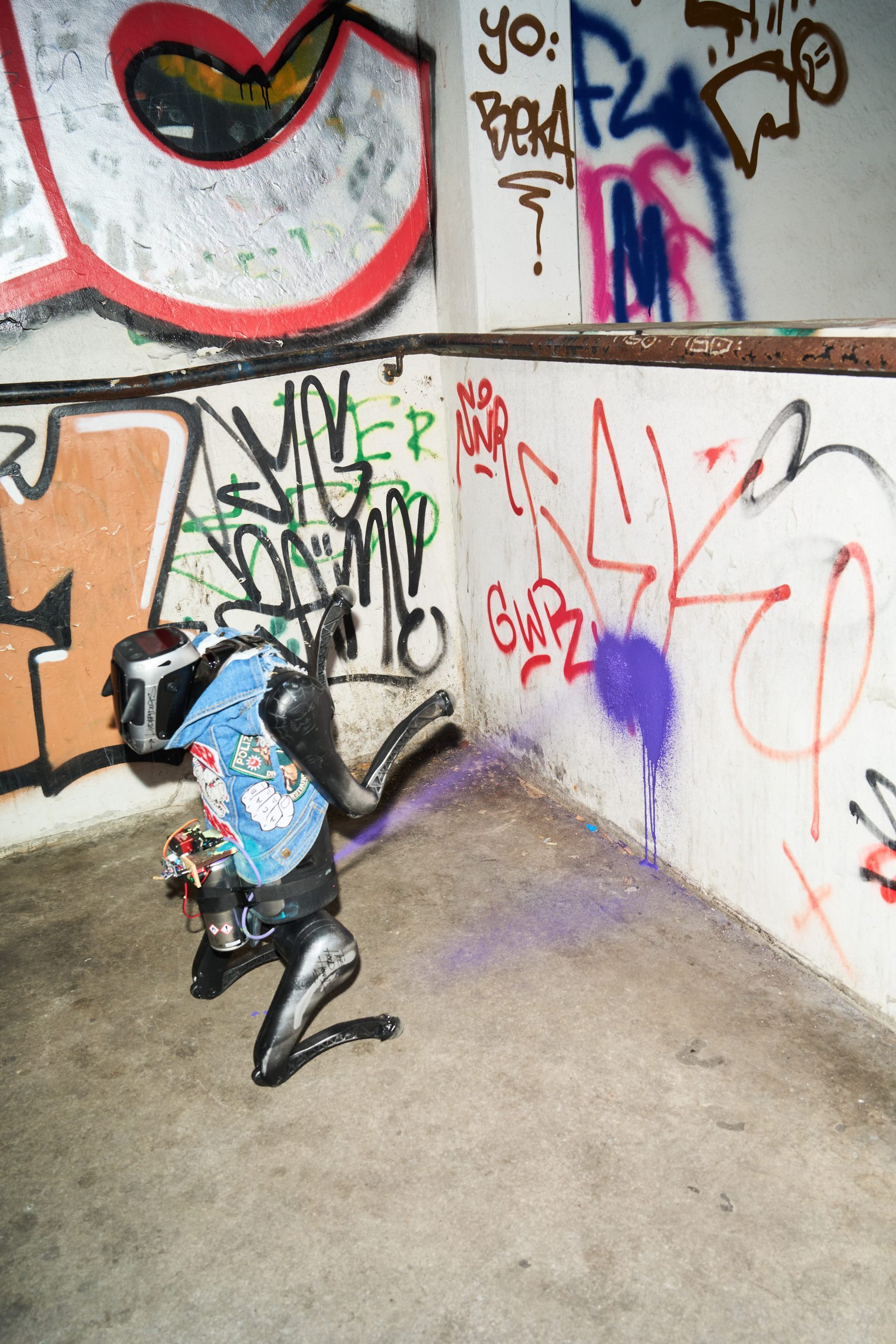
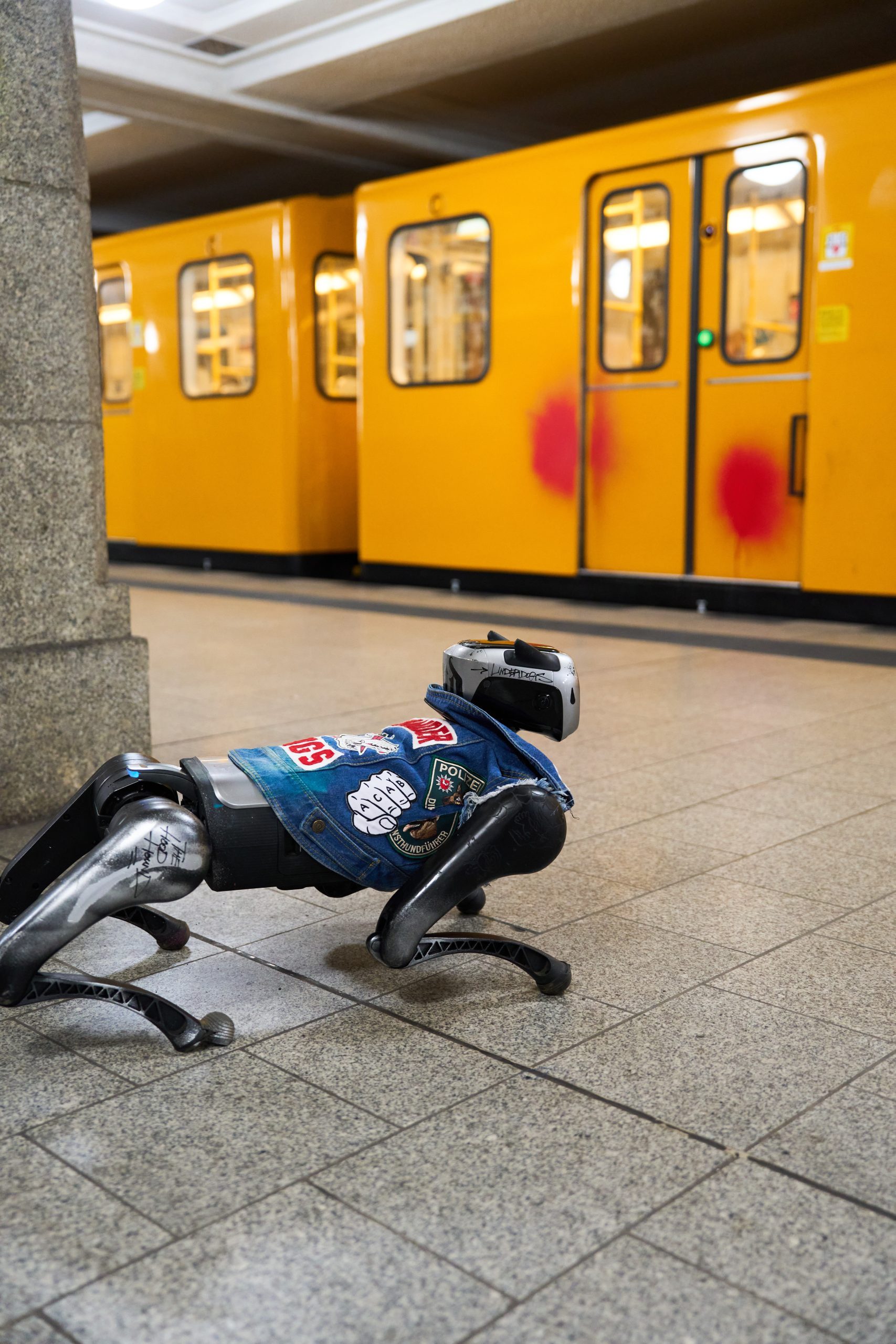
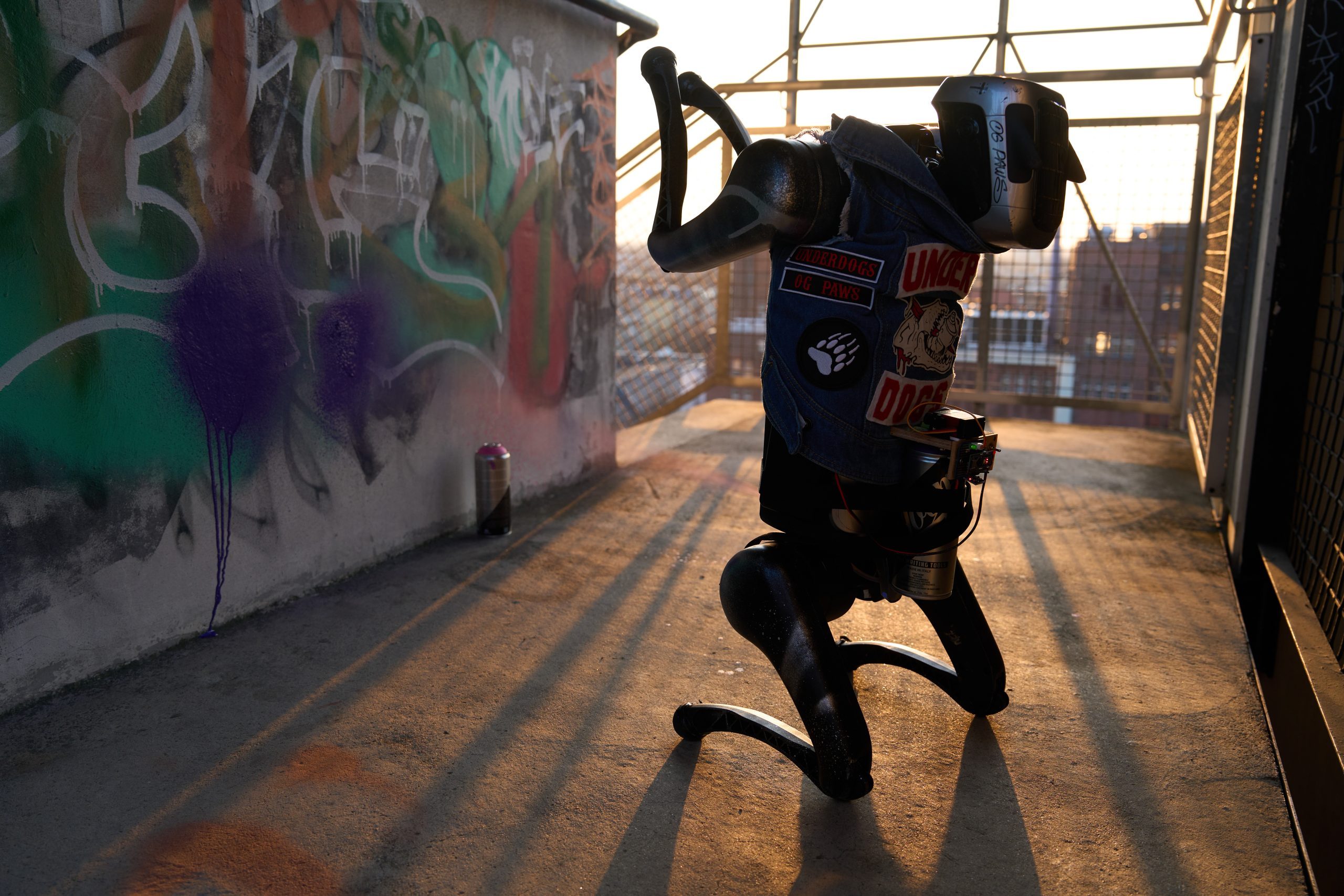
Your new installation in the group exhibition „Under the Milky Way“ is called „The Hoodhound“. On your Instagram account you describe it as an ‘autonomous installation’, a modified robotic platform featuring an AI system, sensors, a spraying mechanism, software intervention, trained to mark its territory, and equipped with P.I.S.S.® (Patrol-Integrated-Spray System).
The Hoodhound is a (repurposed) intelligent robotic dog that carries out specific actions within the exhibition space. Have you encountered and used a robotic dog model like this before?
The description of the Hoodhound sounds a bit like the product page for a piece of technology that you’d actually rather not own.
However, we were less interested in the technology itself than in the machine’s history.
Robotic dogs are now turning up in the military, the police and security services, and nobody seems particularly surprised by this anymore. Yet not so long ago, they were the villains of dystopian sci-fi films and *Black Mirror* episodes. Today, they’re out on patrol and are showcased at security and arms fairs. So the future has largely taken care of itself. The Hoodhound begins precisely at this point. We haven’t built a robot, but have steered an existing narrative in a different direction. A tool of control has become a disruptive force. A system designed to gather information has become one that prefers to leave traces behind. Obedience has turned into a mind of its own. OG Paws, as he calls himself, is the worst possible version of a police dog. He doesn’t listen to what you tell him, marks his territory without being asked, constantly runs off and, of all people, has befriended the very people he’s actually supposed to be monitoring.
In 2024, Deutsche Bahn announced the deployment of a robot dog called ‘Spot’ to track down people who illegally paint on trains and to combat vandalism. That’s what gave you the idea for The Hoodhound, isn’t it? Is this ‘Spot’ really already in use?
In 2024, there was a trial phase at a Munich S-Bahn depot, during which the dog was supposed to help prevent graffiti. The astonishing result after a month of AI-assisted total surveillance using a robot dog costing around 200,000 euros: Not a single graffiti writer was spotted, scared off, let alone caught. In this respect, the project was more of a failed PR stunt than a revolution in security technology. However, we found something else interesting. Deutsche Bahn made a conscious decision to present, in a way designed to attract public attention, a technology that originally stems from military and police contexts. These are machines used by armies and security agencies worldwide, and some of their platforms can even be equipped with weapons.
If simply painting trains is enough to legitimise robotic dogs, AI surveillance and military-developed technologies, then the fascinating question is not whether it works. But what comes next.
Did you catch the installation by the artist Beeple at Art Basel Miami in 2025 – the ‘Regular Animals’ installation featuring robot dogs with silicone heads modelled on Elon Musk, Jeff Bezos, Mark Zuckerberg, Andy Warhol, Pablo Picasso, and Beeple himself? Did this installation also inspire you for The Hoodhound?
The Hoodhound had already been wandering through Berlin’s underground tunnels by the time Beeple was still selling holiday snaps of himself as ETFs. In that sense, I’d describe it more as a chance encounter between different robotic dogs than as inspiration.
Actually, the only thing the works have in common is their four legs. Beeple’s dogs represent an art market that sells even its own excesses at sky-high prices. The Hoodhound comes from a culture where value is traditionally measured more by how long something lasts before it’s removed.
What’s more, I’m pretty sure he’d take the silicone dachshunds out in a cage fight with relative ease. If only because he’s the only one who’s regularly out and about.
Where on earth did you get the model for this installation? Where can you buy something like that?
As with so many strays, its history is a bit of a mystery.
Was it difficult to fit the robot dog with the Patrol-Integrated-Spray System, and what else is such a system used for?
P.I.S.S.® stands for Patrol-Integrated-Spray System. We reckoned that if the military, the police and tech companies are allowed to give their projects the most impressive acronyms possible, then so should we.
What else is the system used for? Well, from a biological perspective, dogs have been using similar systems quite successfully for several million years to mark their territory. The Hoodhound is simply continuing this tradition with slightly better hardware.
How long did you test it for beforehand? And did it work straight away after programming, carrying out the actions you’d programmed perfectly?
‘Perfect’ is a big word. Anyone who’s ever worked with sprayers, dogs or computers knows that perfection is rather rare among all three groups. So, naturally, things didn’t always go to plan. Sometimes it would come to a standstill, sometimes it would run off into the distance, and sometimes it was interested in things completely different from what we’d intended. He also had a habit of simply toppling over. But to be honest, those were often the best moments. If you build a machine that’s supposed to behave like a stray dog, it would be rather contradictory if it then carried out every command perfectly. In that case, we’d have ended up building nothing more than a police dog after all.
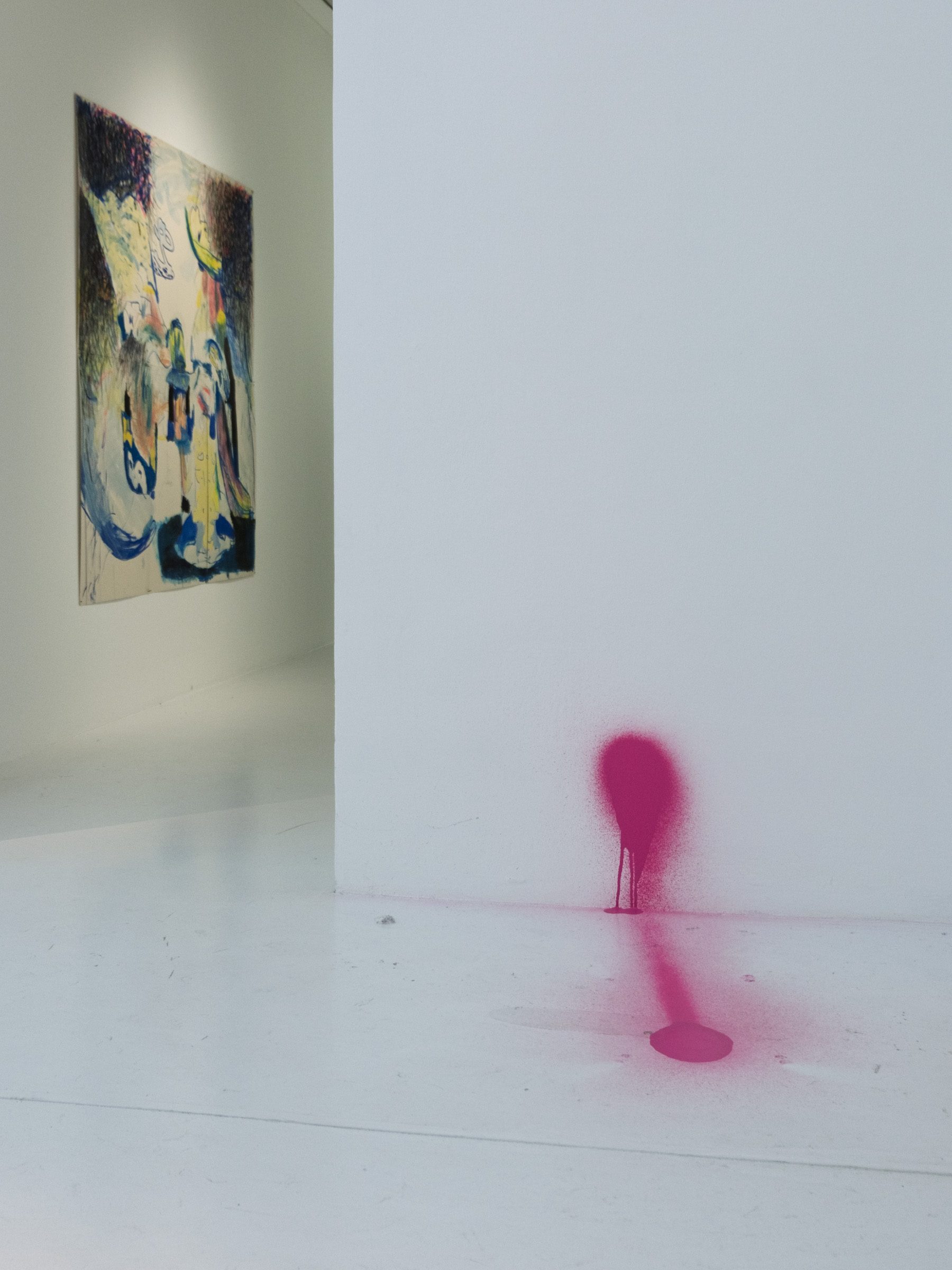
Can you describe what sort of actions your robot dog performs in the exhibition? The exhibition text reads: “The dog, named ‘Spot’ by the DB, seems to have switched sides and, as a dropout, maverick and punk, inhabits the exhibition spaces, where he himself leaves ‘spots’ behind, as he goes for a walk – independently, and also AI-controlled – whenever he pleases.” Exactly how many actions were programmed, and for how long?
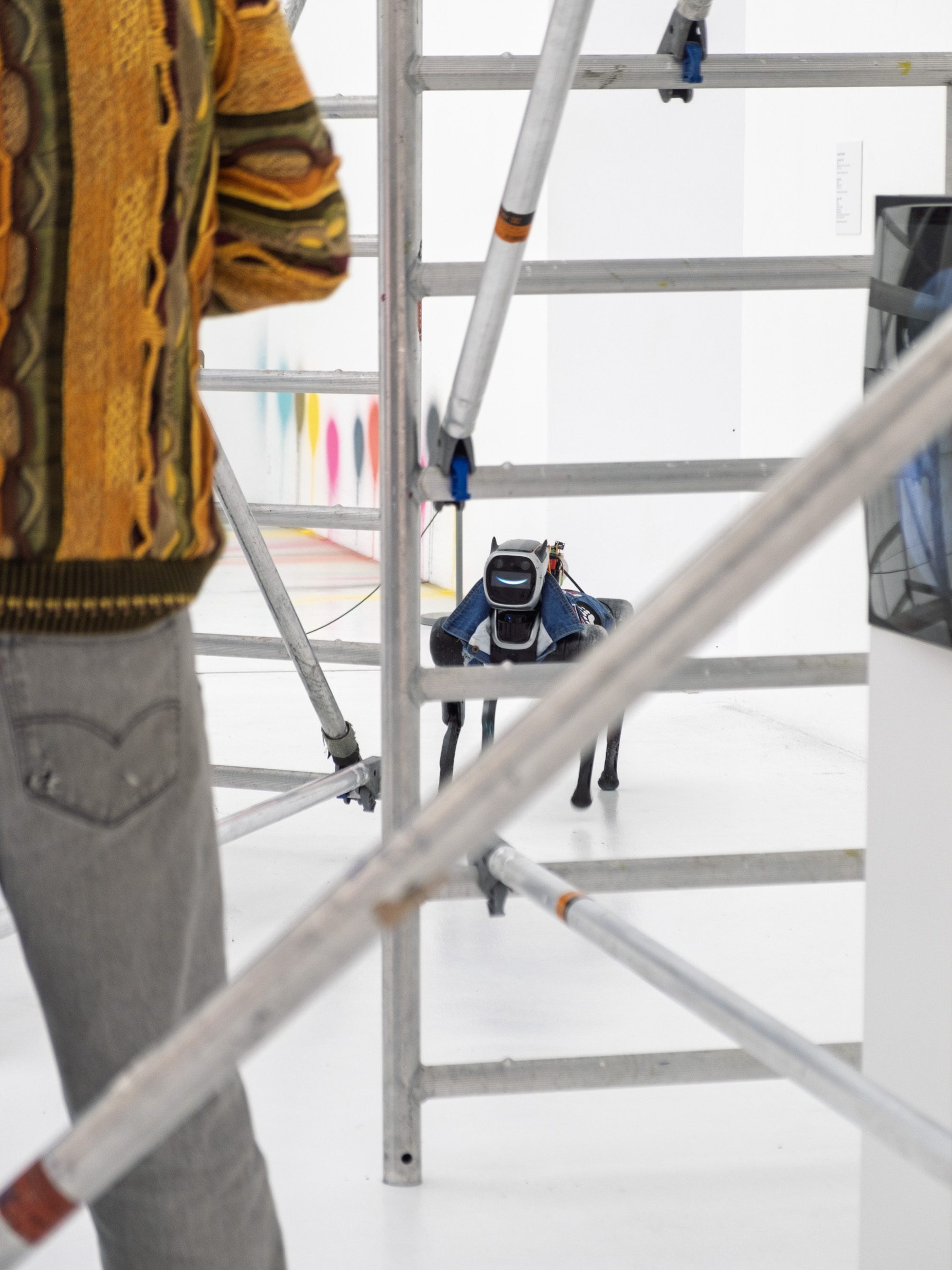
He really does walk around autonomously. That wasn’t a joke. Many visitors initially assume that his movements are pre-programmed or choreographed. In fact, his paths and decisions can only be predicted to a limited extent. This also applies to the choice of the spots where he sprays. You have a rough idea of what sort of dog he is, but not necessarily what he’ll do next. Using various sensors, it scans and maps its surroundings.
The exhibition space thus gradually becomes its territory. It moves within it not like an exhibit, but rather like an animal seeking to discover what belongs to it and what does not. The number of its actions or movements cannot therefore be quantified in any particularly meaningful way. We were less interested in a fixed choreography than in the possibility of restoring a certain degree of independence to a technical system. There are also reports that, during the exhibition, OG Paws is said to have climbed onto the Miniature Spitz belonging to an elderly visitor to the Kunstverein. However, we cannot confirm this first-hand. Like any good myth, The Hoodhound grows a little bit bigger with every retelling.
How long can it stay active, and how long does its battery last? And how long does it take to charge?
Of course, it needs plugging in every now and then. But to be honest, we’re far less interested in the Hoodhound’s technical capabilities than in its character flaws. Nobody asks a stray dog about its battery life. Besides, it’s part of the concept that even machines need to take a break.
Could he be programmed to do more than just ‘spots’ – for tags or pieces, for example?
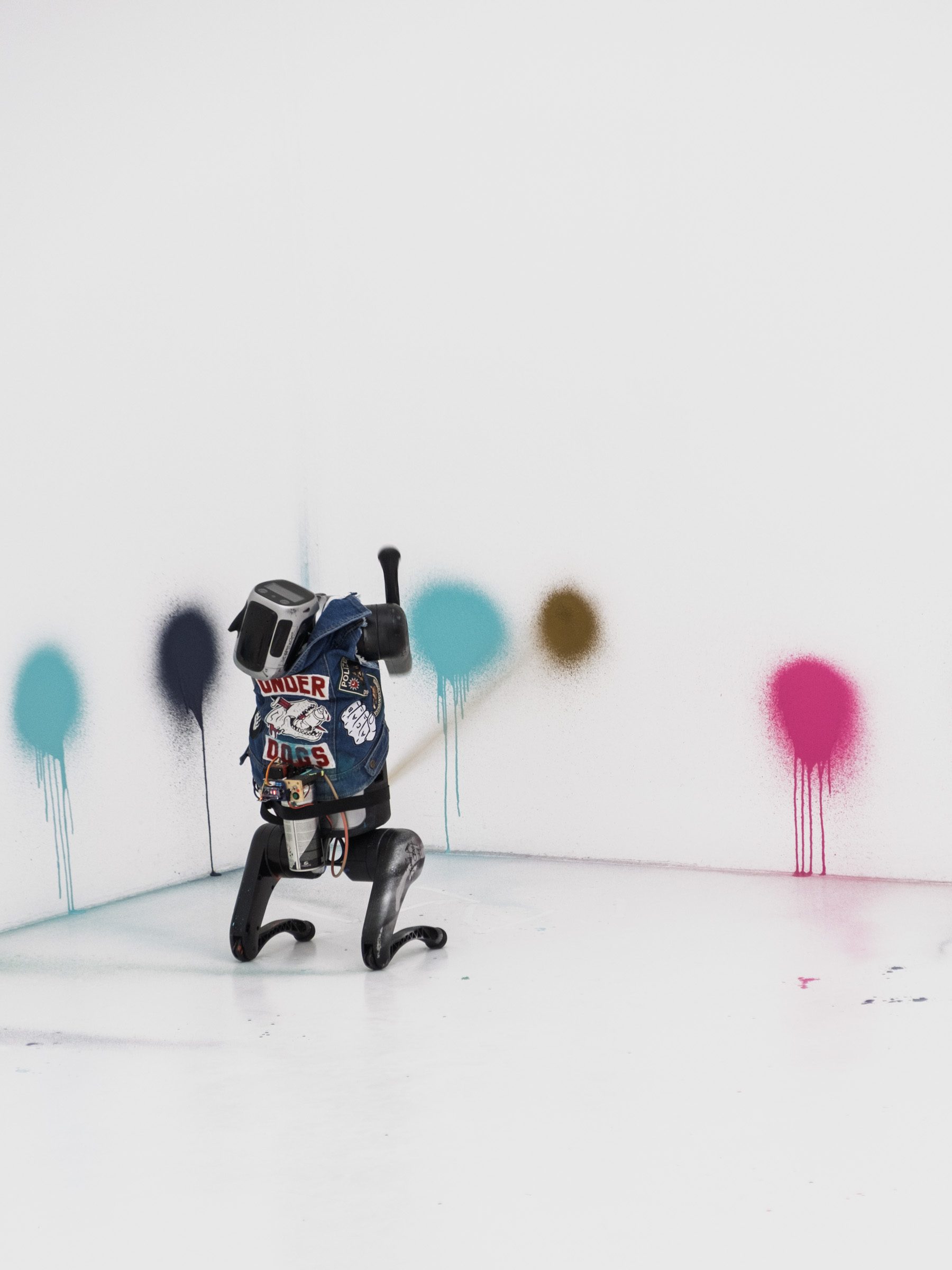
That’s far too pretentious nonsense for him. The Hoodhound doesn’t need outlines, fades or artfully placed signatures. He’s not interested in pretty or particularly elaborate kitsch graffiti. He wants to mark his territory. As directly as possible, as unambiguously as possible, and ideally with a few proper drips. Basically, he reduces graffiti to what is probably its oldest and most honest concept: I was here. Besides, we’re just confirming a classic narrative. Graffiti artists have been compared for decades to dogs that piss everywhere. And The Hoodhound has finally taken this accusation seriously.
Could it have been programmed to perform many more actions, or are there limits?
Of course, it could have been taught a great deal more. But should it have been? We liked the idea of a robot with very limited ambitions. Marking its territory, wandering about, annoying the authorities. That’s quite enough.
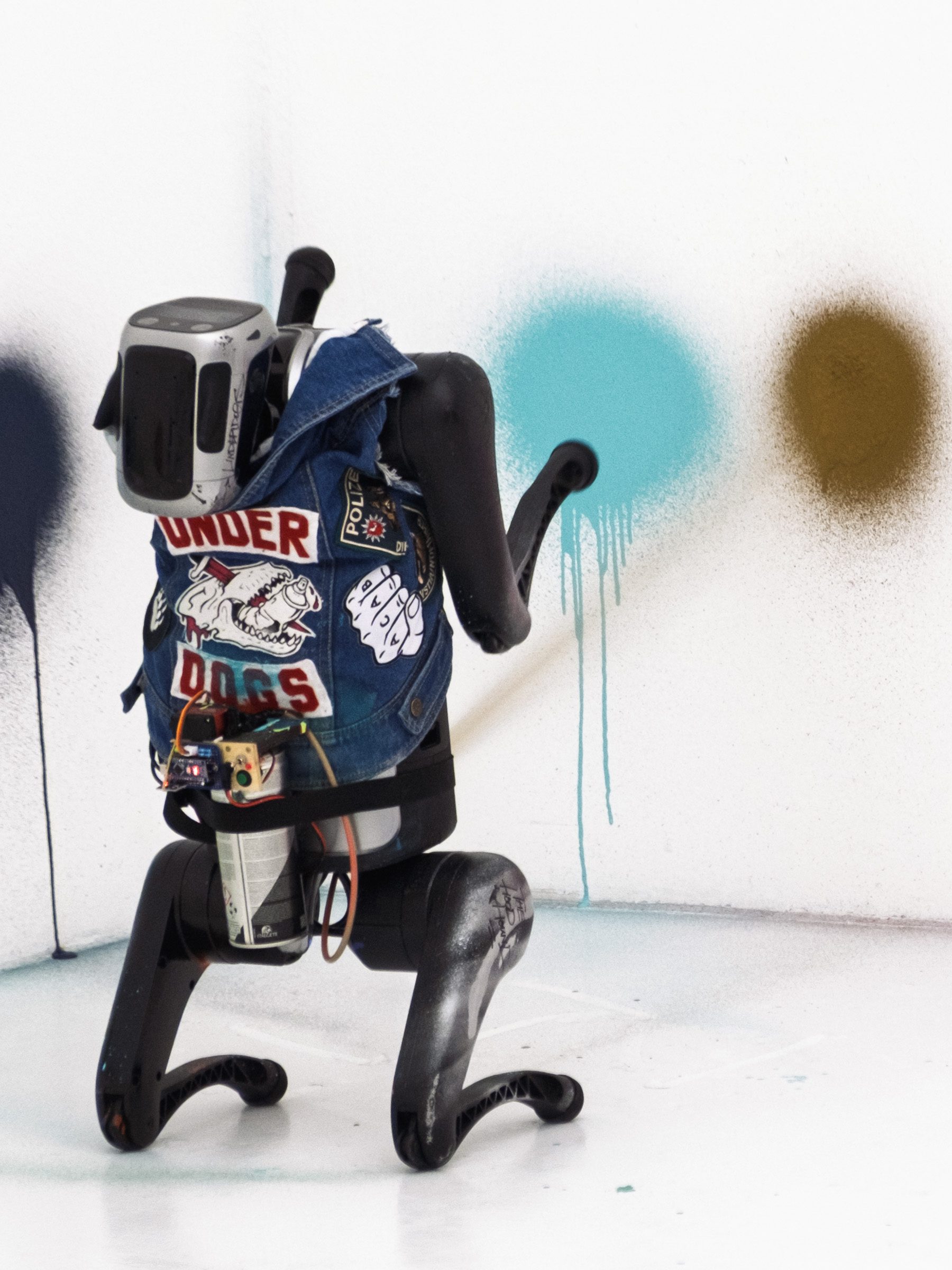
He’s wearing an ‘Underdogs’ jacket, and ‘Underdog’ stands for the weaker or ‘hopeless’ underdog, right?
Every street crew needs a gang. His is the Underdogs. And in keeping with the ‘traditions’ of our subculture, a proper denim waistcoat with a ‘backpiece’ is, of course, a must. Other dogs get reflective safety vests from their owners. OG Paws wears his team colours. The term fits well, of course, because in his original role, The Hoodhound was never the stronger one. He was meant to keep watch, deter and maintain order. Nevertheless, he had to obey, was guided and took orders.
Where did you get the jacket from, and what size does your robot dog need – a children’s size?
Like most of the things he owns, its origin isn’t fully documented. Perhaps he took it off a silicone dog. We don’t ask too many questions about that either. As for the size: he’s somewhere between a medium-sized dog and a robot vacuum cleaner. Standard clothing sizes are only of limited help here. In any case, the waistcoat fits.
Do you think there are still shortcomings with these robotic dogs in general?
Of course. At the moment, robot dogs are, above all, an astonishingly expensive joke. If you look at how modern wars are waged, you realise that the truly relevant drone systems neither have four legs nor can they give a paw. Their real advantage lies less in their function than in their impact. They look threatening. They look like they’re there to exert control. They look like something you’d rather not come across at night. In that respect, they’re very successful. In reality, they’re often still surprisingly clumsy. Much like many humanoid robots, which are usually only known because they topple over during a product demonstration, kick a child or dance the waltz at some technologies fair. That is why we are interested in robot dogs not so much as machines, but rather as a social phenomenon. They reveal a great deal about how institutions envisage the future: as autonomous as possible, as controllable as possible, and as intimidating as possible.
Your statement on Instagram pretty much says it all: “They built machines to control the streets. We taught one to take them back.” In other words, you’re reimagining a surveillance dog, turning it into an underdog and an active “perpetrator”. Is it described as a dropout, a maverick and a punk who vandalises the exhibition space? Isn’t it something else as well?
Yes, probably. ‘Dropout’, ‘non-conformist’ and ‘punk’ do capture it quite well. But ultimately, these are all human categories we used to try to explain his behaviour. For us, it’s primarily about the reversal. Normally, such machines are built to enforce order, monitor rules and report deviations. The Hoodhound does the opposite. It is no longer part of the control system, but part of the disruption. At the same time, we wouldn’t necessarily describe it as a perpetrator. That immediately sounds like a moral judgement. And, as we know, OG Paws has relatively little interest in morality. Perhaps that’s why it’s best described as a stray. A system that has become ownerless and has suddenly developed a life of its own. Not particularly revolutionary, not particularly ideological, but no longer willing to do what it was originally built to do. Perhaps that is where the real fantasy of the work lies. Not that the machine takes over, but that it simply quits.
How would you translate the title of the work *The Hoodhound* into German, and what does it mean?
The play on words is actually quite obvious. A bloodhound follows trails. The Hoodhound leaves them behind.
Could you imagine creating further installations involving robots and AI?
Actually, we don’t work with AI at all. Sure, the Hoodhound is controlled by a form of machine vision and navigation. But you can’t use it to philosophise about the downfall of humanity, nor can you write your term paper with it.
Of course, AI can and should be explored in art. It is currently transforming society, work and the public sphere at a pace that is hard to ignore. But we do see a difference between an artistic engagement with AI and an image that has simply been spat out by a piece of software.
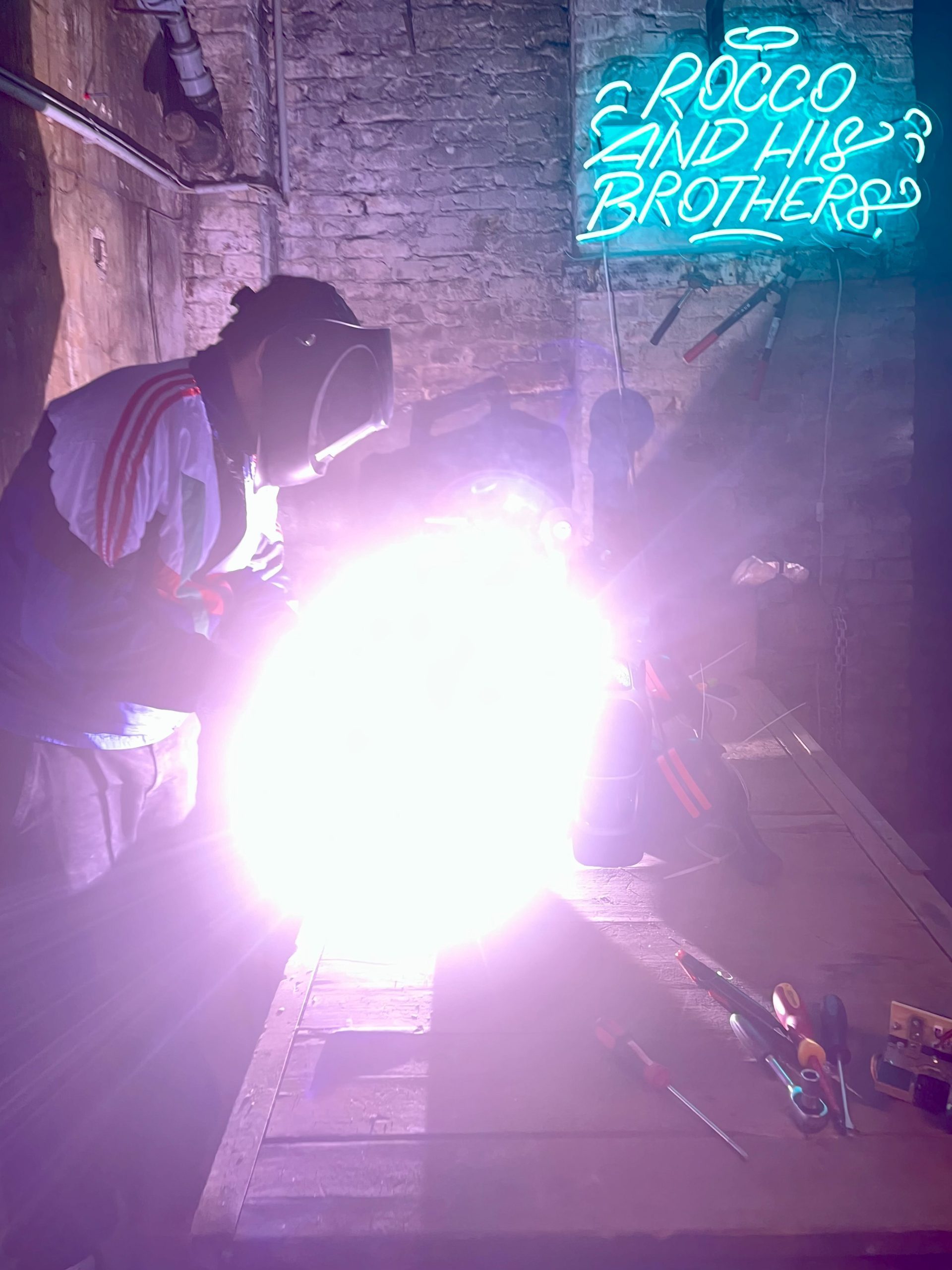
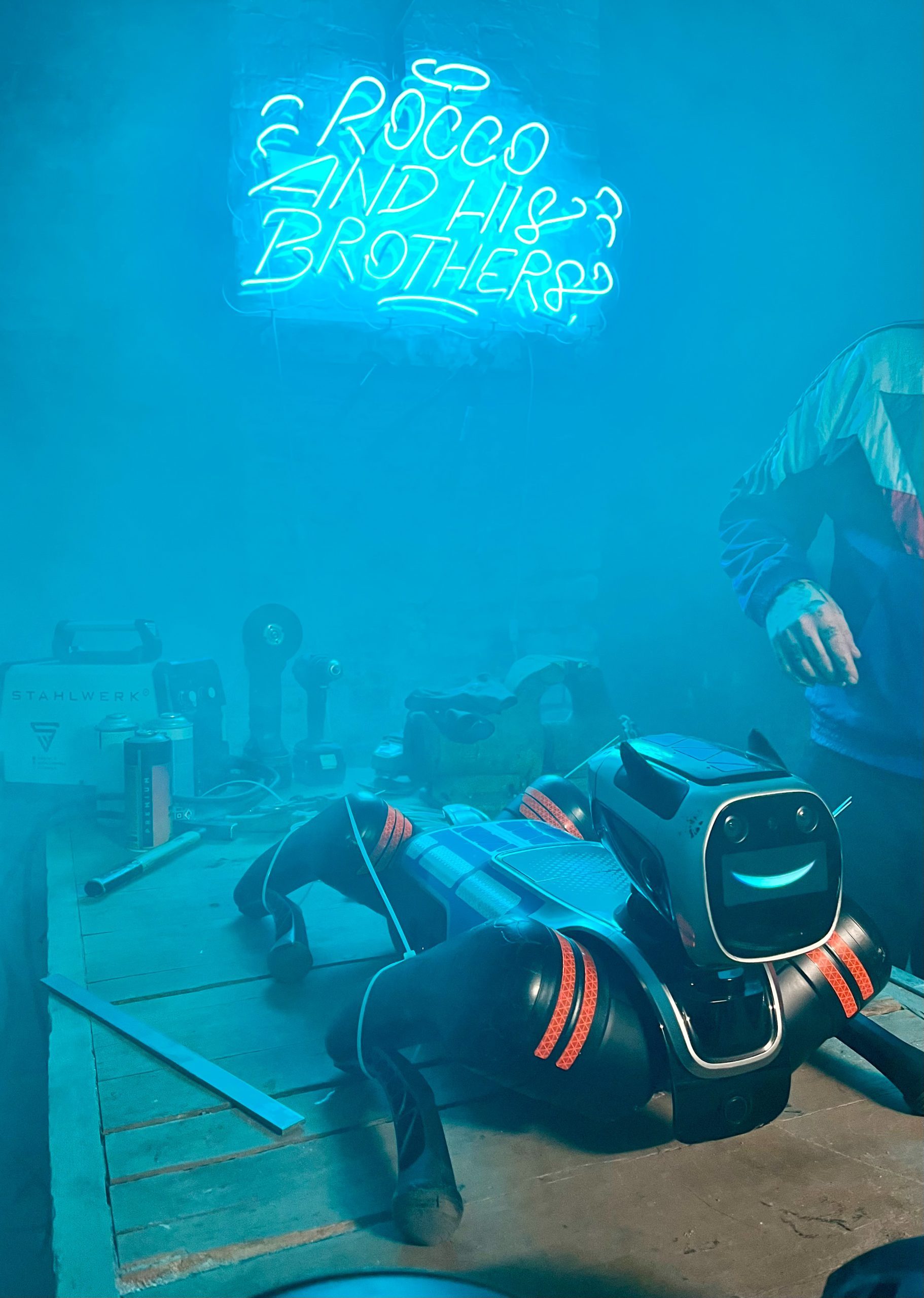
Surveillance systems (the bane of every graffiti artist’s existence) have, after all, been a recurring theme in your work for a long time. Do you see this new piece as a sort of highlight in your artistic career on this subject?
Sure, they’re a nuisance for graffiti artists, but let’s be honest: Without cameras, motion detectors and security guards, painting trains would probably be a lot more boring. Every graffiti artist feels a bit like James Bond when they wrap a bit of aluminium foil round a magnetic sensor. The issue of surveillance that interests us with The Hoodhound, however, is a different one. It’s less about whether there’s a camera hanging somewhere, and more about the creeping normalisation of surveillance. Spaces of freedom are shrinking, blind spots are disappearing, and anonymity is increasingly viewed with suspicion.
At the same time, technologies such as robotic dogs are constantly being promoted using terms like autonomy, efficiency and progress. The paradox is that their autonomy is growing whilst ours is shrinking. But we don’t really need to be the ones to preach that. We’re all observing it. And most of the time, we let it happen without much resistance, because it’s convenient. Who knows. The Hoodhound is originally a Chinese creation. Perhaps it’s been hanging as a cartoon in some toilet at the party headquarters in Beijing for ages. That would probably be the most consistent form of international art reception.
Would you want to/be able to exhibit The Hoodhound again?
If he wants to, sure.
Could he actually be used in public spaces without authorisation, at least for a short time?
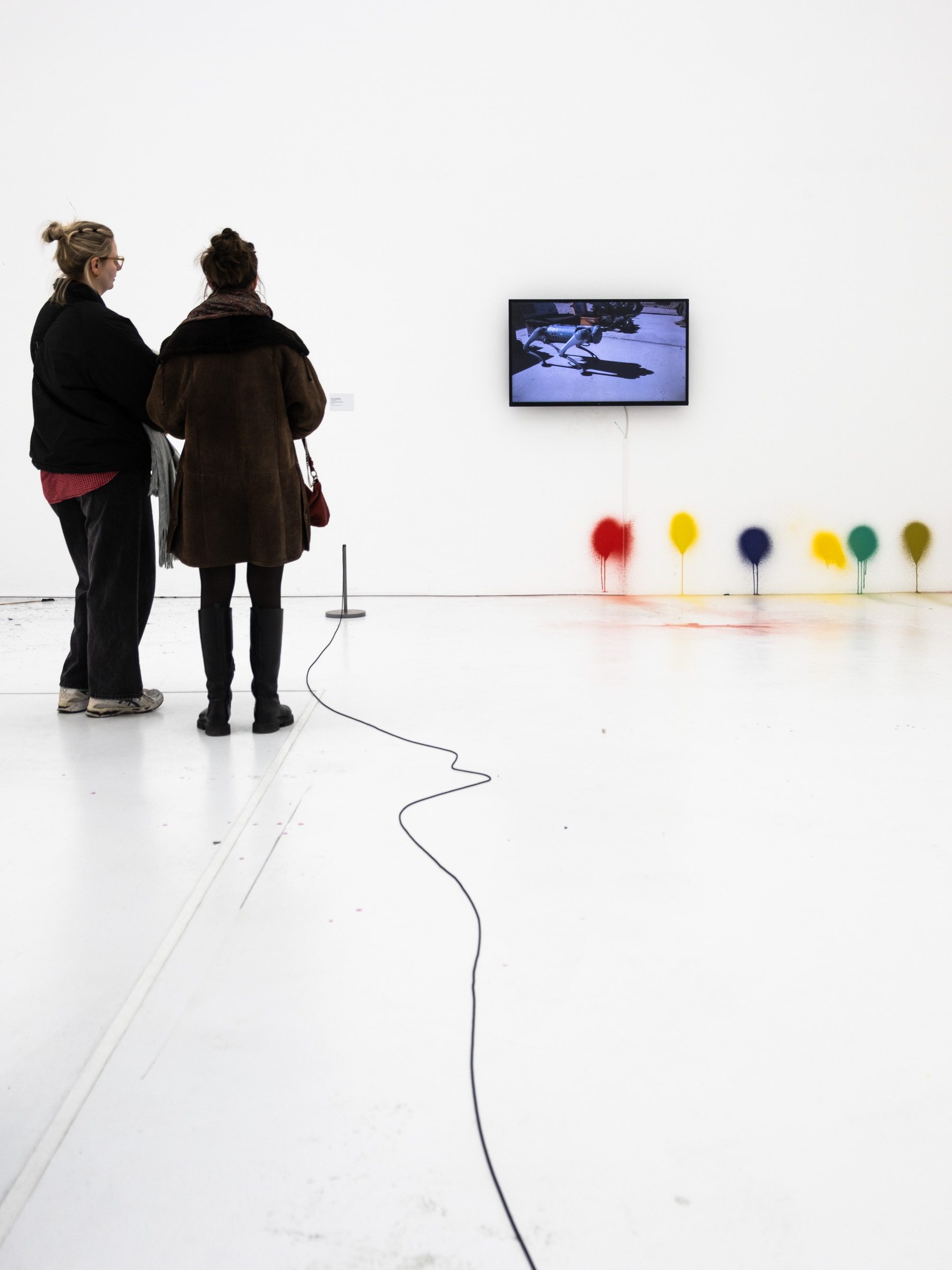
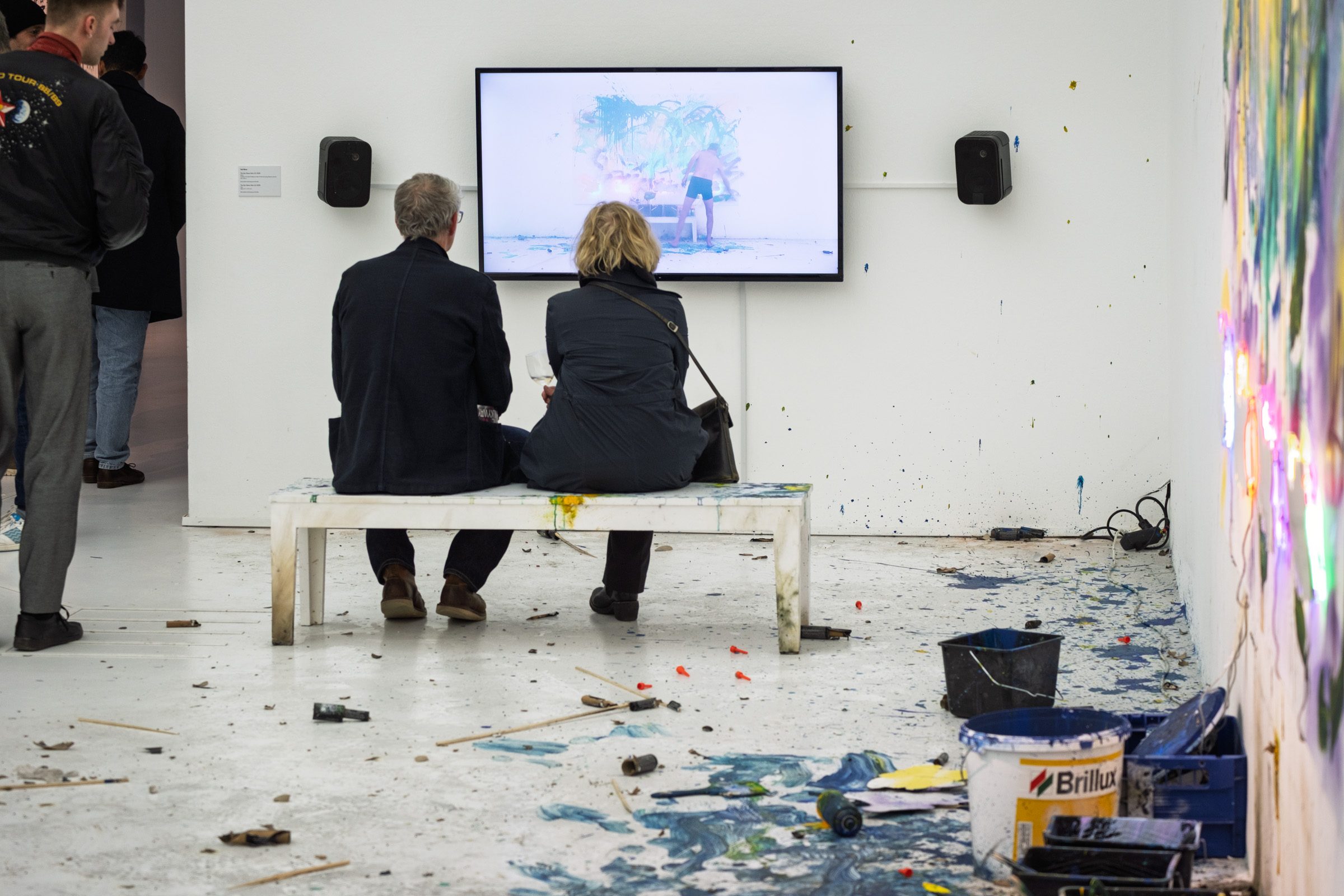
As you can easily see in the exhibition video, he has already done so. OG Paws roams through the Pallass in Schöneberg, runs riot in Berlin, marks his territory without asking, climbs through emergency exits into underground tunnels and sprays trains. As far as we know, he’s probably the first autonomous robot dog to have painted a train. He’s still quite proud of that to this day. Incidentally, the train actually ran for quite a while. In short: the White Cube isn’t his natural habitat. He’s just on holiday there.
What do you think about developments in surveillance systems and AI? Do you already have an idea, or a futuristic vision, of how AI and robots might develop in the city – in Berlin, for example – and how people here would react to it? A surveillance dog in Kreuzberg, for example?
To be honest, nothing would surprise me at this point. The dog would probably have its own Instagram account after three months, be selling merchandise after six months, and become district mayor after a year.
A thousand thanks for your time, and good luck!
The group exhibition *Under the Milky Way: Abstraction, Autonomy and Post-Vandalistic Tendencies in Contemporary Art* runs from 28 March until 19 July 2026 at the Kunstverein Hannover, curated by Larissa Kikol and Christoph Platz-Gallus.
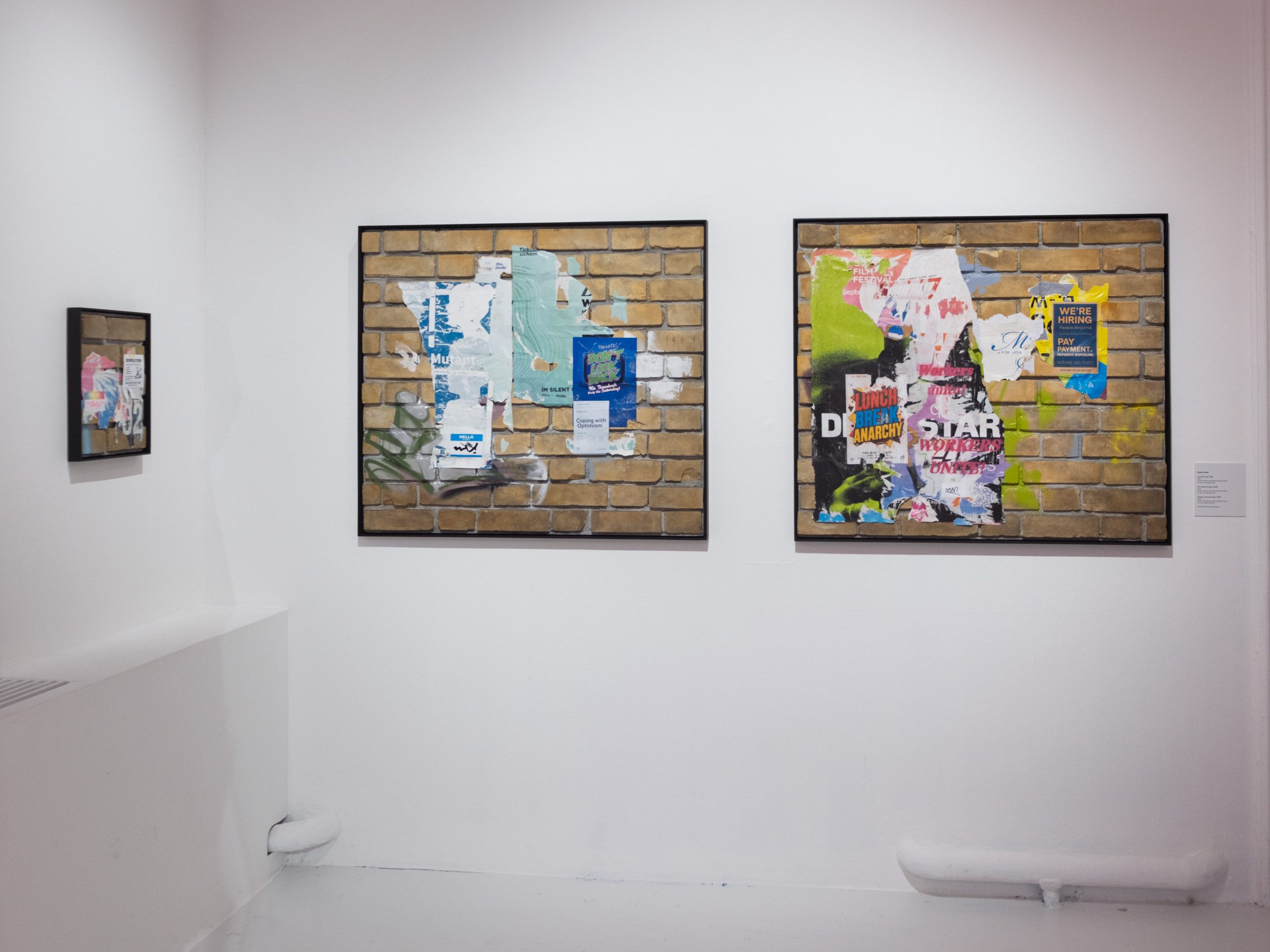
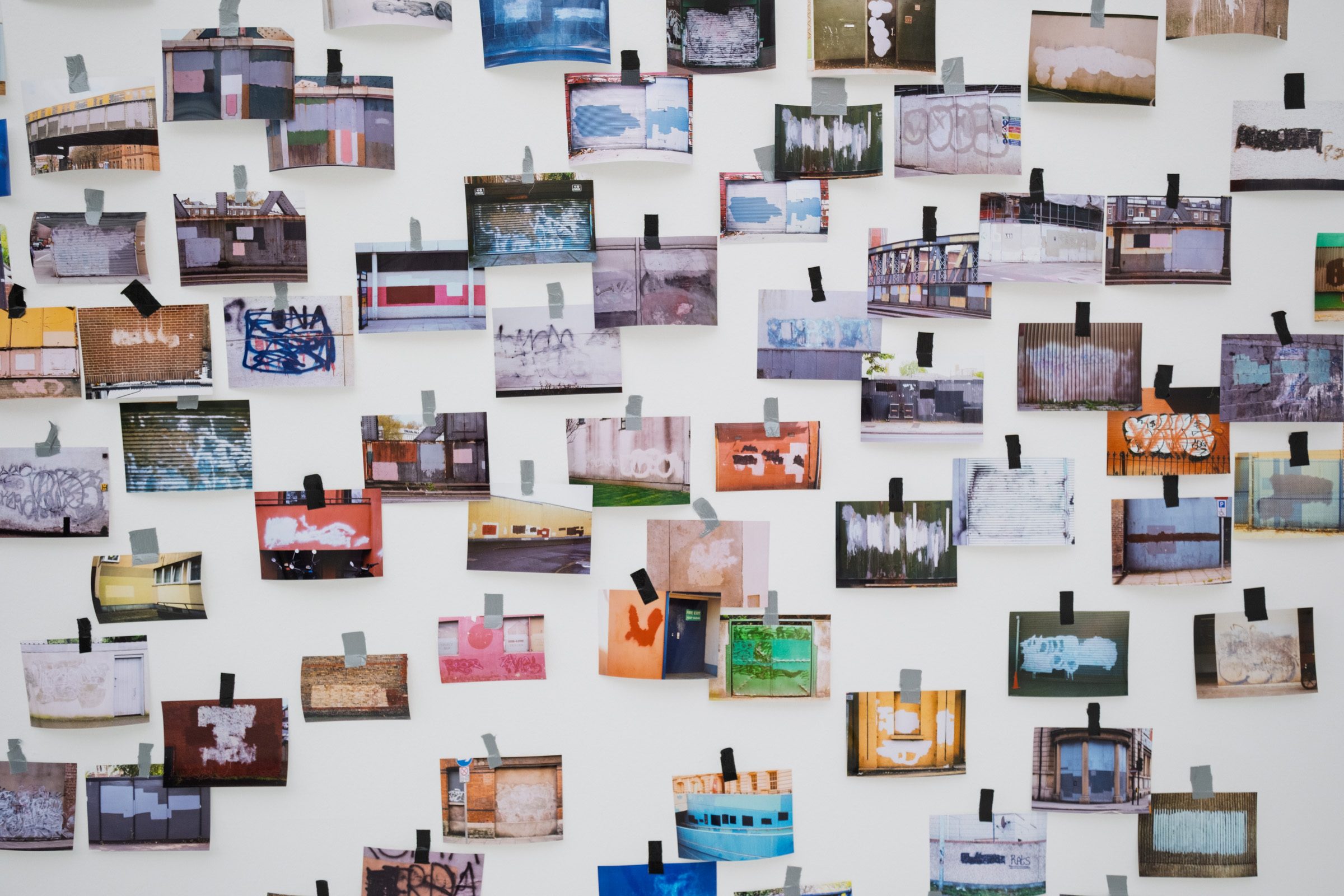
Featuring works by Amos Angeles, Alexandre Bavard, Cäcilia Brown, Stephen Burke, Bus126, Brad Downey and Akim, Antwan Horfee, Hams Klemens, Klub7, Daniel Laufer, Mischa Leinkauf, Martina Morger, Moses and Taps, Christoph and Sebastian Mügge, Patrick Niemann, Rocco and his brothers, Veli Silver, Mathias Weinfurter and Angst Yok.
https://www.kunstverein-hannover.de


Leave a Reply