

Hello NELIO. Thank you for responding to my request and sending me so many photos from your archive. You painted so many works in different stylistic series in over 20 years of painting. Before going into your work since the beginning, I would like to ask some questions about your background.
You are from France, born in 1982, living in Lyon, right. Do you still live there?
I was born in 1982 in eastern France, in Audincourt. I lived in Lyon from 2007 to 2014, then spent some years travelling, and since 2017 I’ve been living in Ardèche.
Can you tell us something about your childhood? Are there any artists in your family?
I grew up in a united family, in a simple environment where passions were mainly related to sports and craftsmanship. I didn’t grow up in an artistic context as such, but rather in a DIY culture, which shaped my self-taught and experimental approach to art.
Did you draw as a child, and if so, what did you draw?
I loved drawing. I have a vivid memory of my father layering the same colour on a drawing to create shadows. Since then, I’ve been fascinated by colour mixing, creating restricted palettes, and working with gradients.
When did you discover style writing, when did you start writing graffiti and with what names?
I discovered graffiti at the age of 13. I especially enjoyed drawing letterforms and inventing stylized alphabets. My first wall pieces date back to 1999. After changing my name several times, I started using Nelio in 2003.
Can you describe us your style from 1999 until 2003?
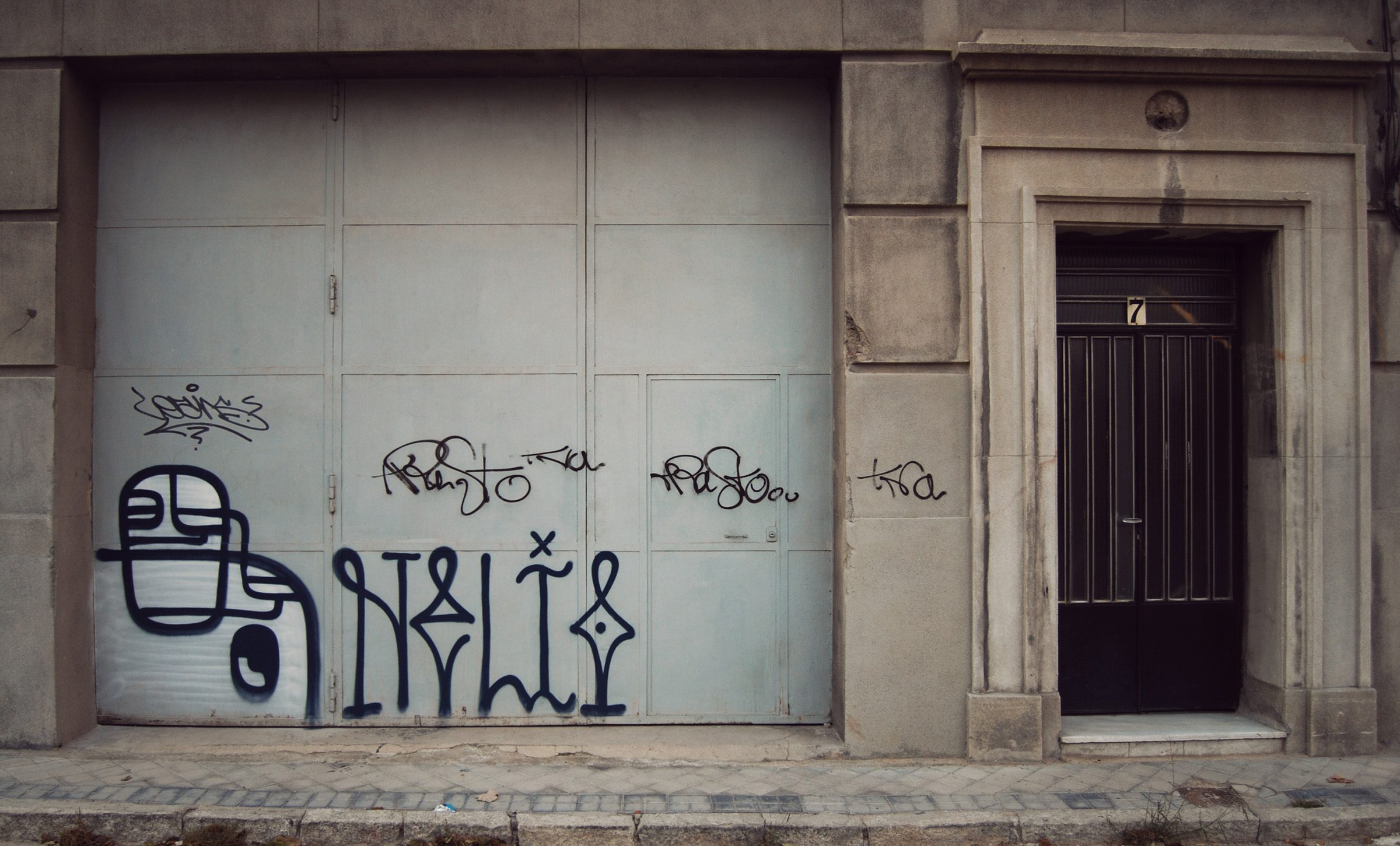
I was navigating between Throw Up, Block Letters, and Wild Style. I was in a constant state of research, without having a truly personal style. At the same time, I was experimenting with characters and faces. Some of my letter pieces included figurative elements, and I would sometimes add backgrounds to enrich the composition.
Did any particular style or writer impressed and influenced you in the beginning?
My graffiti culture was quite limited, but I was mostly influenced by Throw Up, as well as by the solid and minimalist radicality of Block Letters.
What kind of style of lettering did you prefer, and was tagging something you did ?
I started painting in abandoned factories, where I enjoyed doing One Liners. Later, when I began tagging in the city, I was more influenced by the style of Pichação.
In 2003, you created the name NELIO painting different motifs, as well as letters. Can you tell how the letters looked at that time?
The letters were becoming increasingly geometric and minimal, sometimes fragmented into simple shapes. I was still searching for a personal visual language.
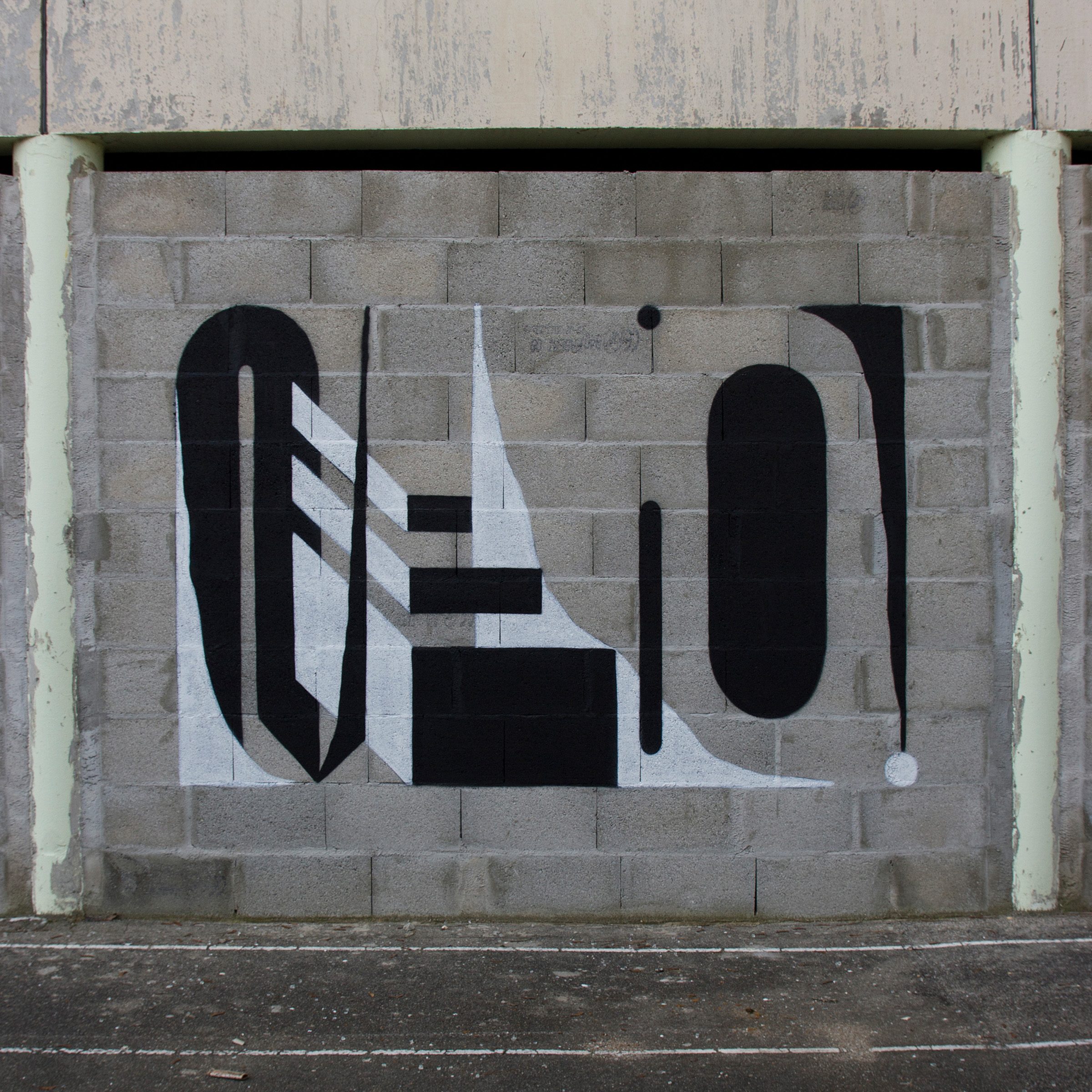
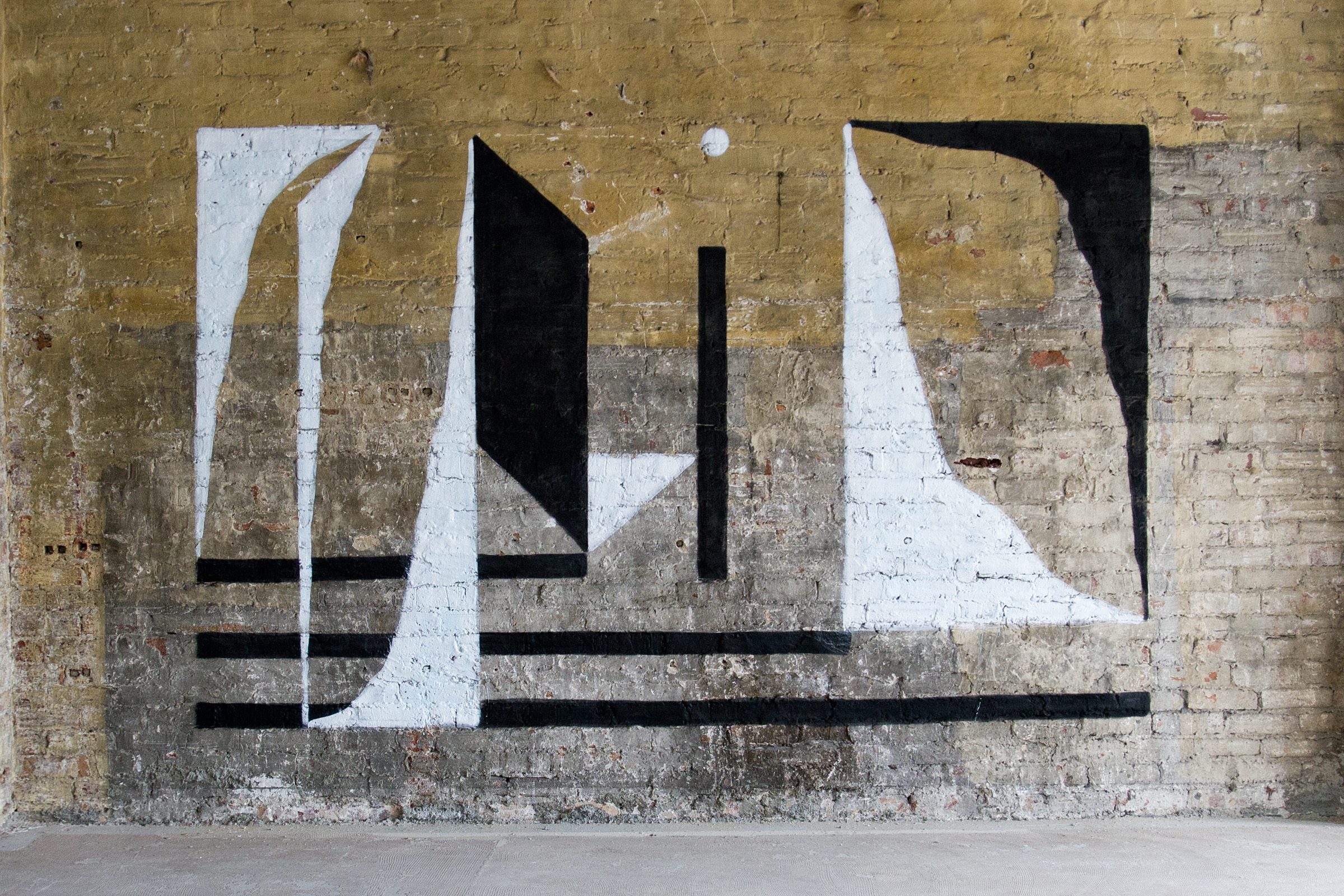

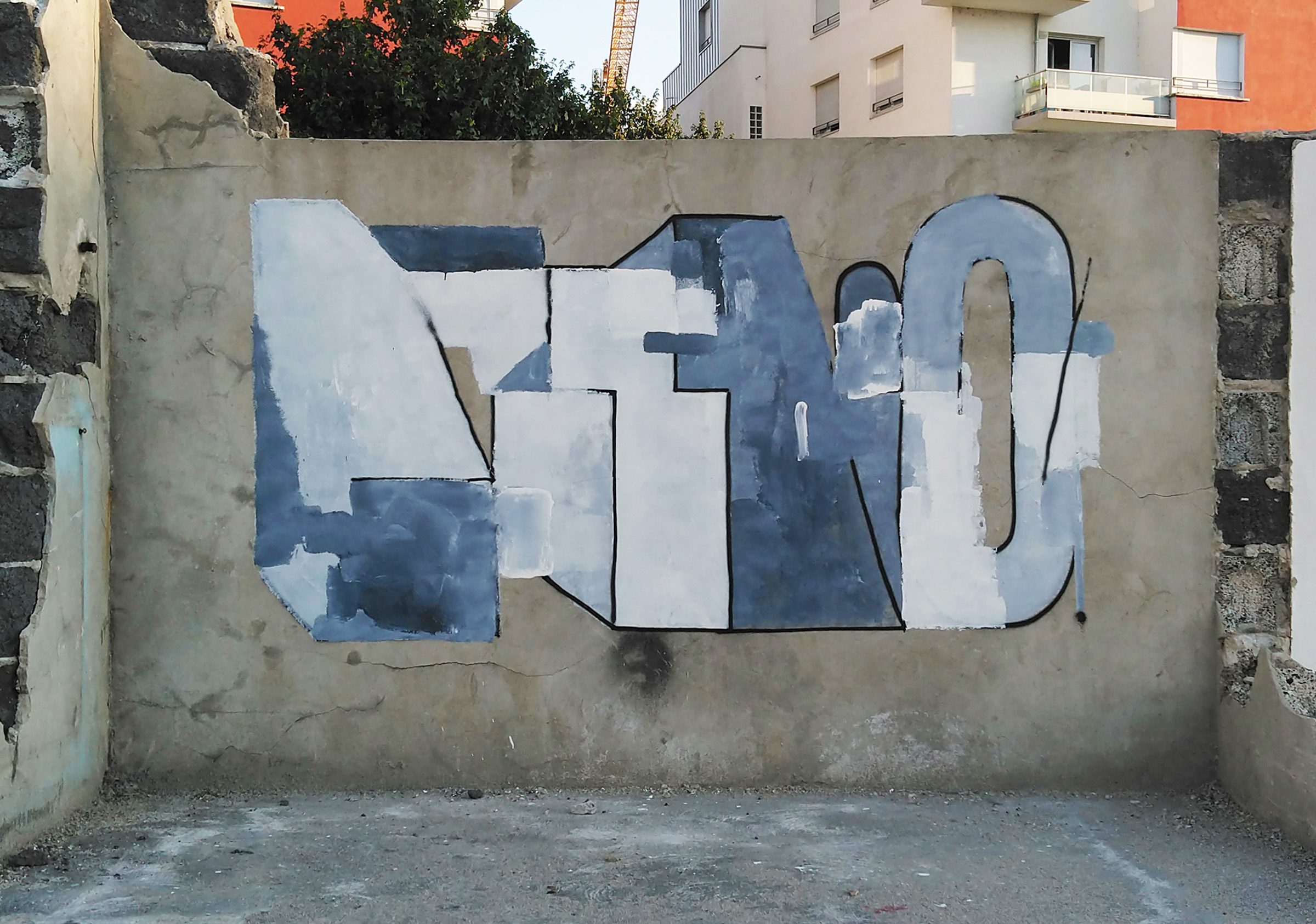
You worked and are still working on different series in parallel on walls that you give names to. Did you gave those series of works names after or beforehand?
Series are often conceptualised along the way, when I start noticing recurring elements between different works. I then try to understand what these works evoke for me and identify the specific characteristics of the process. If it feels relevant, the body of work may become a distinct line of research, which I then give it a name to clarify the intention, even if temporarily.
At other times, I begin with an idea or a protocol, often noted down with a provisional title and simple sketches. Some of these directions are developed immediately, while others resurface years later depending on the context. In those cases, the series is anticipated and conceptualised before the works are actually created.
Why do you think do you have the need to work on different series in parallel all the time?
I develop several series in parallel for different reasons. First, I function in a cyclical way: I like to adapt to context and to my current desires. I also tend to get bored if I stay focused on the same thing for too long. I enjoy returning to it later, but I need change in order to clear my head and to nourish my practice.
I love experimenting, and sometimes drifting from my main line of research when I make a discovery, only to refocus later. That’s how I learn as a self-taught artist.
All these experiences feed into one another. That’s why some works can belong to several series at the same time. The boundaries are porous, and sub-series sometimes emerge naturally.
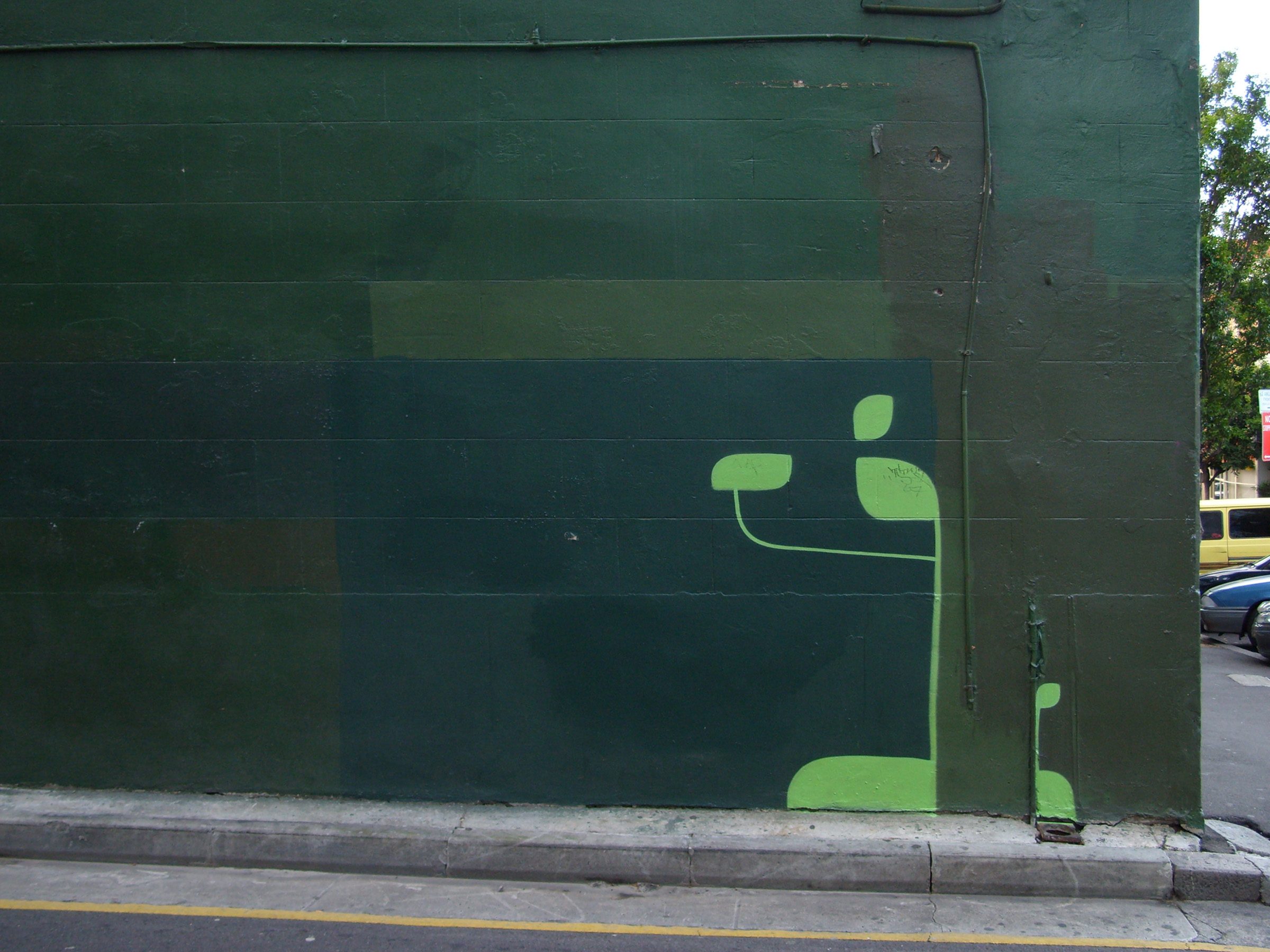
I see my work as a tree structure, where everything is connected through subtle, regular bifurcations. Even when my explorations seem antagonistic (minimalism / maximalism, assemblage / erasure…) they are part of the same overall structure, like a tree with branches on one side and roots on the other.
If I refine this image, it would be more like a spherical branching system, where roots and branches meet, intertwine, and sometimes merge. There is a central axis, but I don’t impose fixed limits; they are only temporarily defined by time and by my current abilities, and they are meant to evolve.
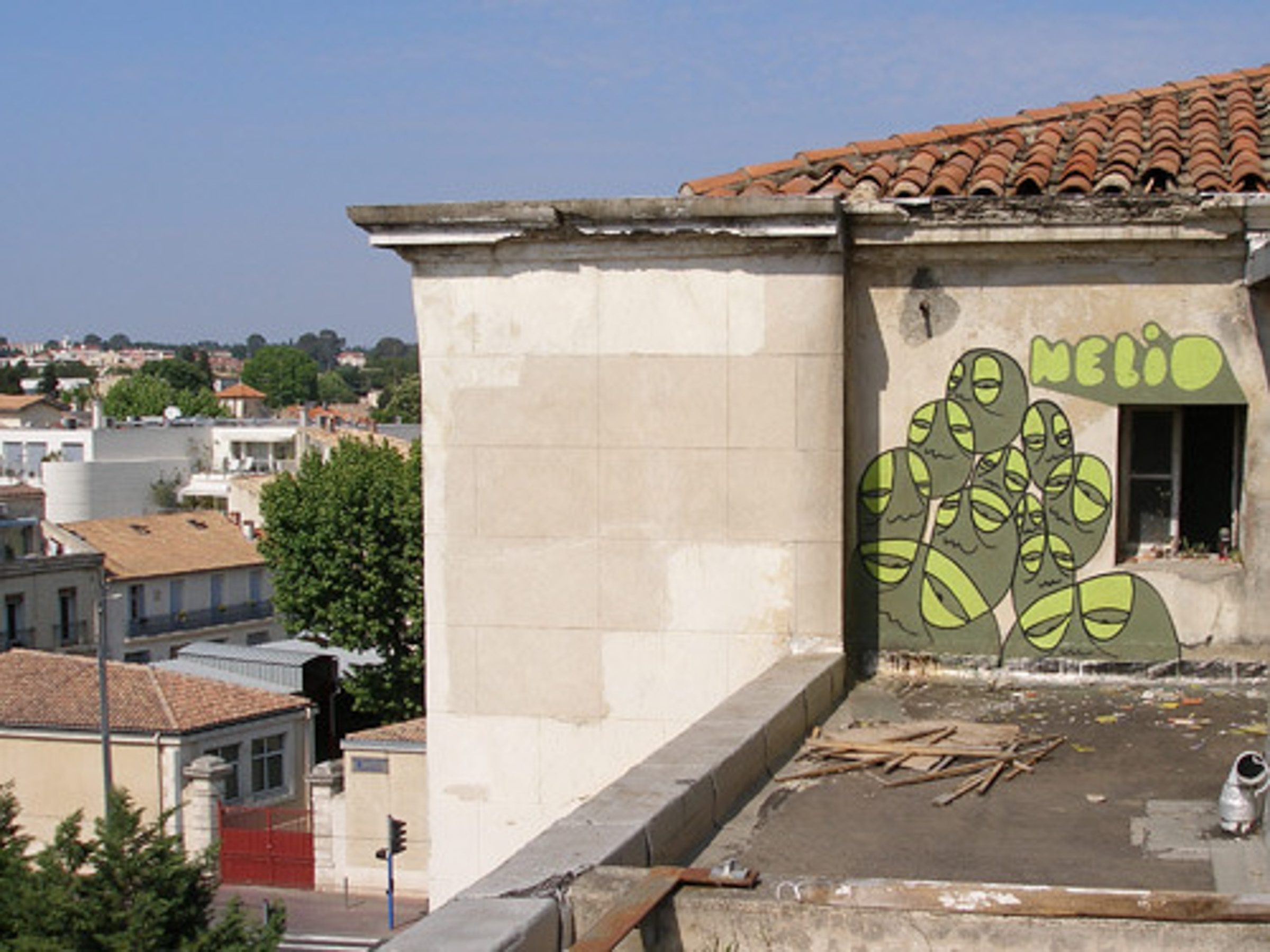
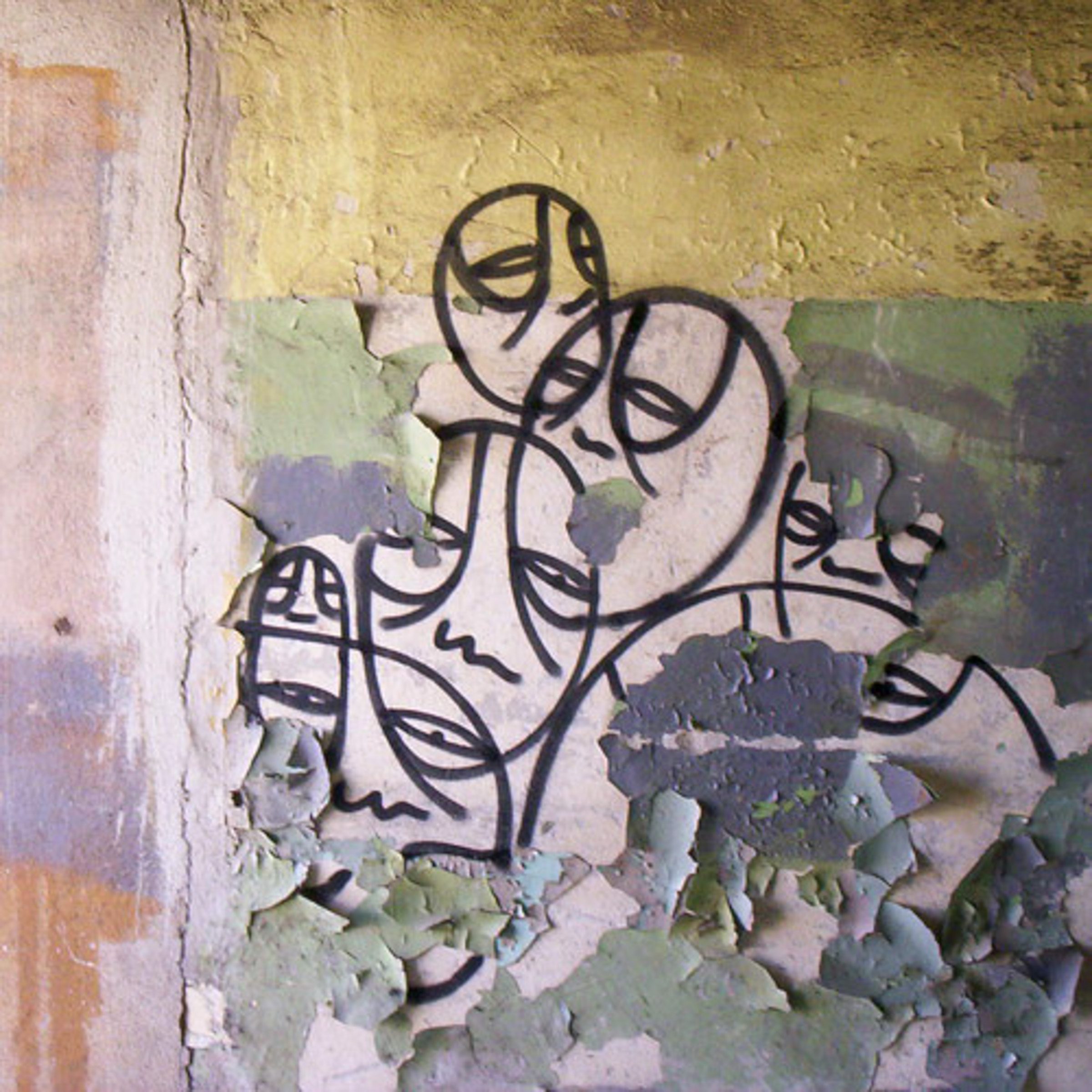
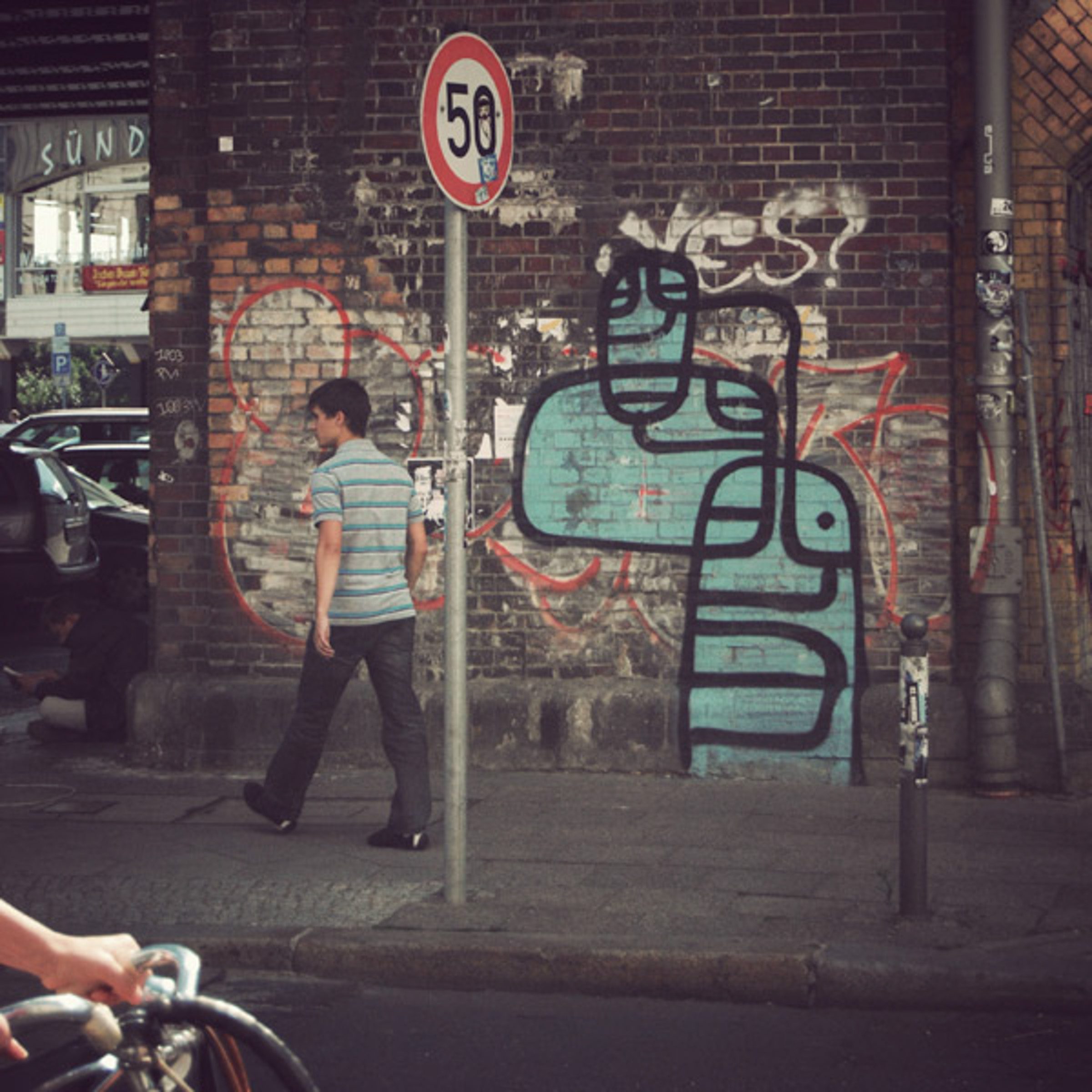
From 2005 until 2013 you painted stylized interlinked faces in the streets in different cities. I think your works were reproduced in many street art publications at that time, right? Did you sign those faces in the streets? Is there is any special meaning behind those faces?
There were indeed a few publications of this work at the time. I created some paintings mixing letters and characters, but in the streets it was mostly a kind of Throw Up made entirely of faces. I preferred their more mysterious quality compared to lettering, and for a while these faces became a sort of signature.
When I started this series, it was the first time my paintings truly began to make sense to me. I felt they reflected my personality in the process of being formed, while also opening up to more universal themes.
These interlinked faces evoked humanity as a whole, its connection to nature, almost an interpretation linked to evolution. I saw them as carrying a message of tolerance and anti-racism: a reminder of a shared origin, emphasizing the interdependence between individuals and their inseparable link to nature. The idea that we are neither separate from it nor superior to it, but simply part of a larger whole.
There was therefore a positive dimension to this work, which made it easier for me to accept the fact that I was imposing my paintings illegally in public space. It was during this period that I became more active in the streets, and this series marks, for me, the true starting point of my artistic practice.
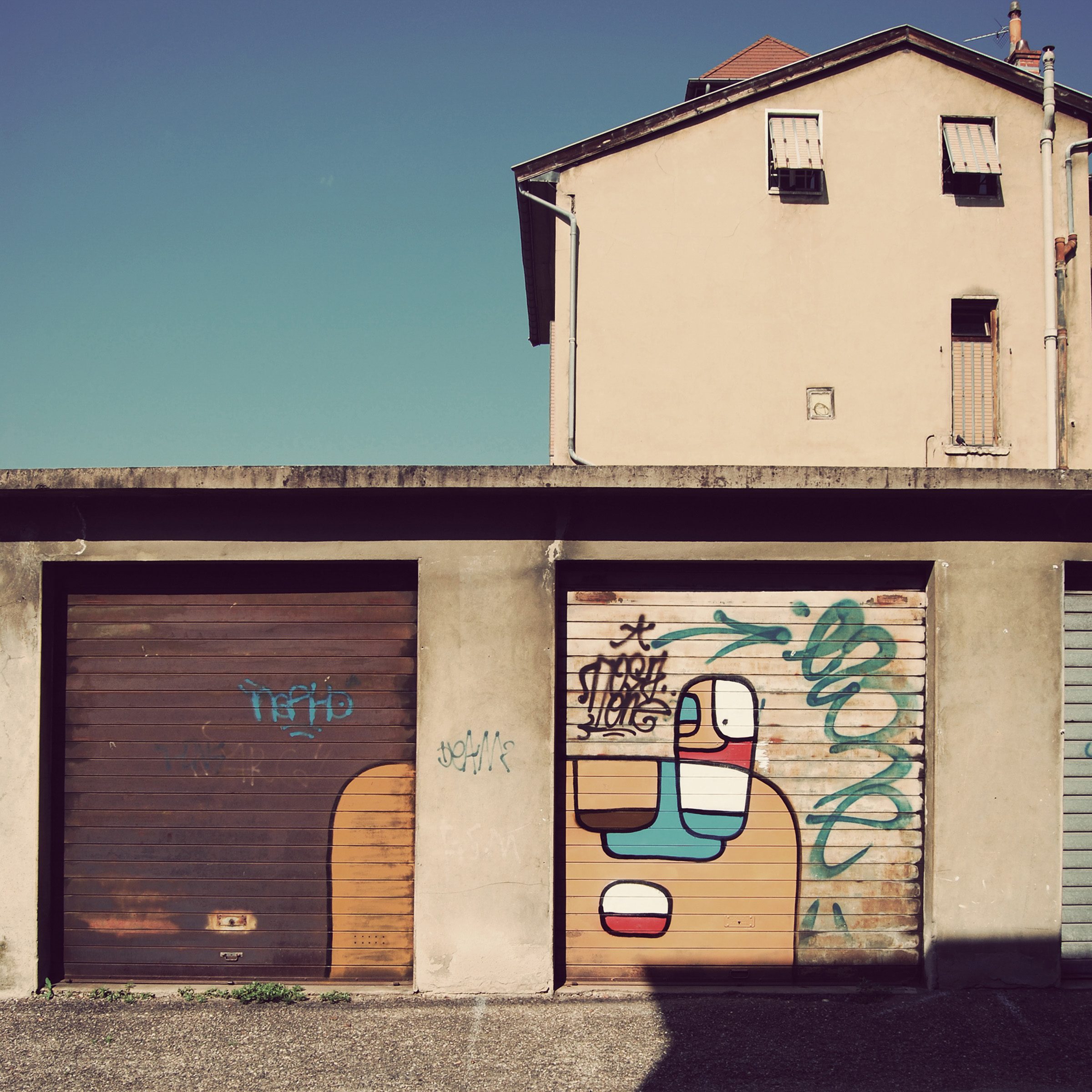
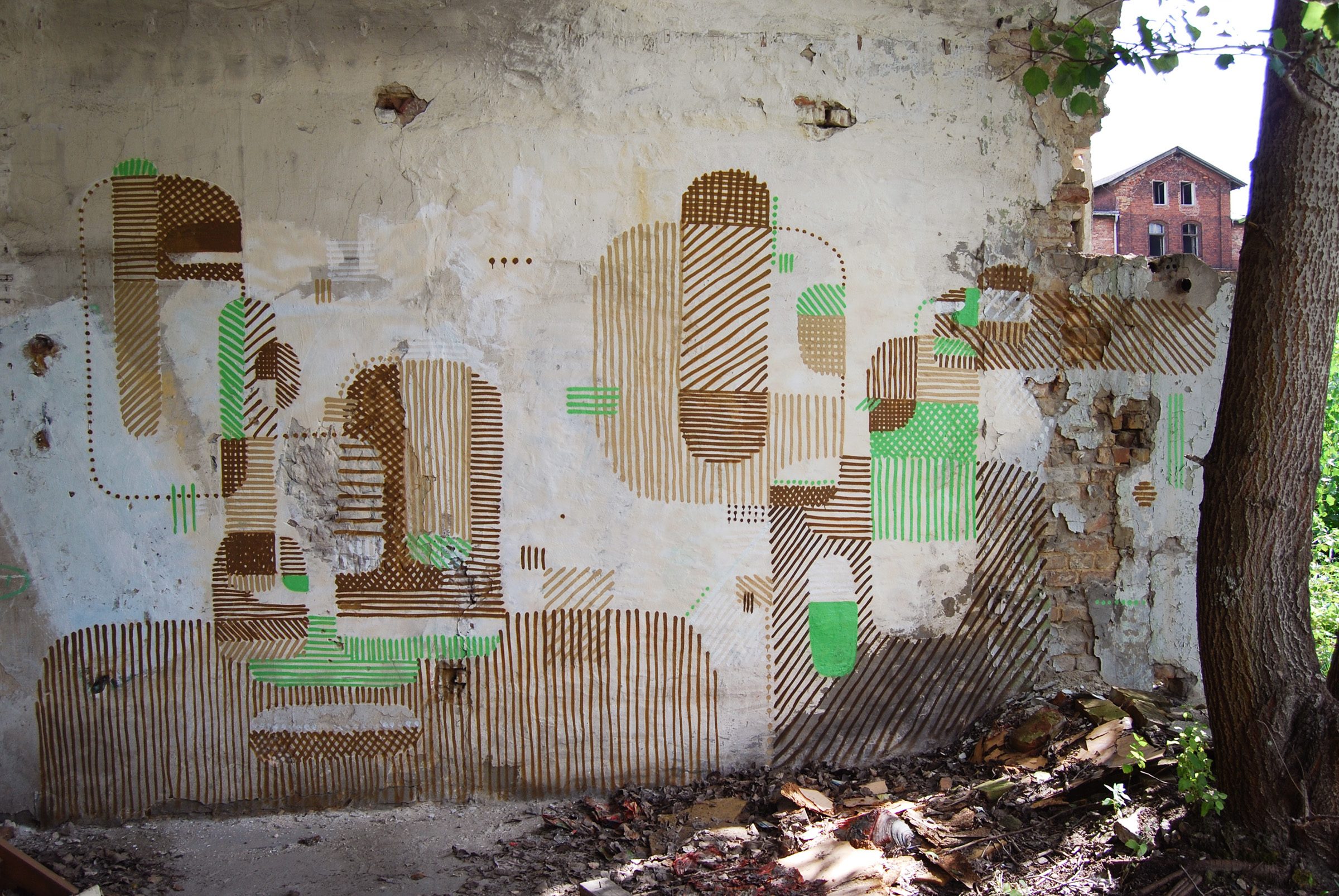
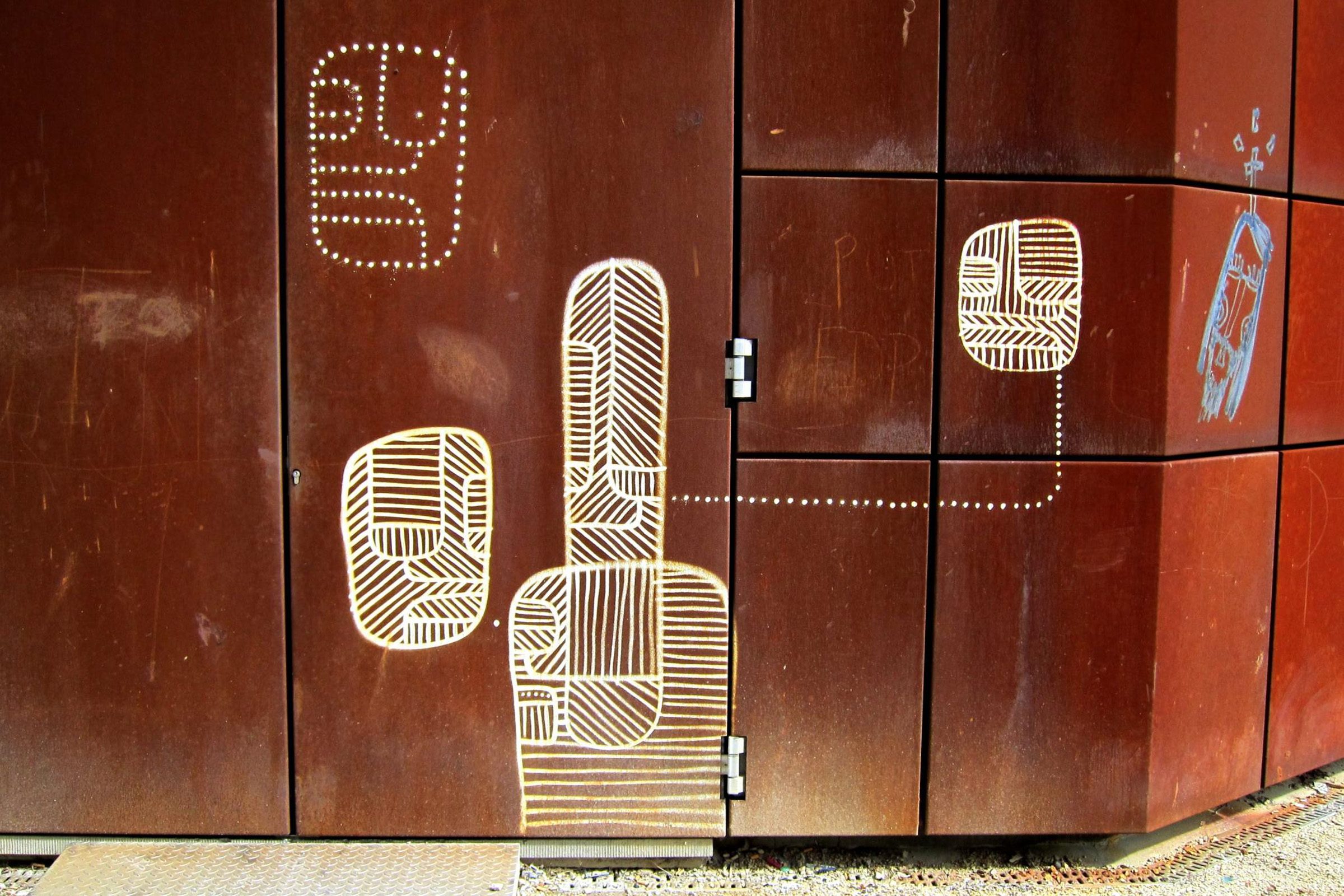
Another series you painted for two years in 2007 is a series you call Abstract leafs. Can you describe this series? Is it the beginning of a kind of minimalism before the series of Minimalism you started in 2007 with geometric and simple shapes?
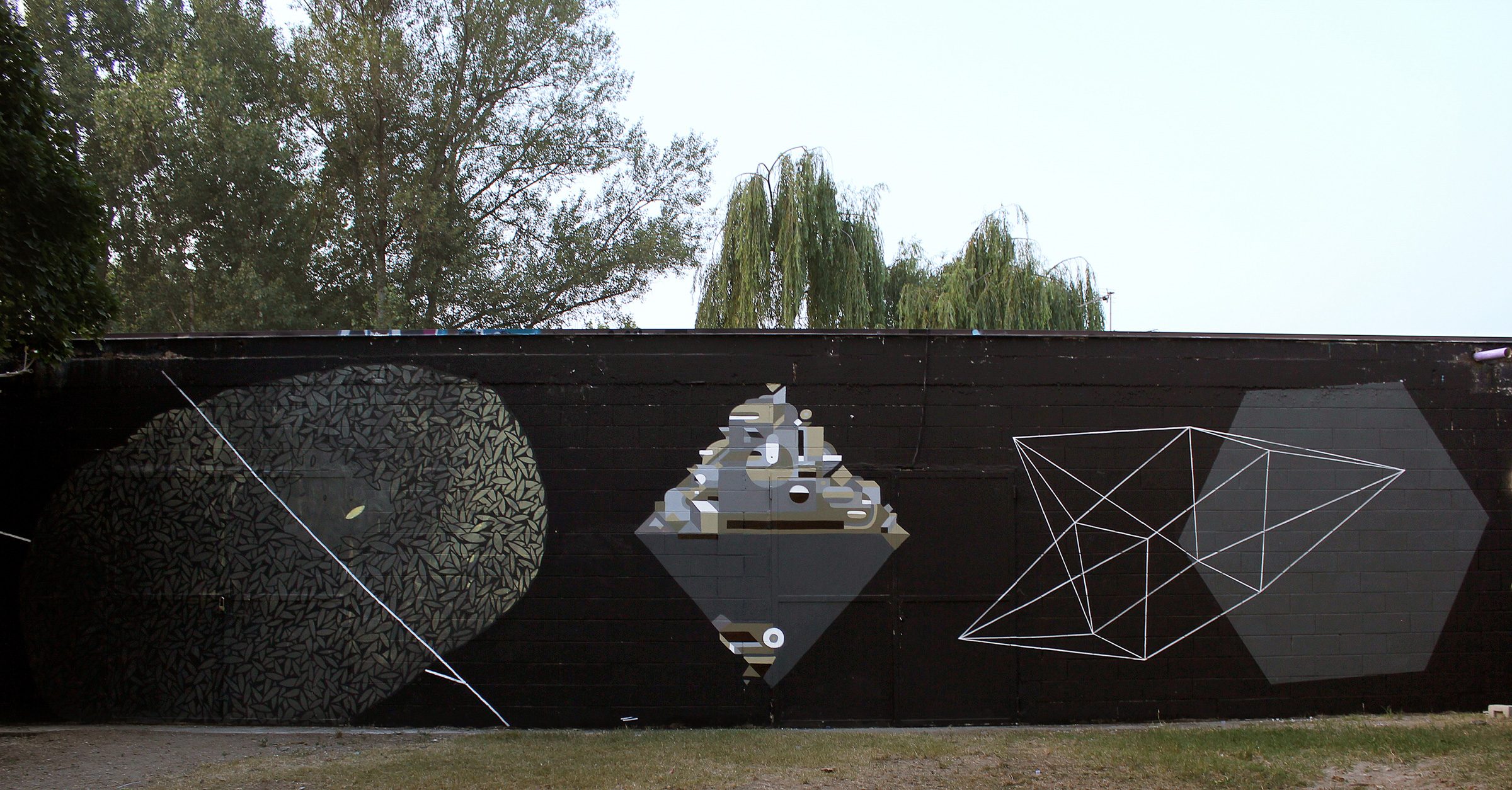
Abstract Leafs is a sub-series of Interlinked Faces and indeed marks the beginning of my exploration of minimalism and abstraction. The faces were reduced to their essential elements: mainly the shapes that ensured the connection between the characters, along with a few remaining outlines.
The overall forms evoked leaves and stems, symbolizing for me the link between humanity and nature. It was a way of simplifying the figure to the point where it almost became an abstract sign.
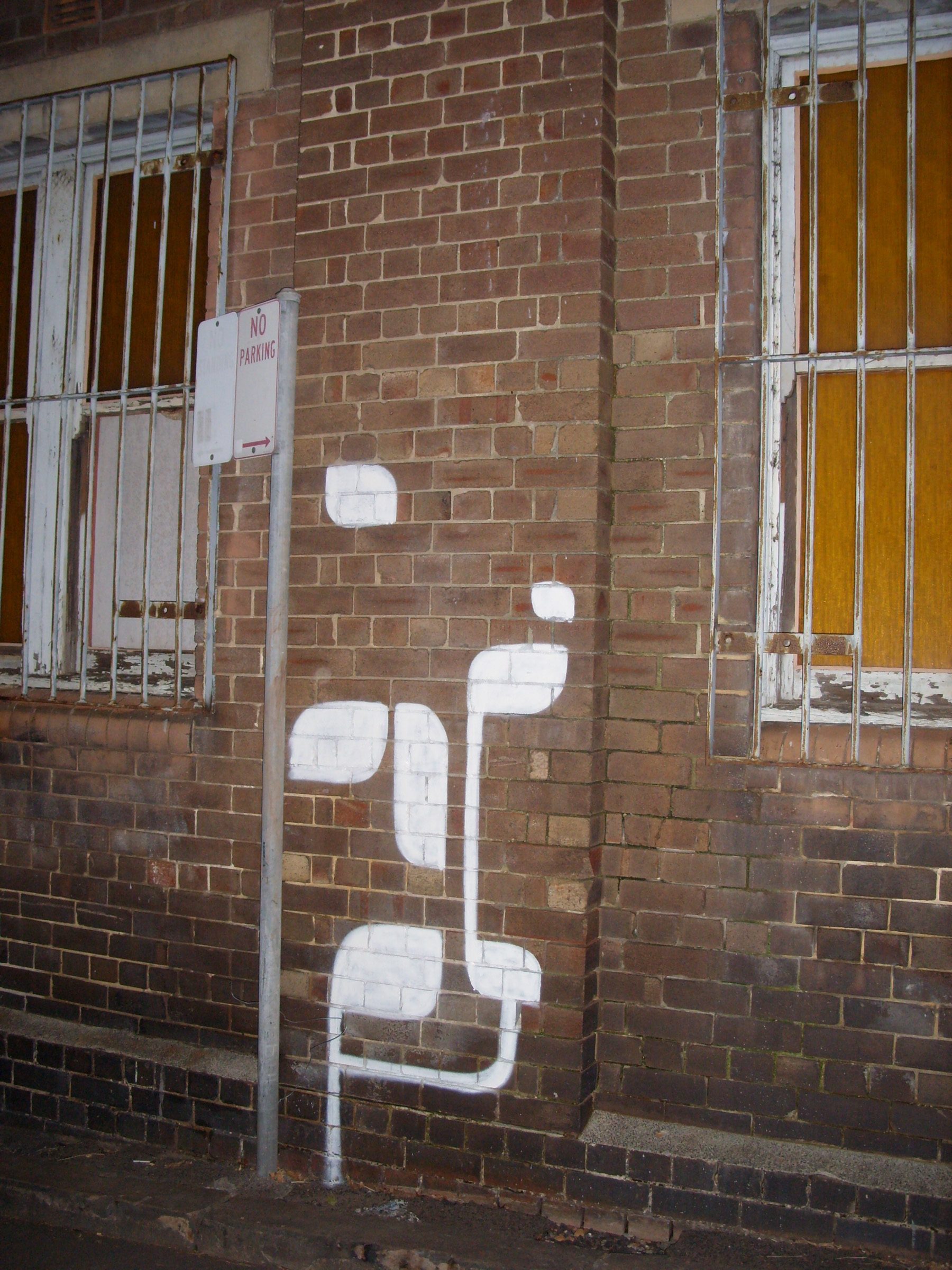
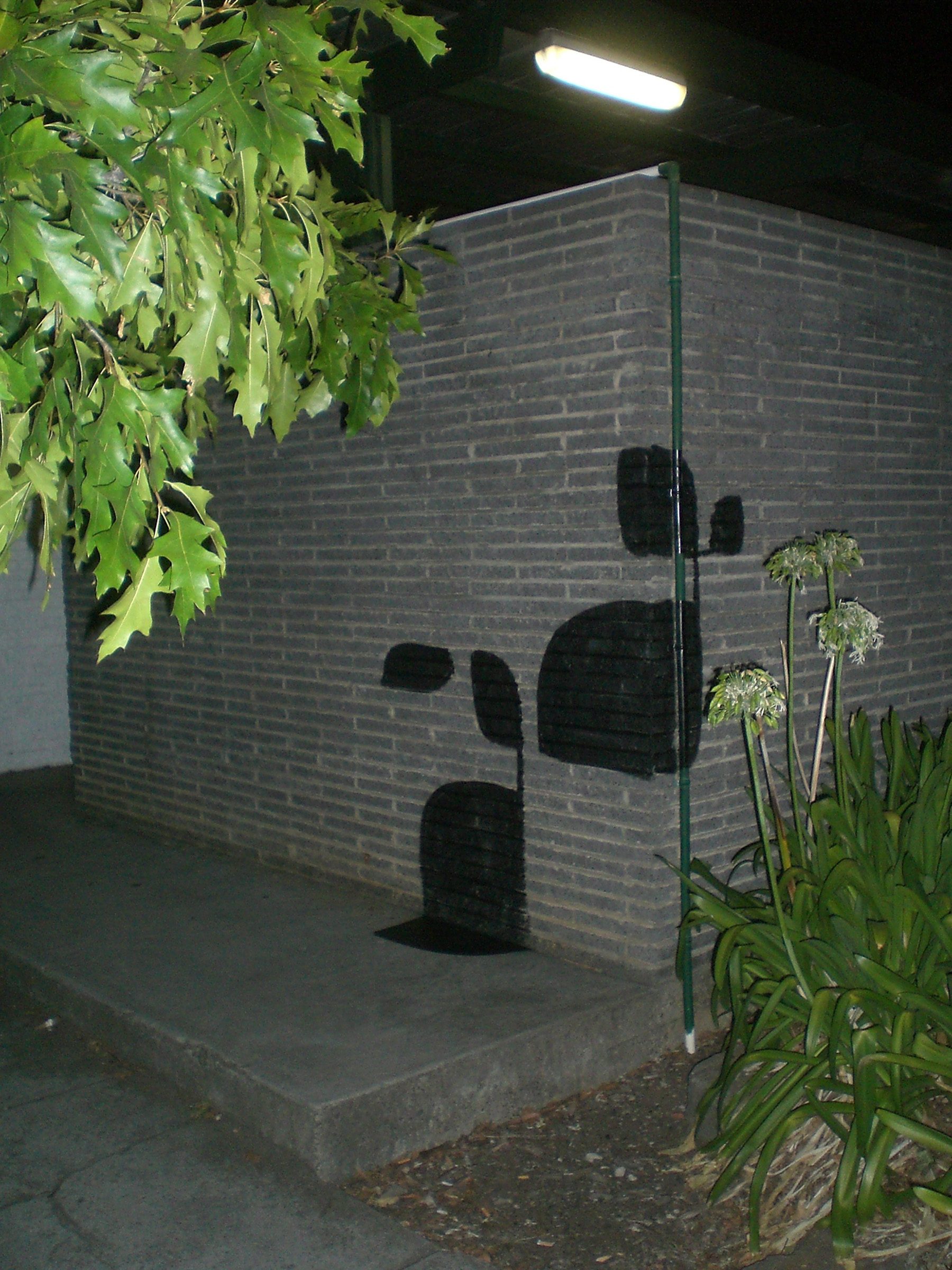
What inspired you to focus on minimal non-figurative shapes from 2007 on?
It depends on the period. At first, it was connected to my interest in graphic design, especially logo creation, where the challenge is to condense ideas into the most refined and simplified composition possible. Later, minimalism became a way for me to push each series toward its essence, to reveal its underlying structure and clarify its mechanisms. It also allowed me to abstract certain themes, making them more open and freer to interpret. Architecture and Buff also played an important role in my exploration of minimalism.
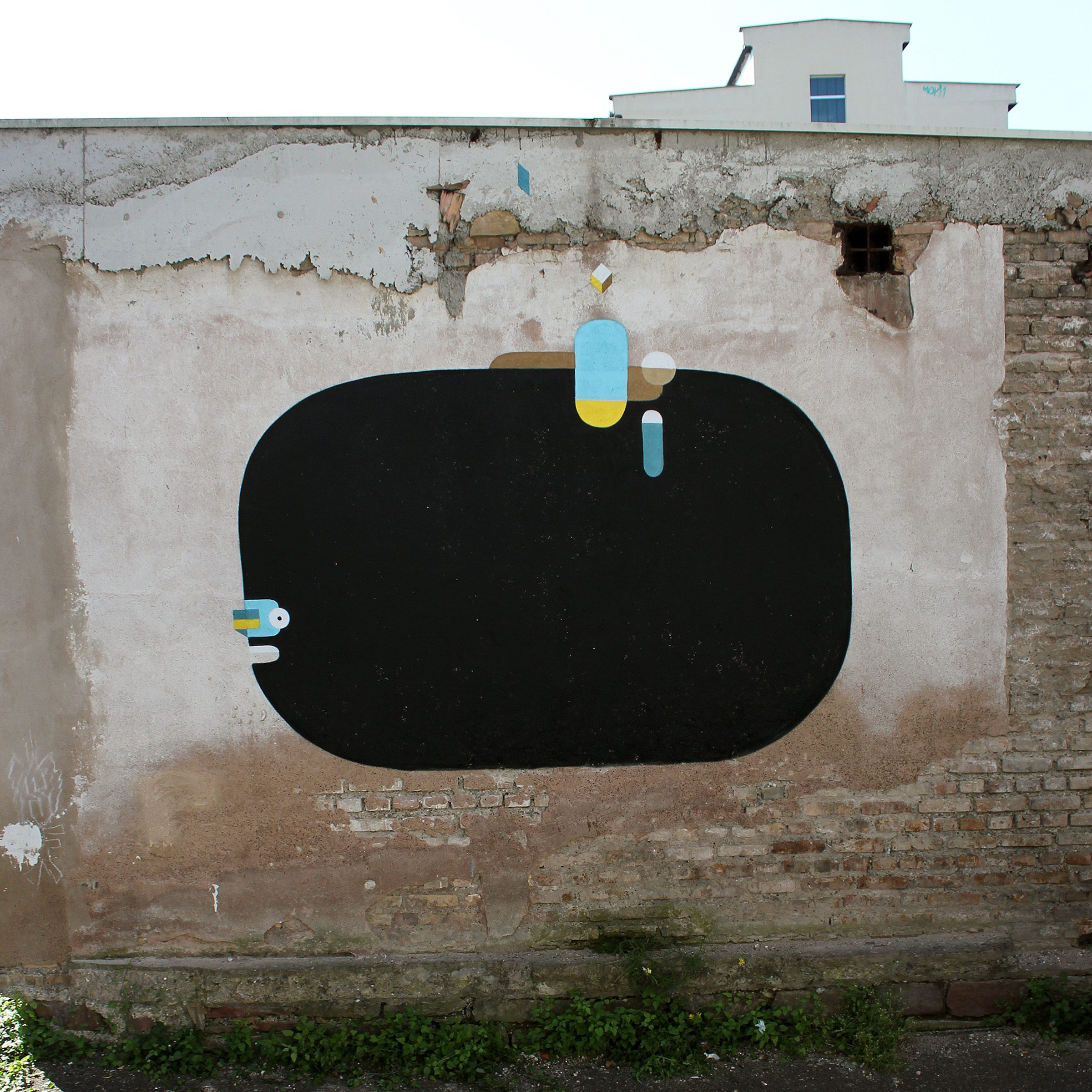
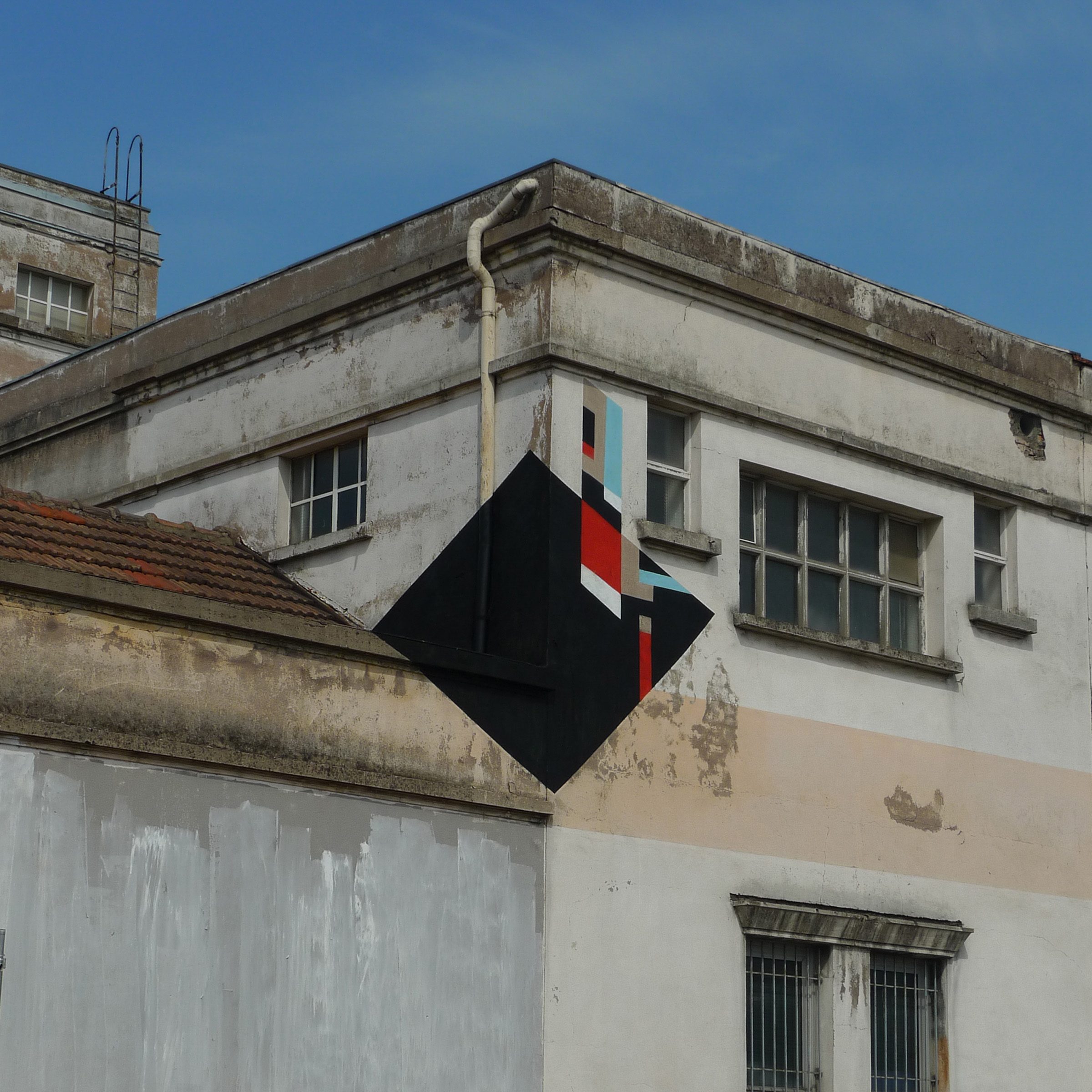
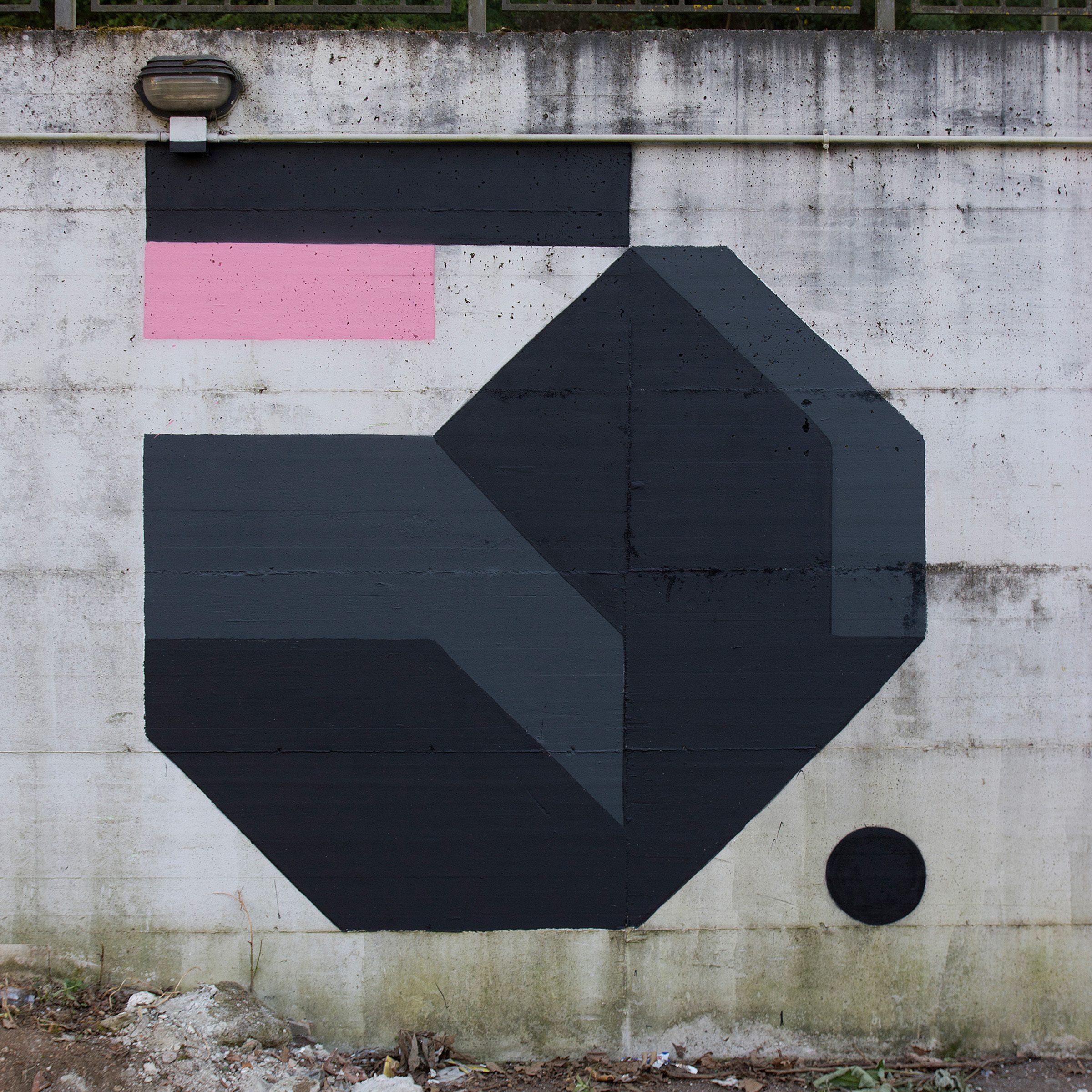
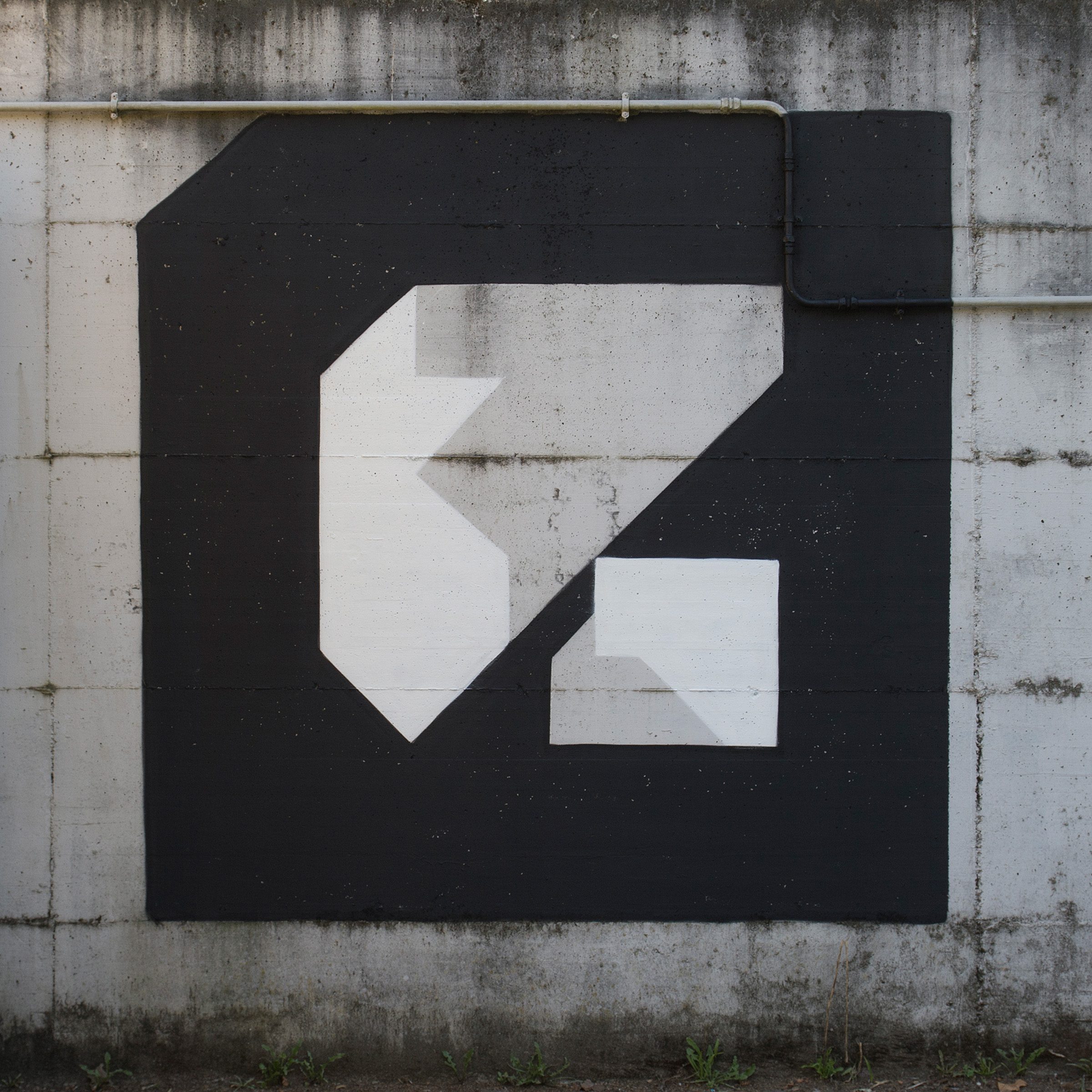
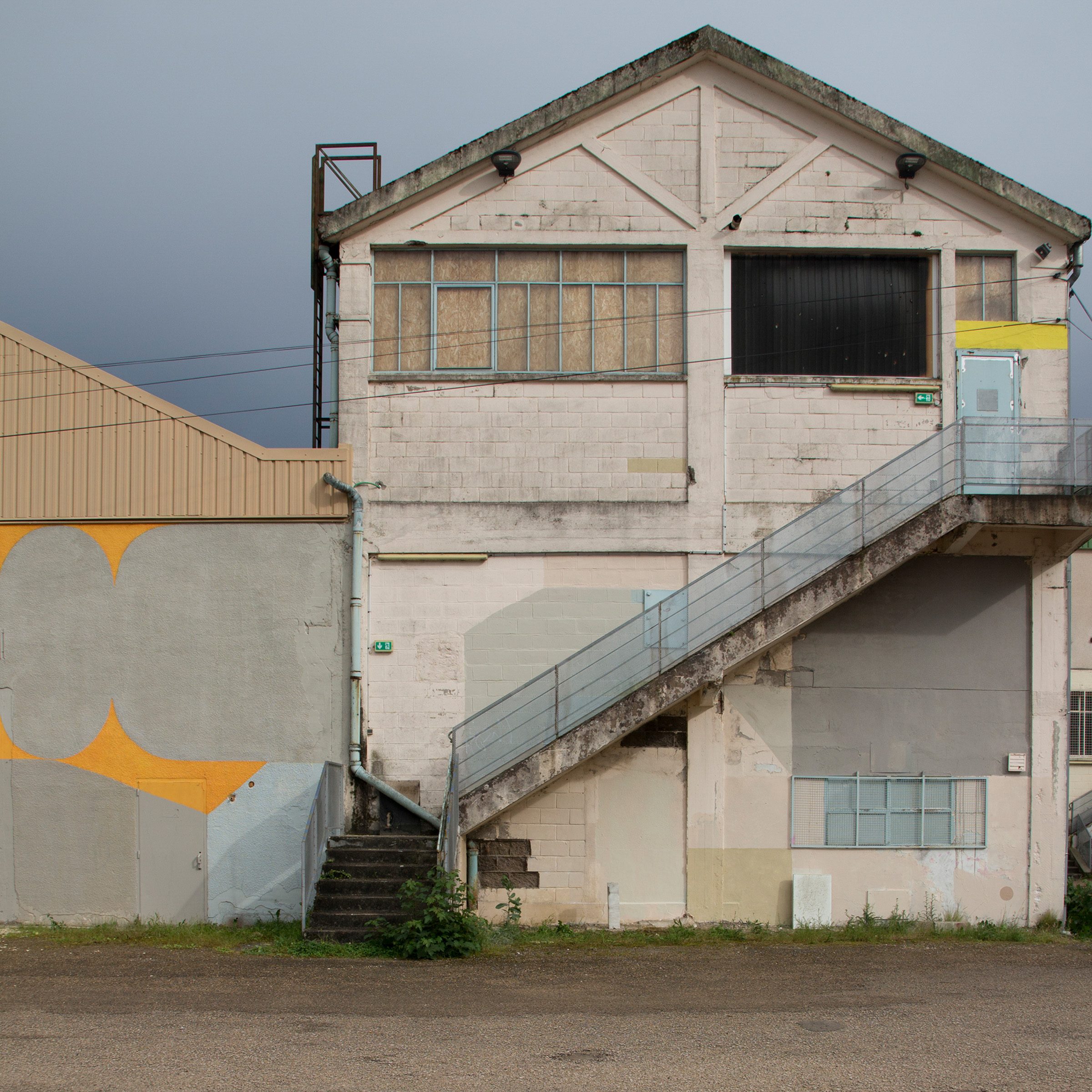

Your series Lines (2009) are compositions of geometric and simple shapes composed by and filled out only with lines, giving those works a more graphic, translucid and light aspect on walls. What is interesting to work only with lines?
Working with lines allows me to create contrasts and a sense of volume using only a single colour. I first started using this technique for my screen prints, as a way to work around the limitation of a restricted number of colours. It enabled me to juxtapose several shapes with different contrasts on a single screen, while adding a certain visual richness.
Practical constraints during some of my travels also pushed me to adopt this system, which is both efficient and economical. For drawings, I used only a black pen on paper, and for murals, a single black spray can. Because this technique is slower than a simple flat fill, it led me to create very small-scale drawings. I liked the intimate quality this produced, in contrast with the large scale of my outdoor interventions.
On walls, I also appreciated that the texture of the surface remained visible through the paint. Despite the strong contrast of black, the work seemed well integrated into its environment.
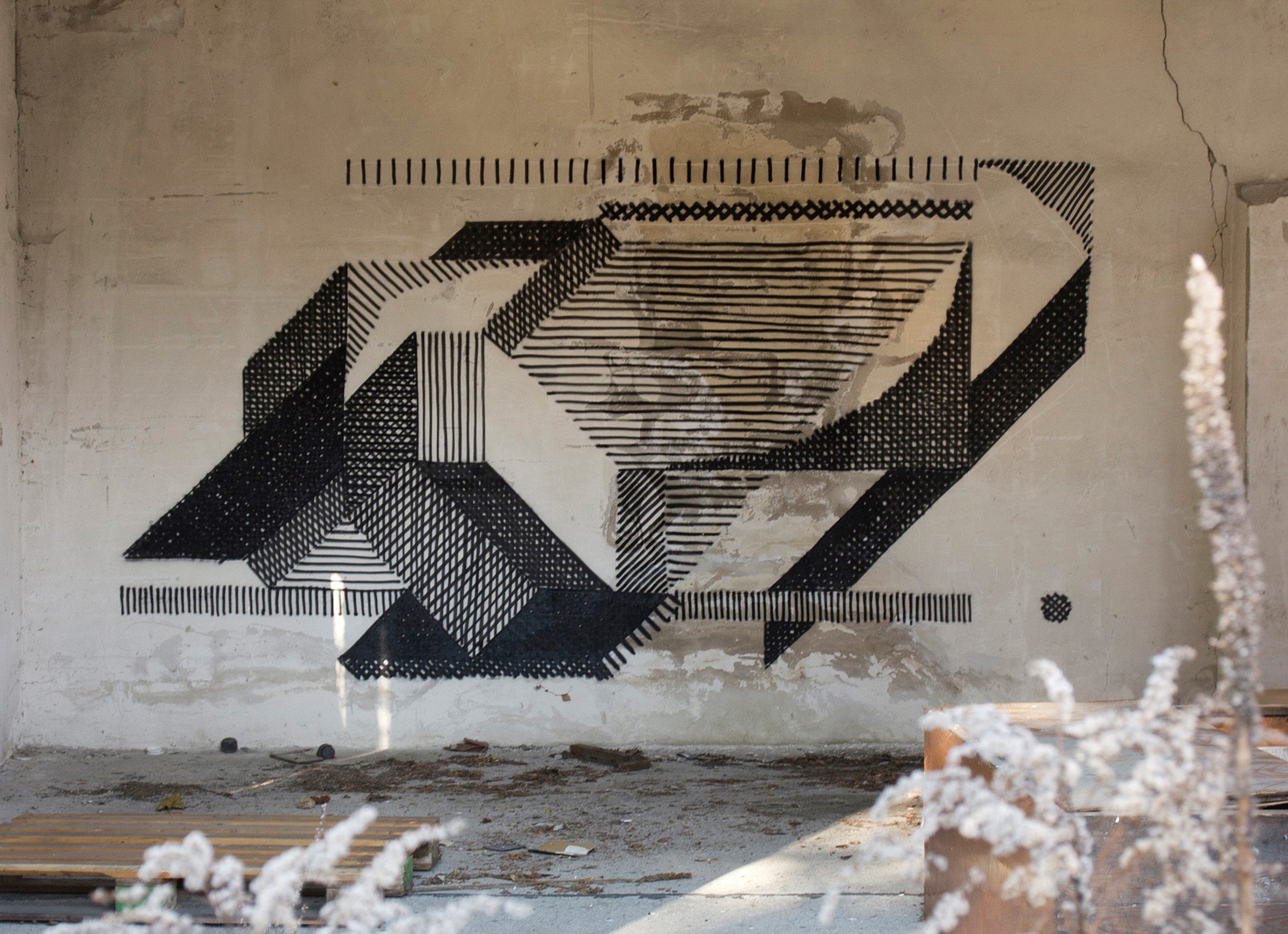
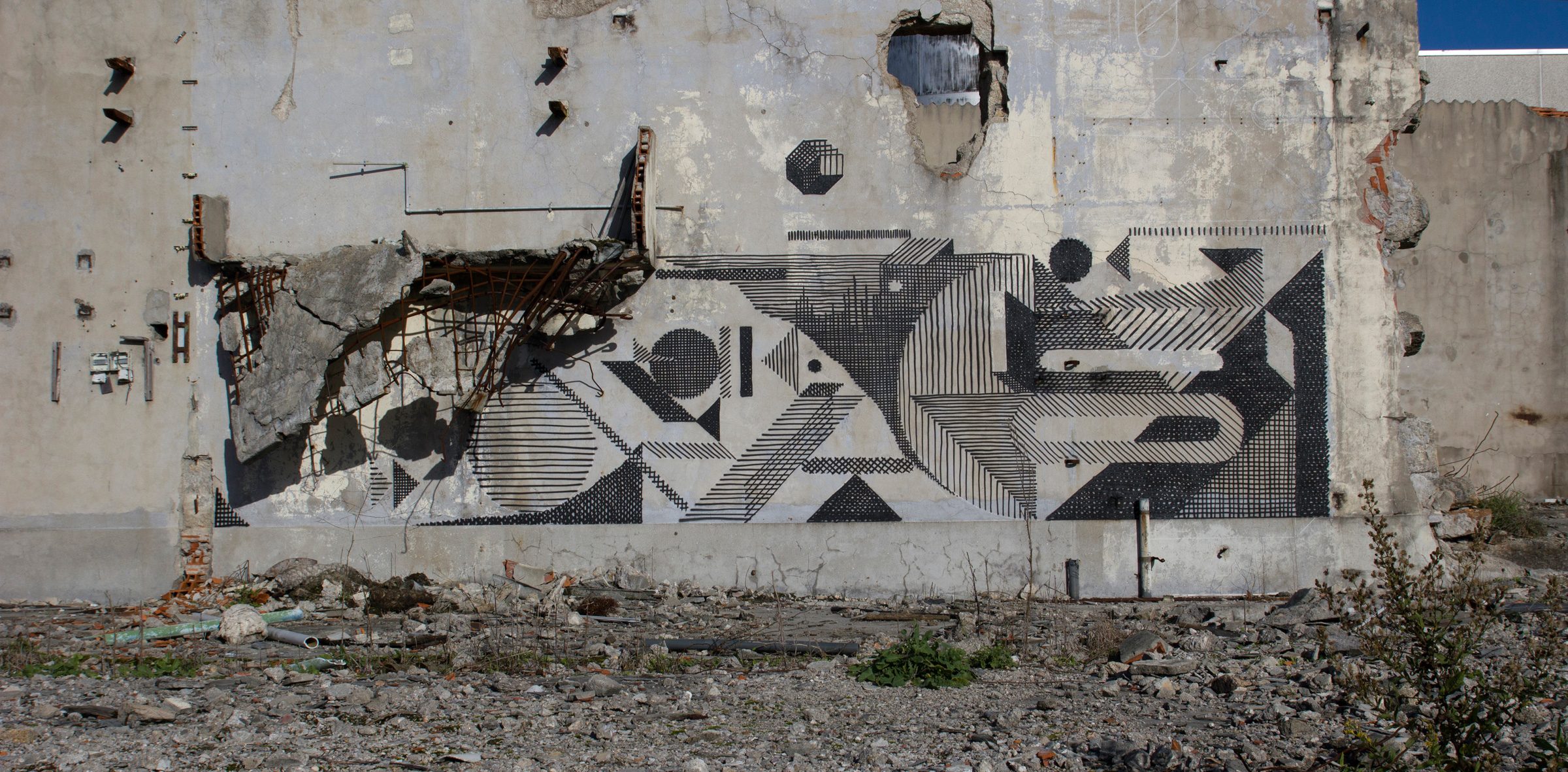
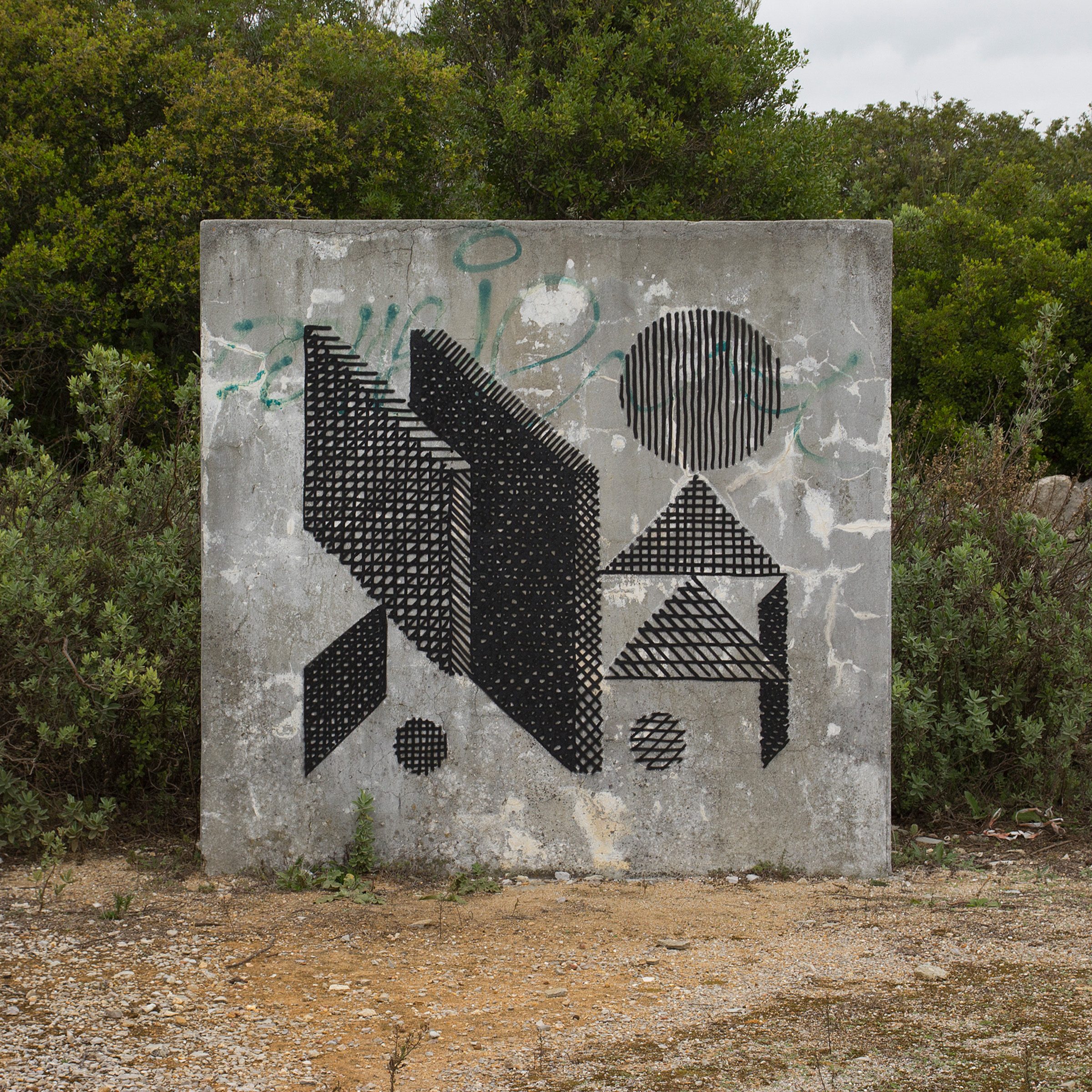
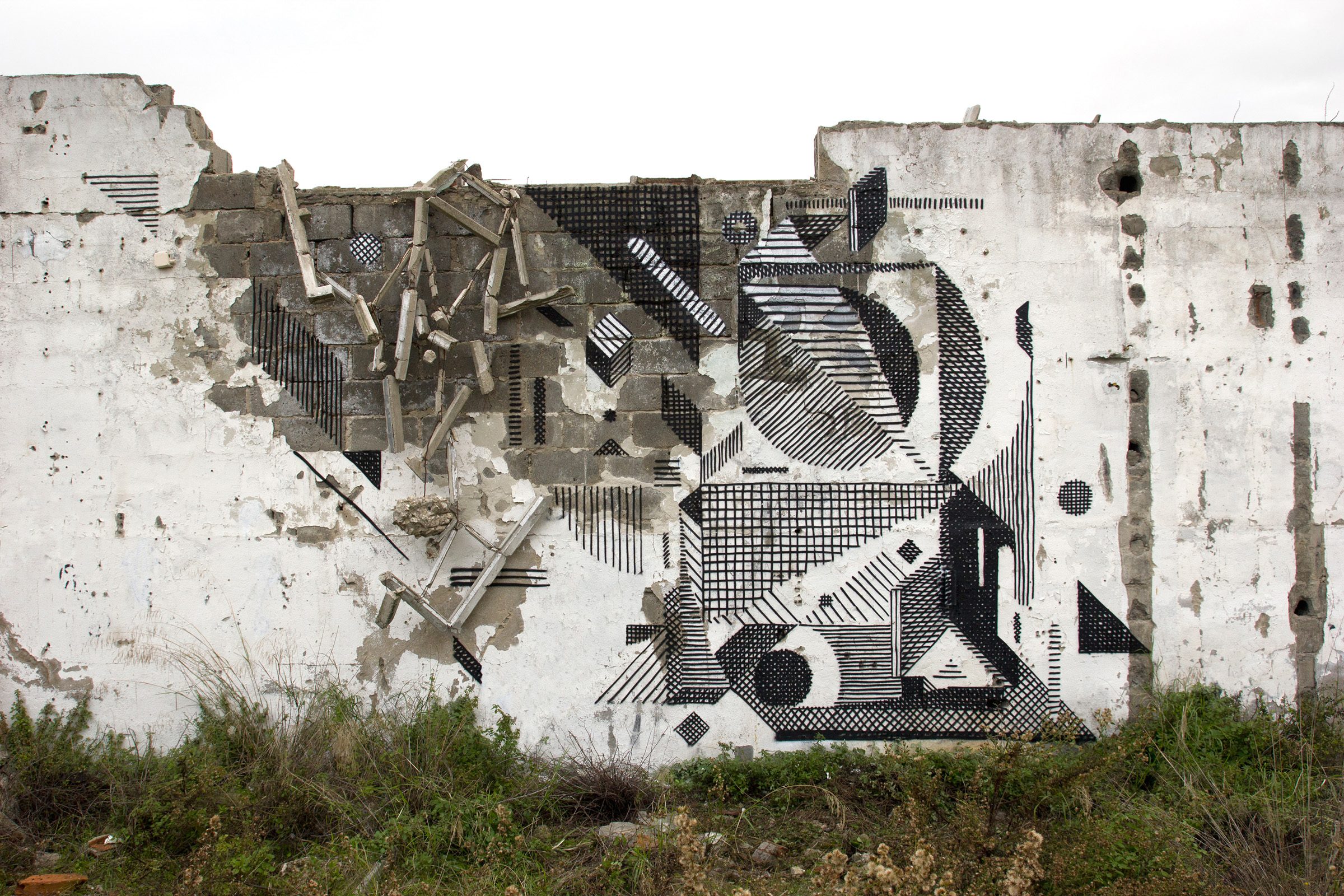
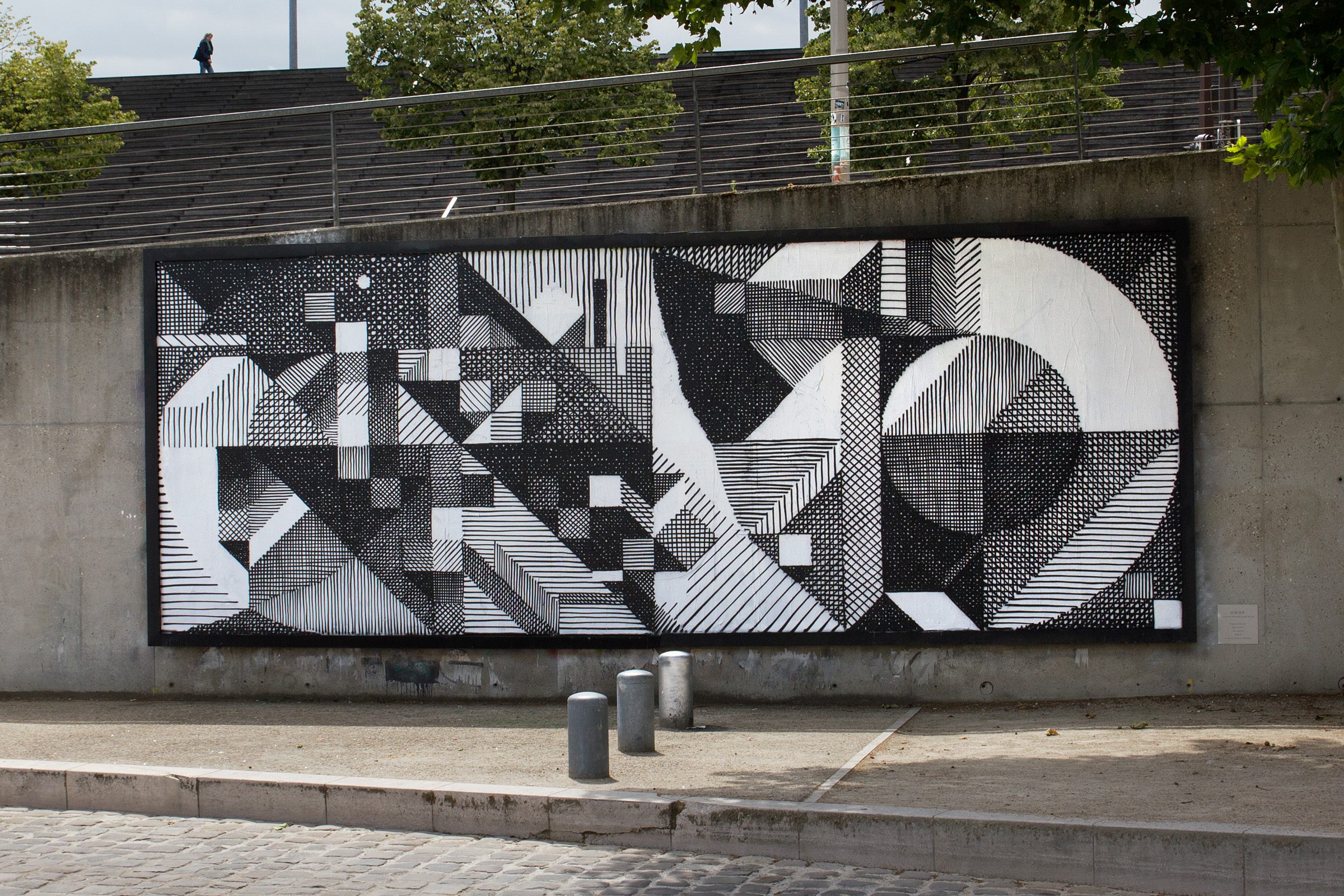
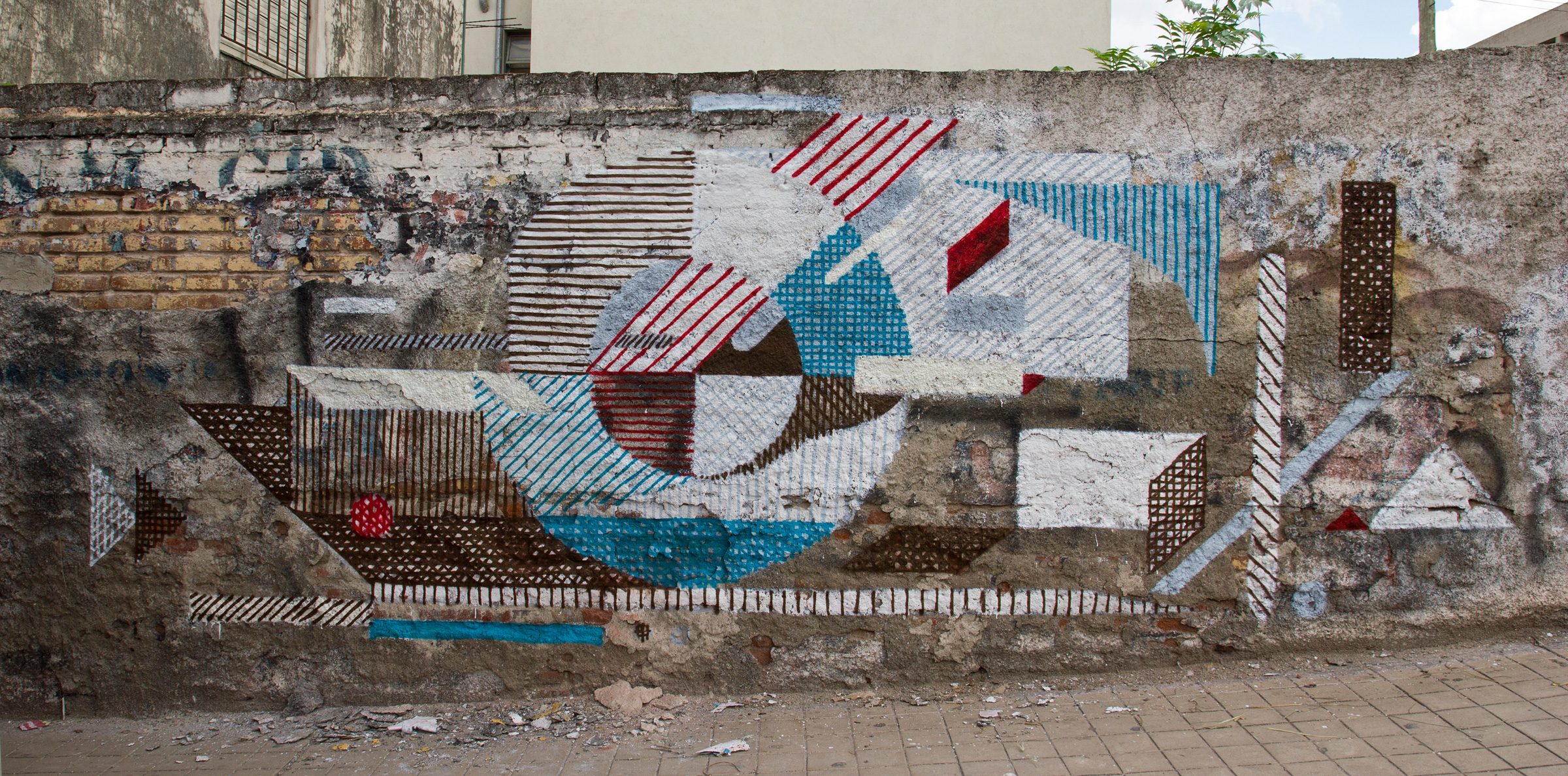
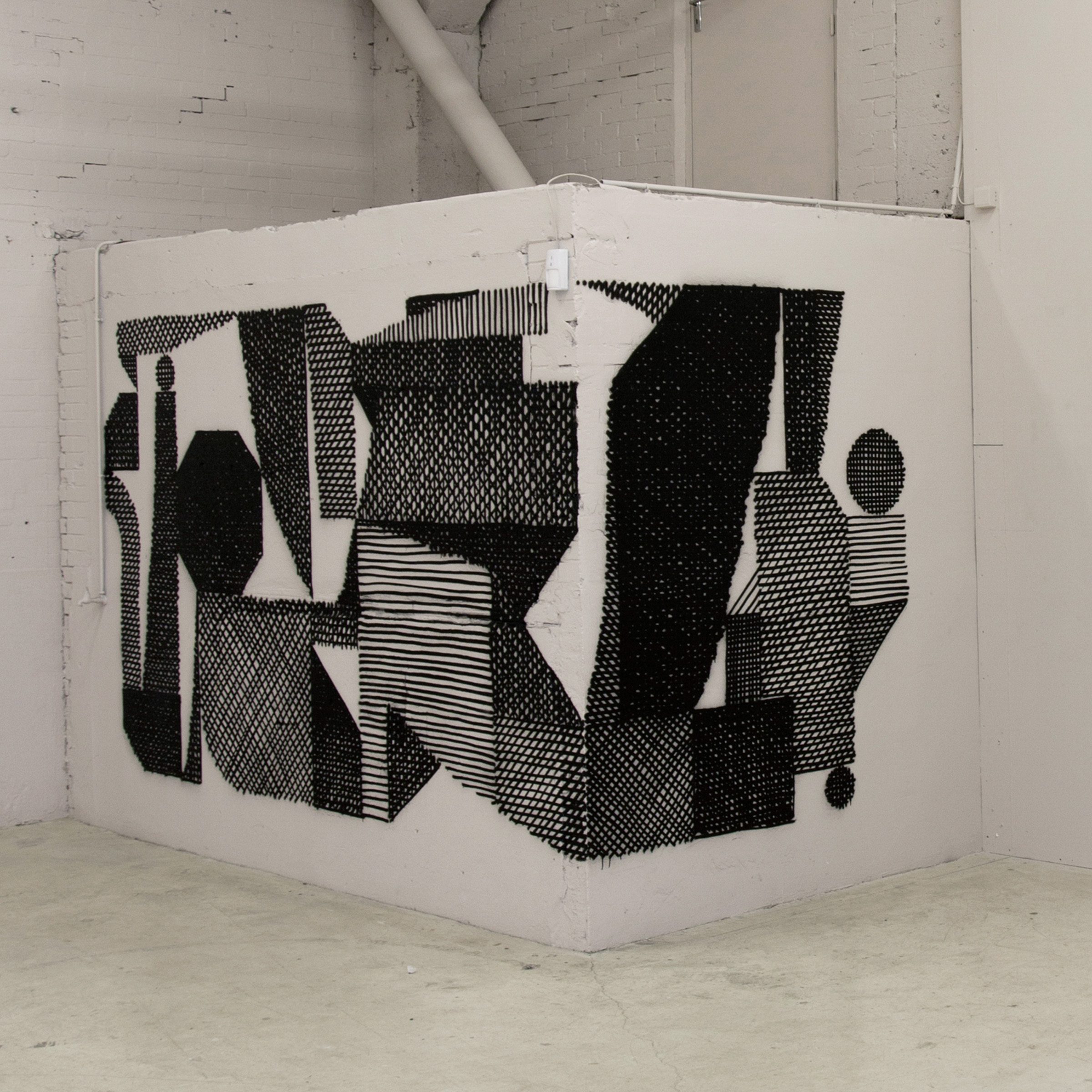
Especially your series Architectural Dialogue (2010-now) points out your sensibility for the implementation of painting in/on architecture in its surrounding. What are the challenges for you of those wall paintings, and how do you create a dialogue with architecture?
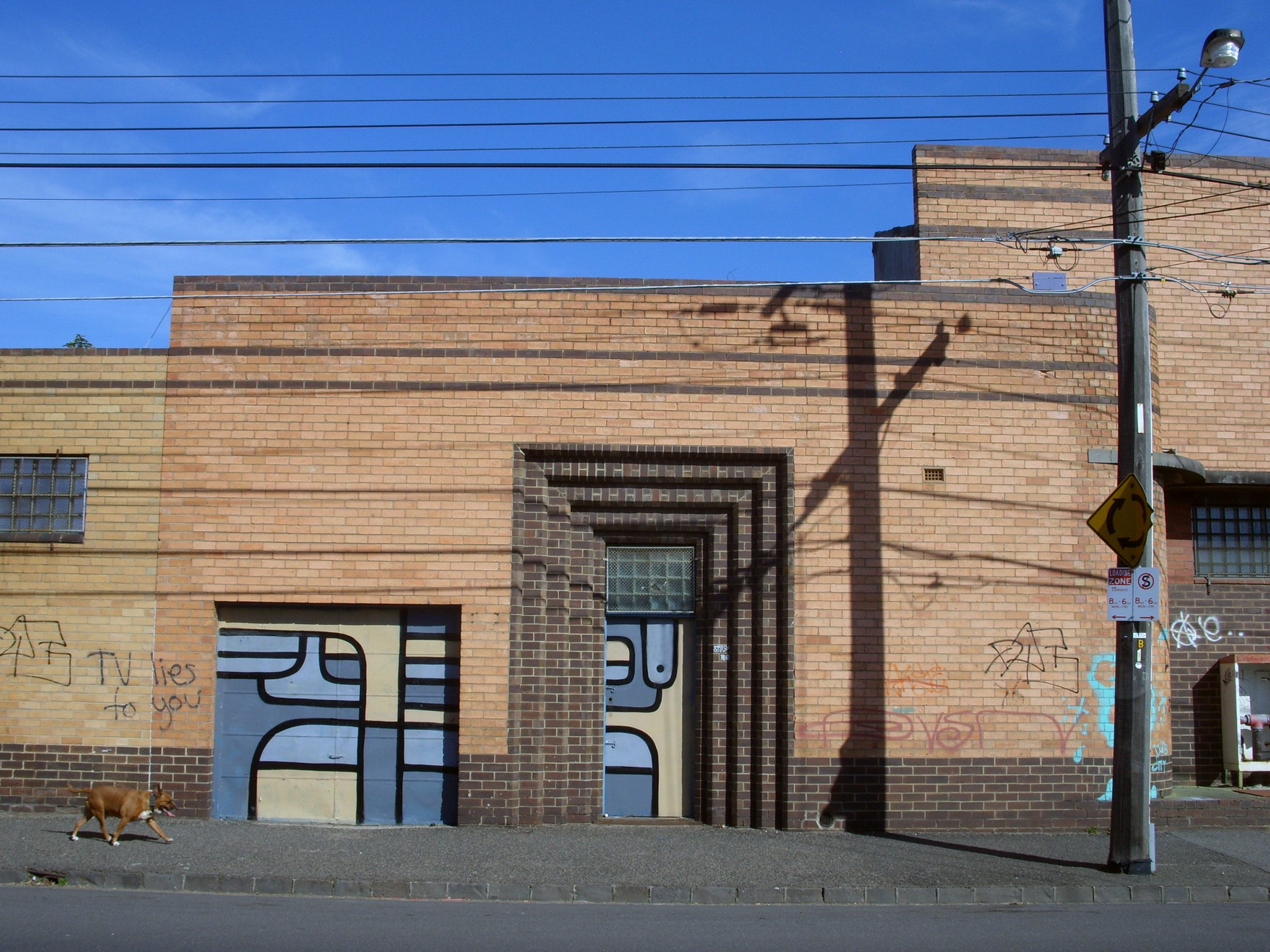
My compositions began evolving toward geometry partly in response to the architectural lines of the buildings I was painting on. Even when I started to paint on canvas, I perceived it as a kind of architecture: to adapt to it, my lines became straighter and the interlinked faces more “Mondrian-like.”
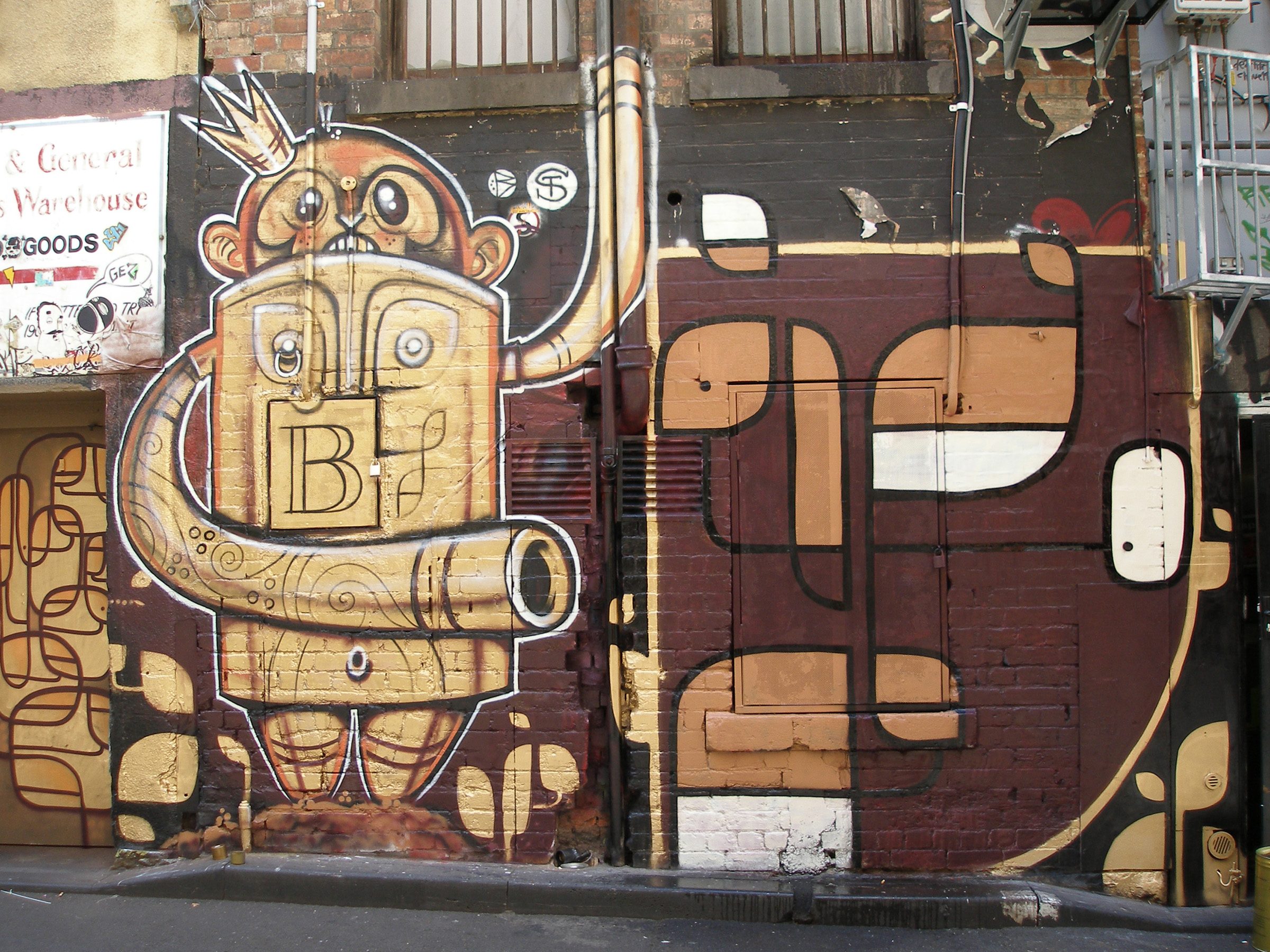
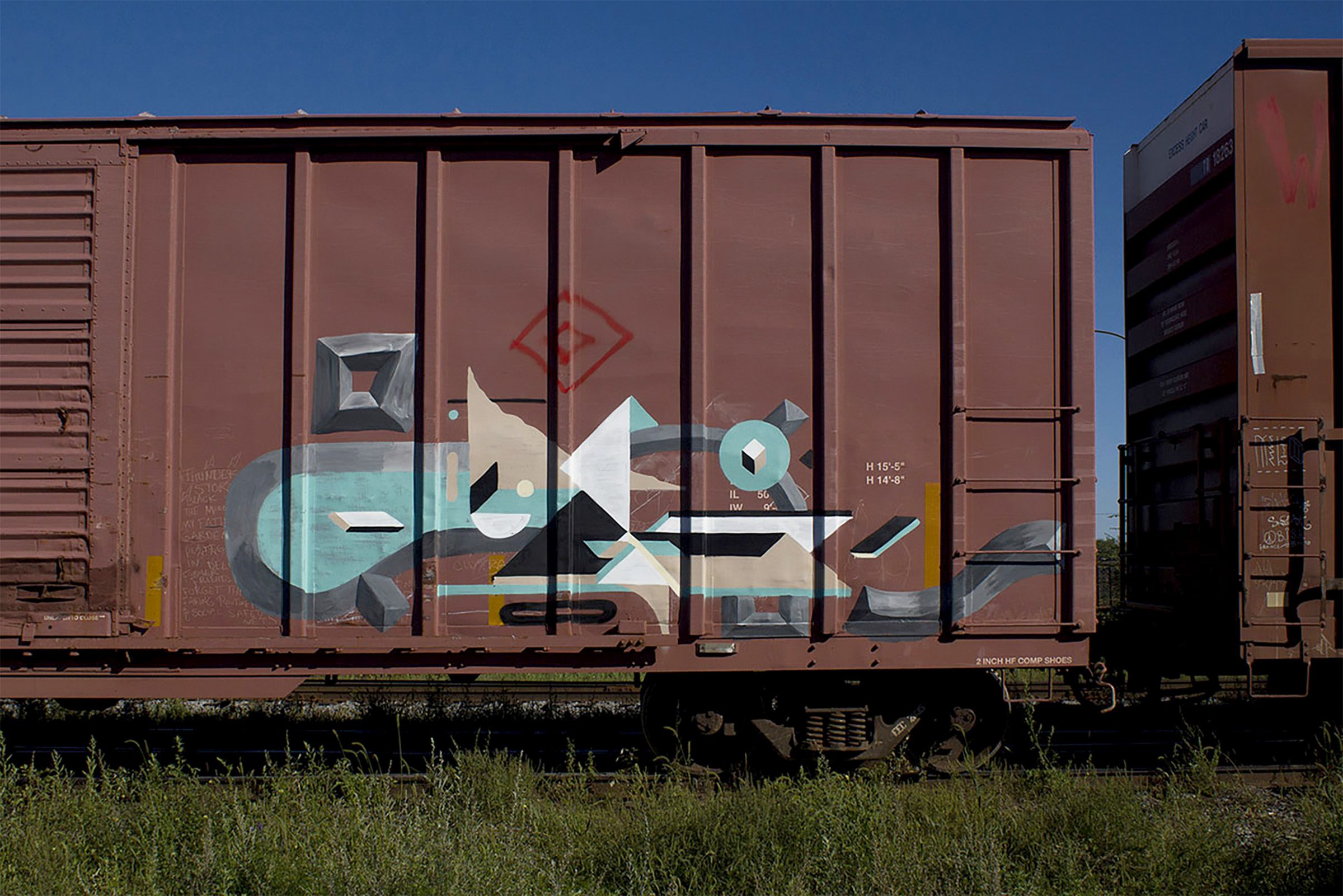
In the street, I started painting doors as if they were canvases, developing the faces across the entire surface. Gradually, they adapted to architectural elements such as bricks, becoming more rectangular. They truly began transforming into autonomous shapes when I stopped outlining them.
My approach progressively became more constructivist: abstract geometric elements replaced some of the faces while maintaining the same logic of interconnection. As the faces became unnecessary for what I wanted to express, they eventually disappeared entirely. This transition, between 2010 and 2012, marks the beginning of the Architectural Dialogue series.
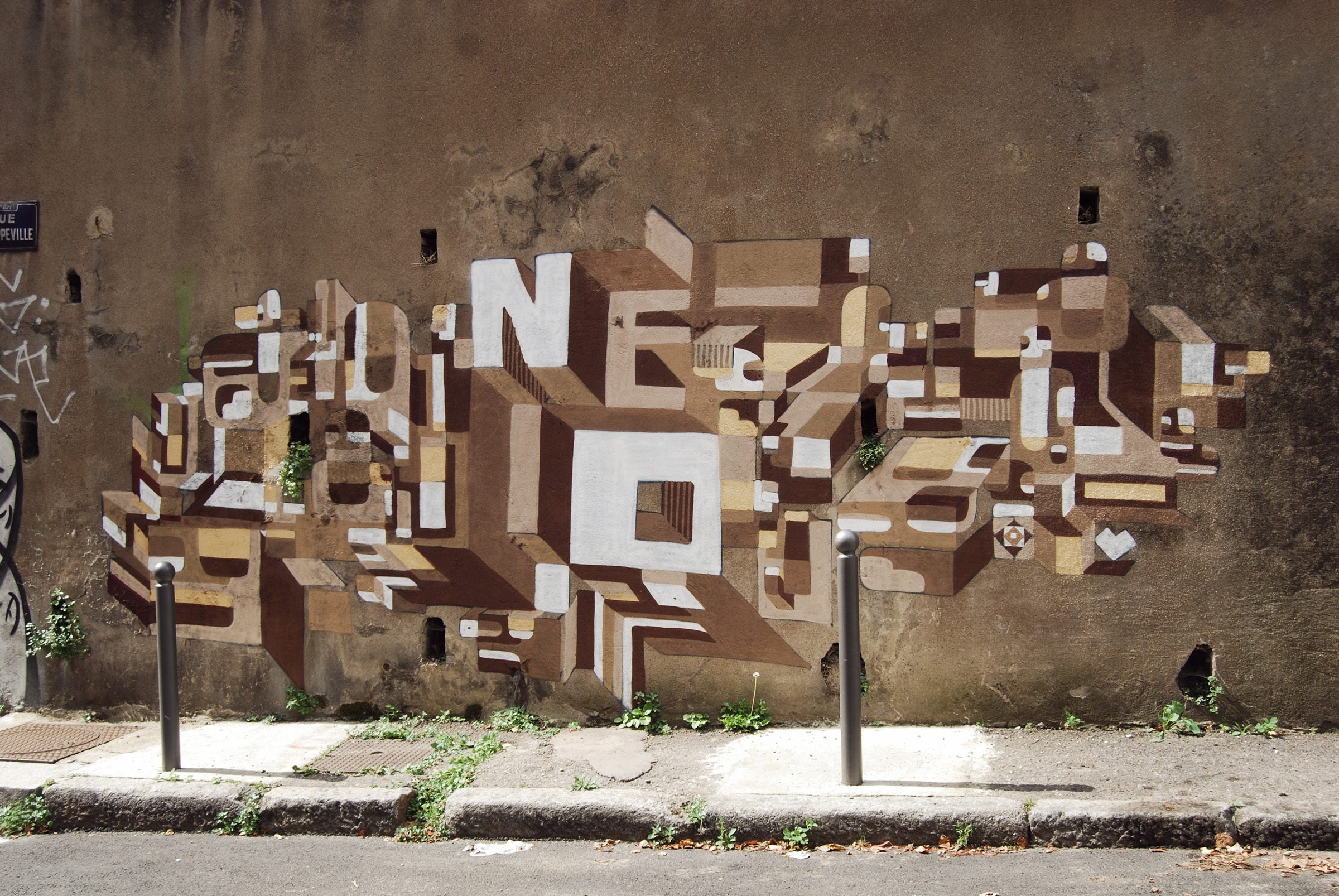
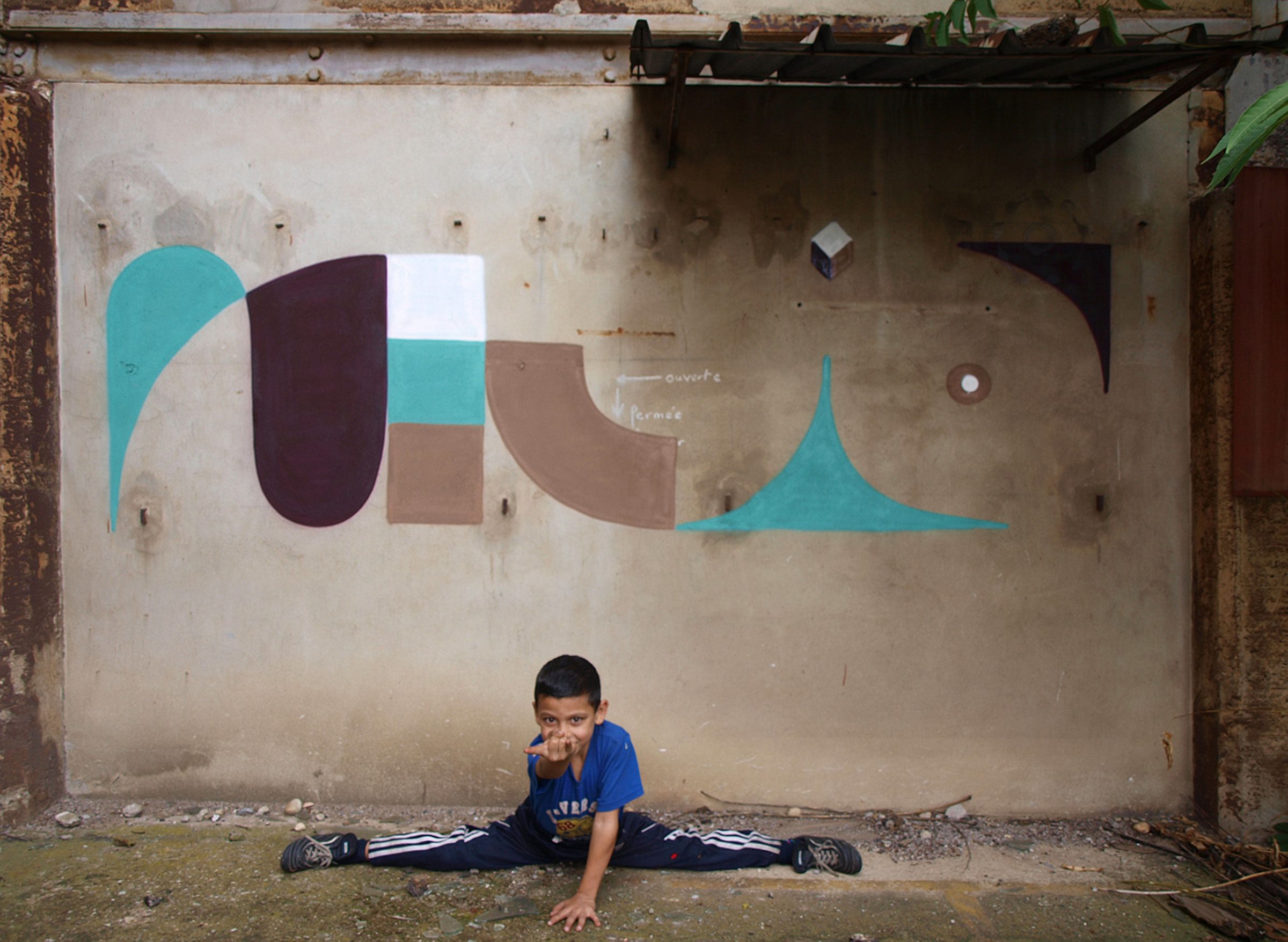
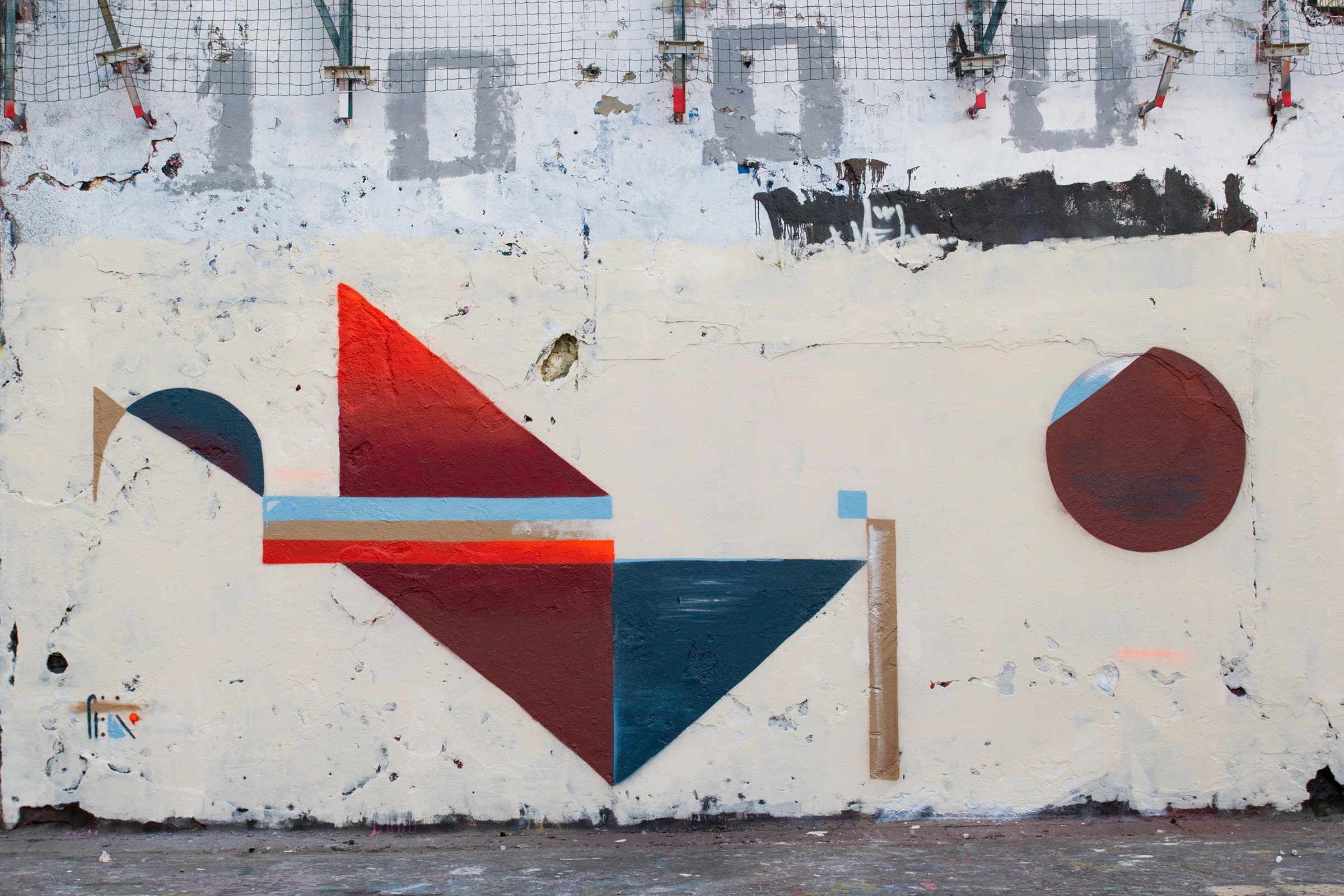
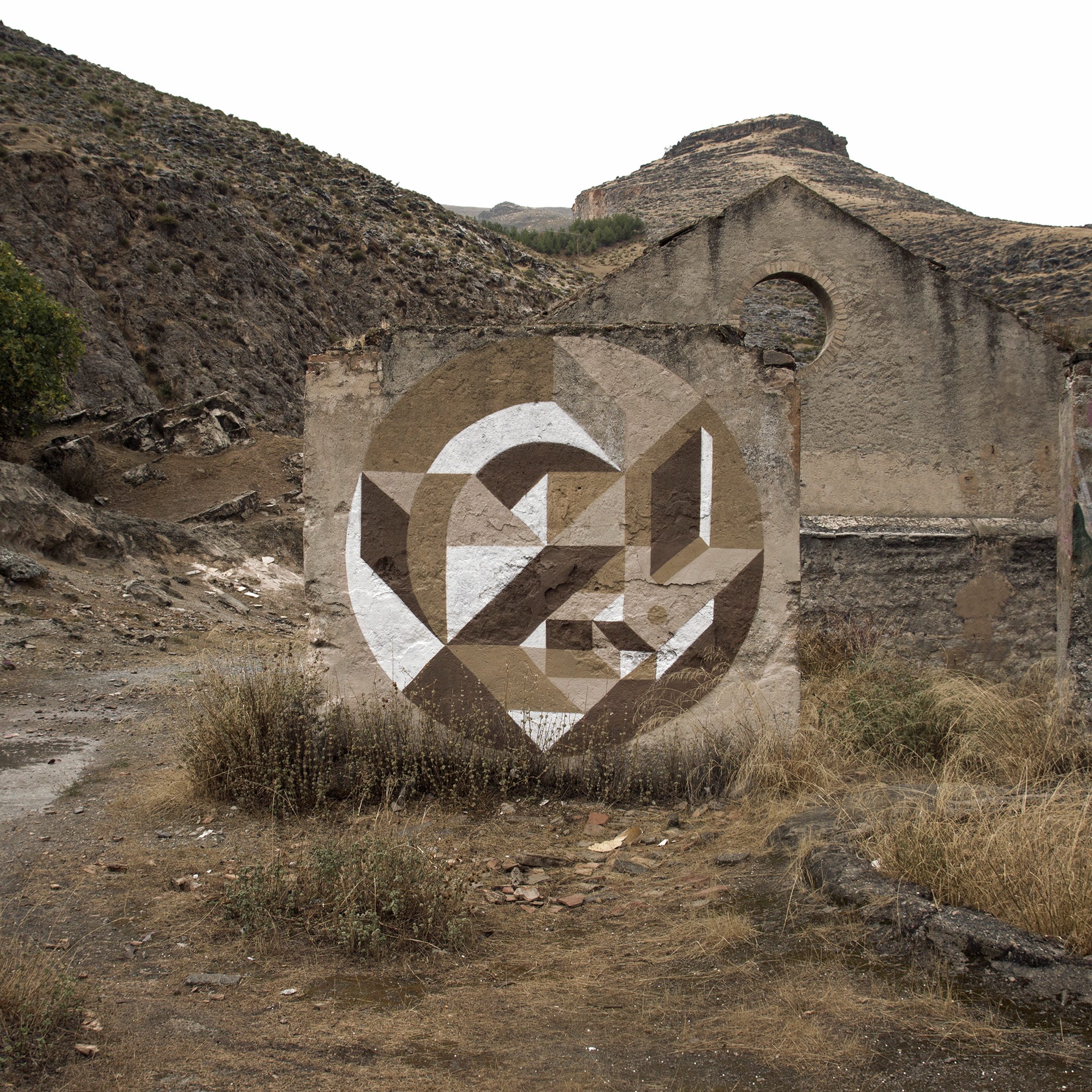
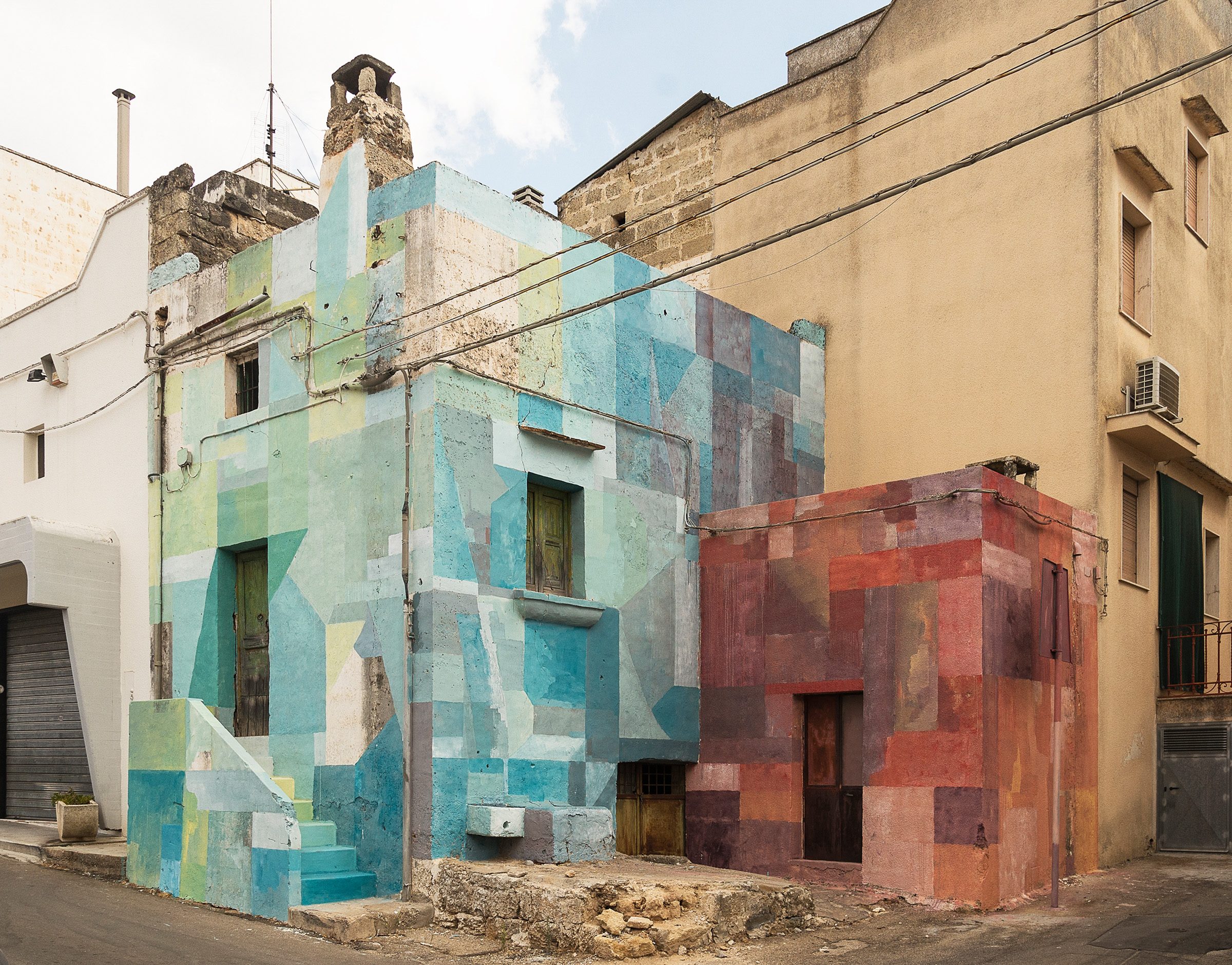
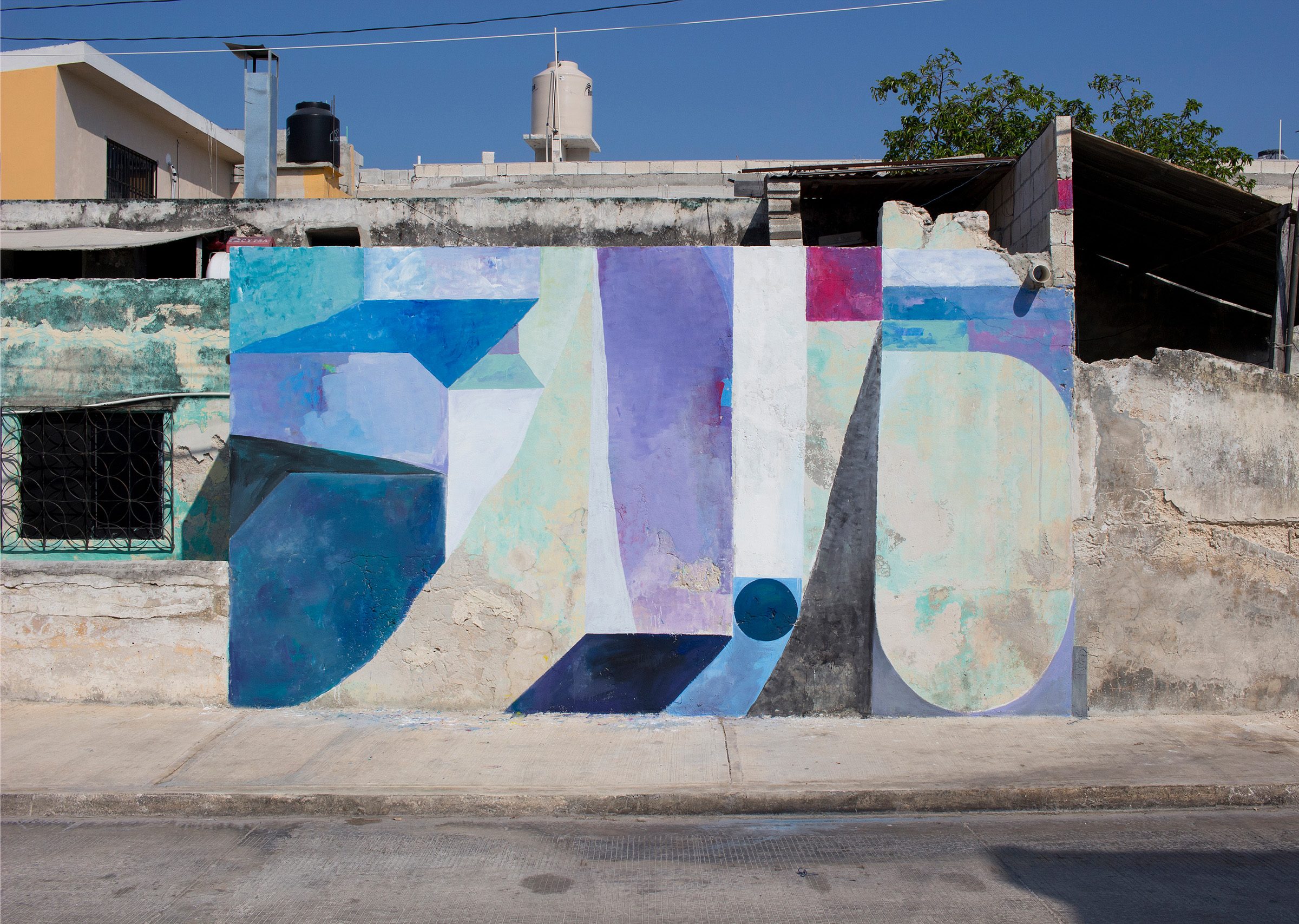
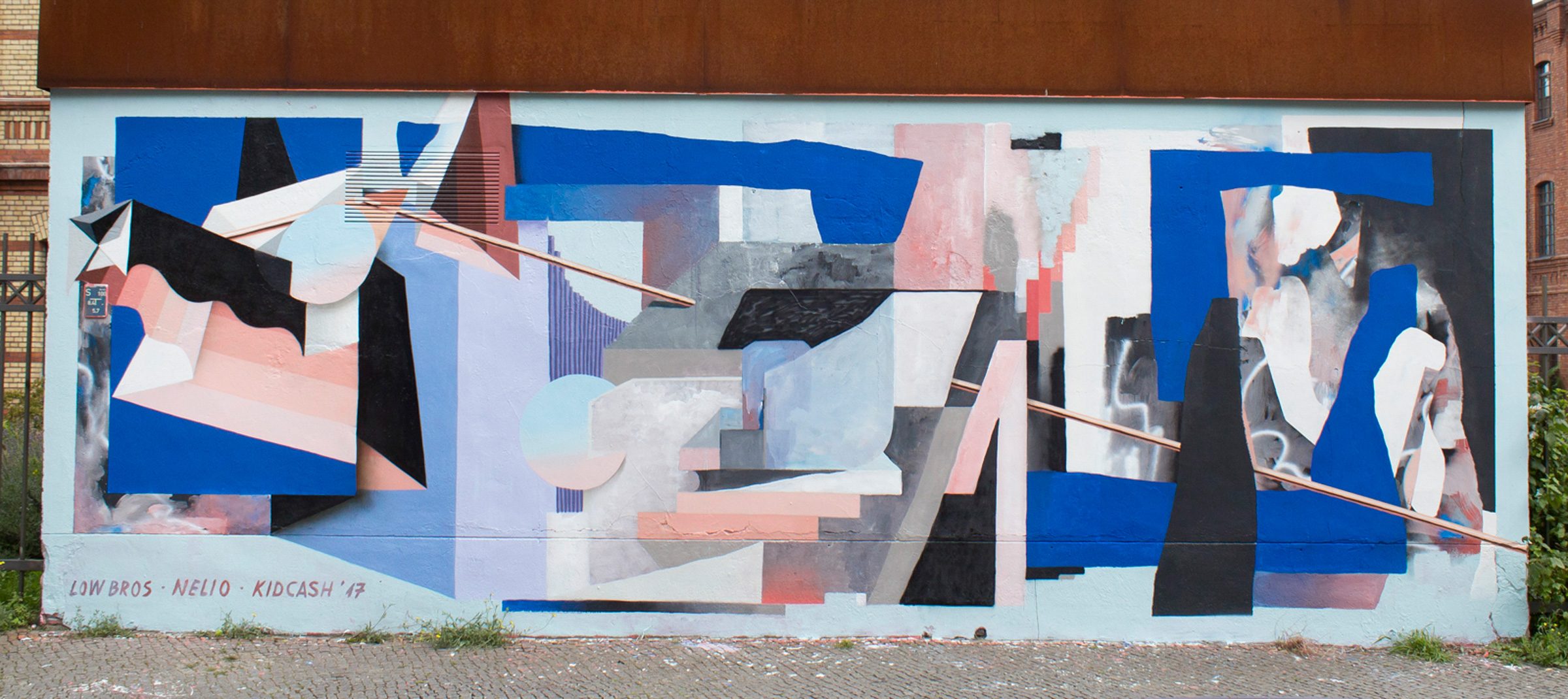
Freed from figuration, I emphasized in situ influences even more. For example, in a mural painted in Granada in 2013, the circular composition echoes the round opening in the back wall, and the colours blend into the surrounding landscape: the beige of the wall, the ochre of the grass, the brown of the mountains, the white of the sky. This specific work also contains the early stages of another series, inspired by Land Art, which is still in development.
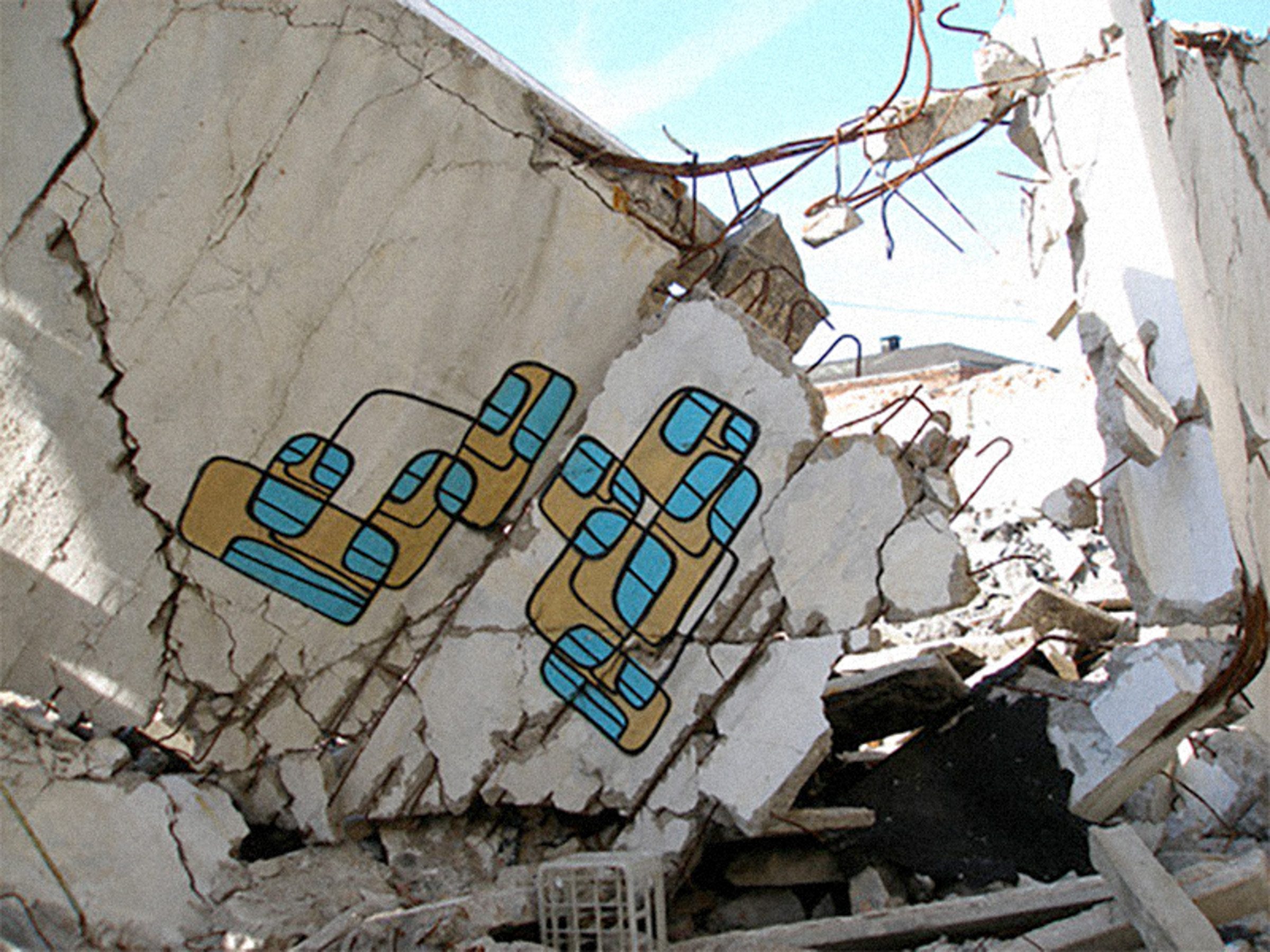
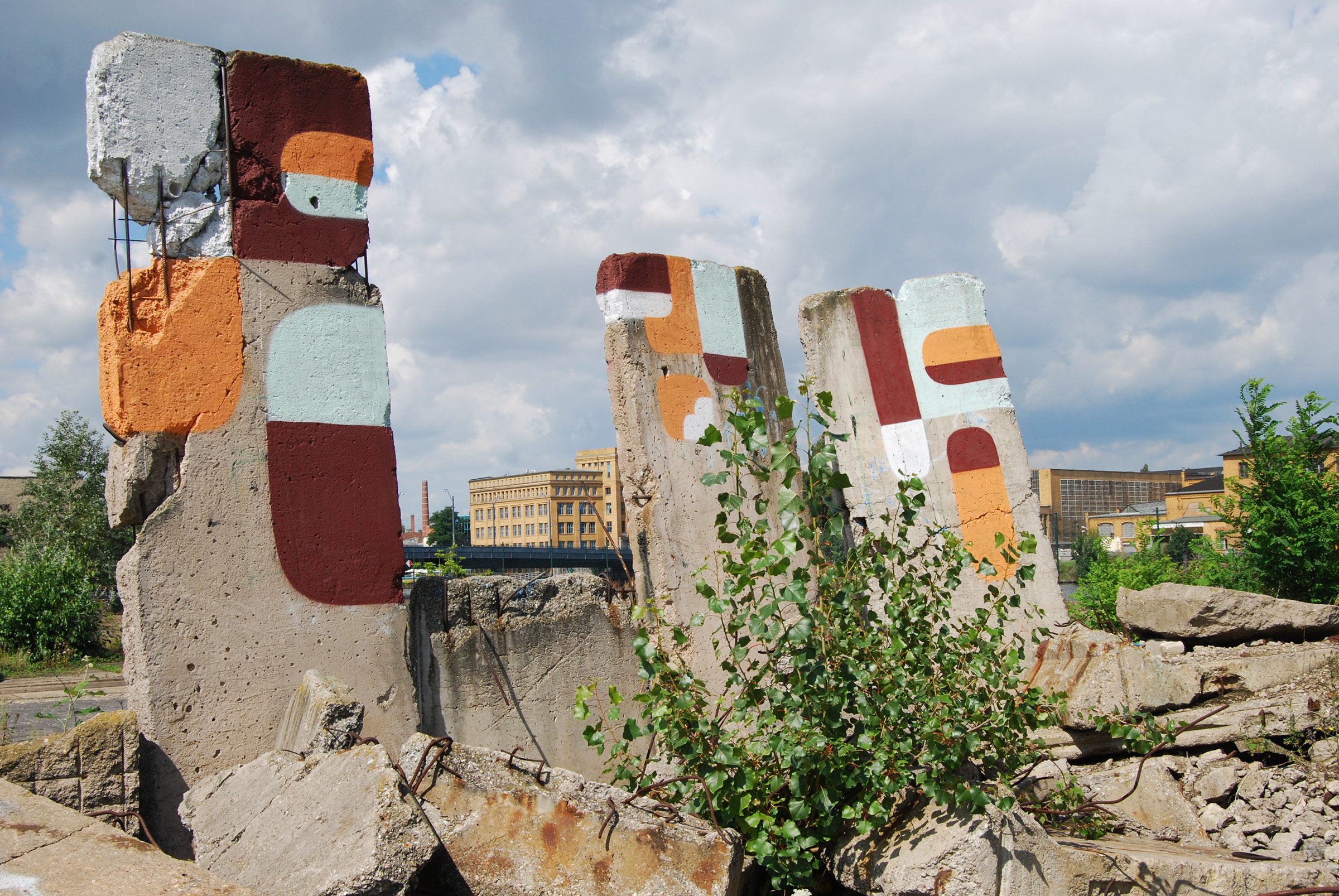
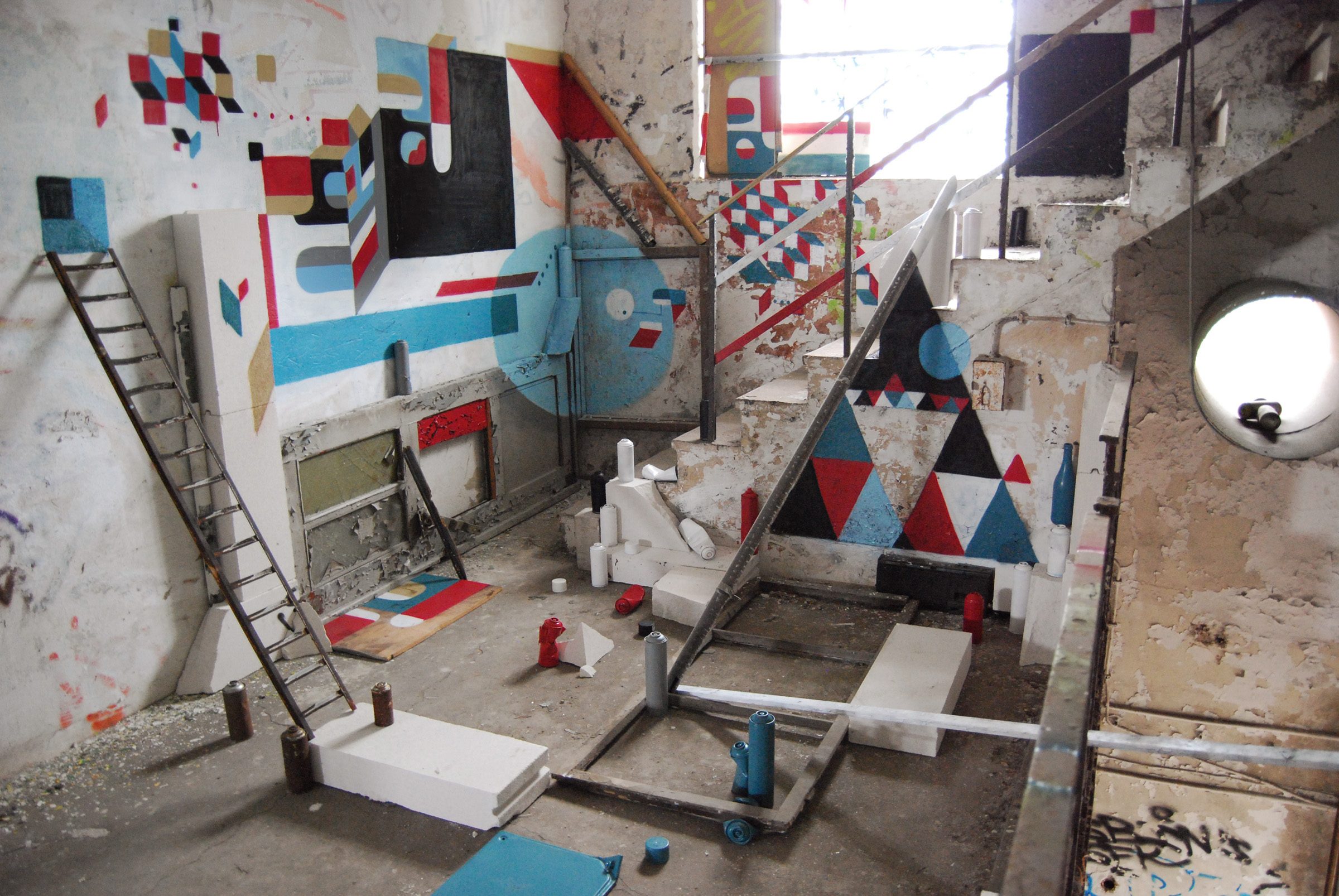
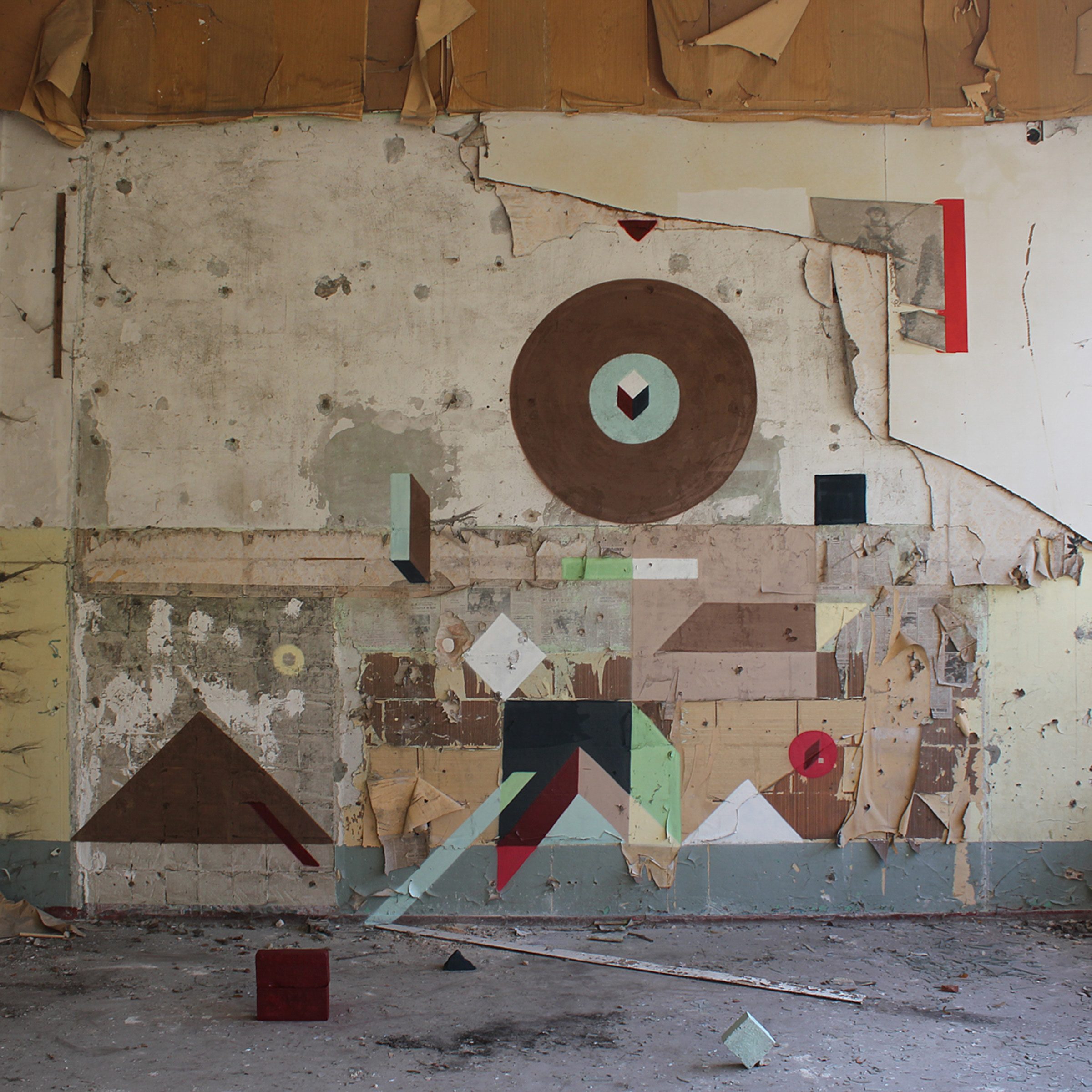
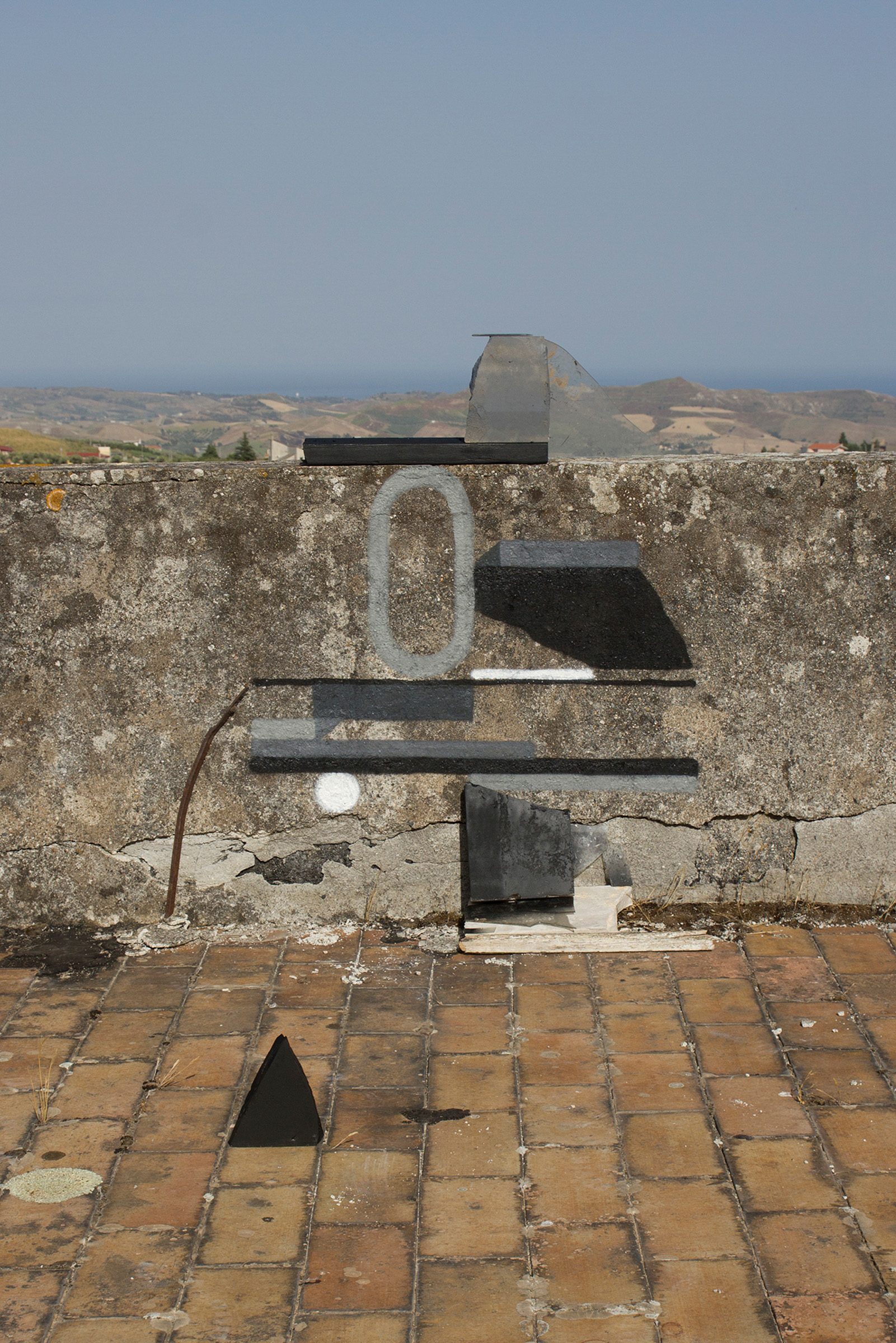
I often paint in abandoned places. Architecturally, I am particularly sensitive to the contrast between the straight lines of the built structure and the more chaotic lines of collapsing walls. Integrating these dynamics of rupture into my geometric forms allowed me to continue this dialogue with architecture in the process of disappearing, as in a mural painted in Porto in 2013, for example. This also influenced my research in directions opposed to constructivism, such as Abstract Expressionism or Erased Structures, which were then emerging.
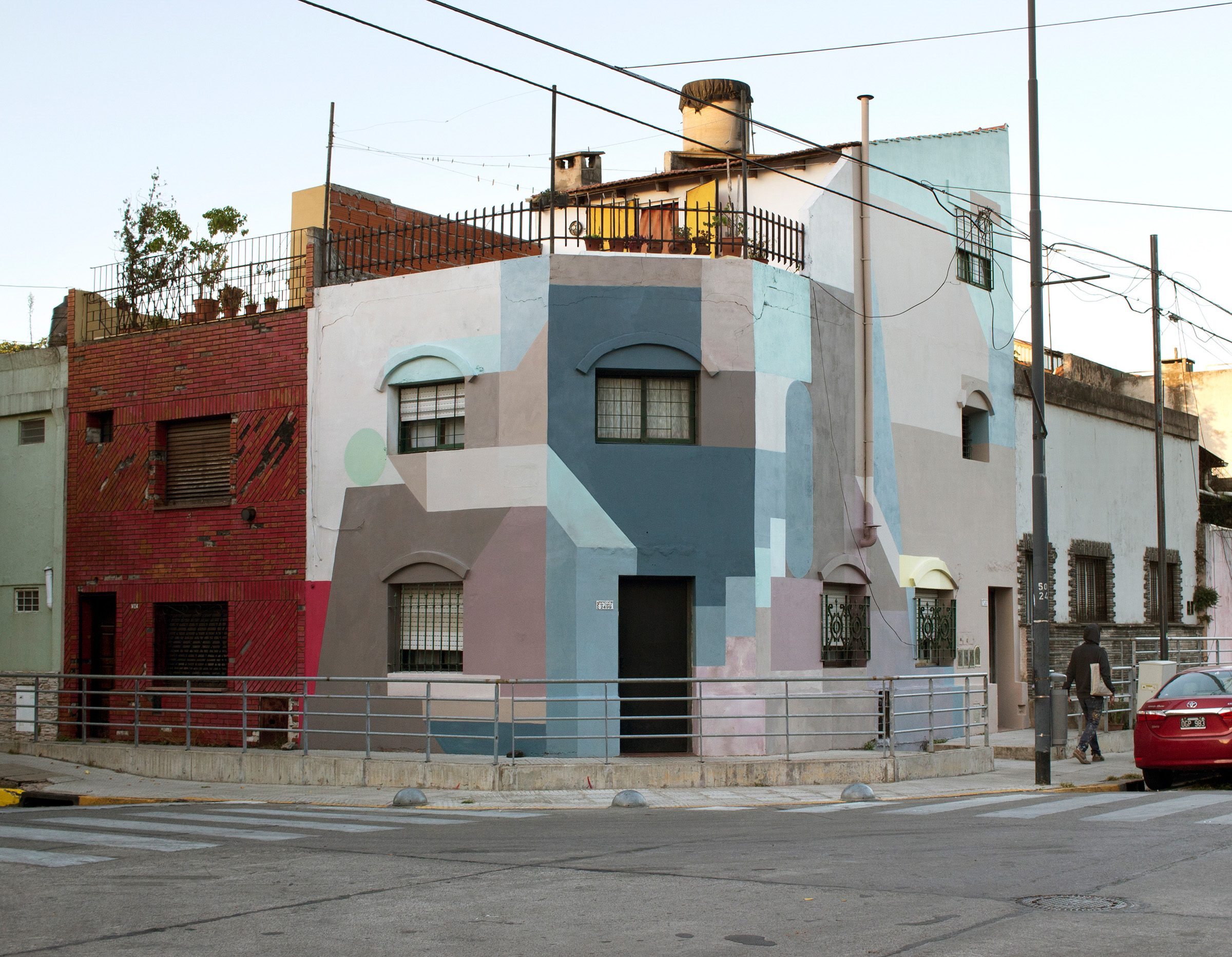
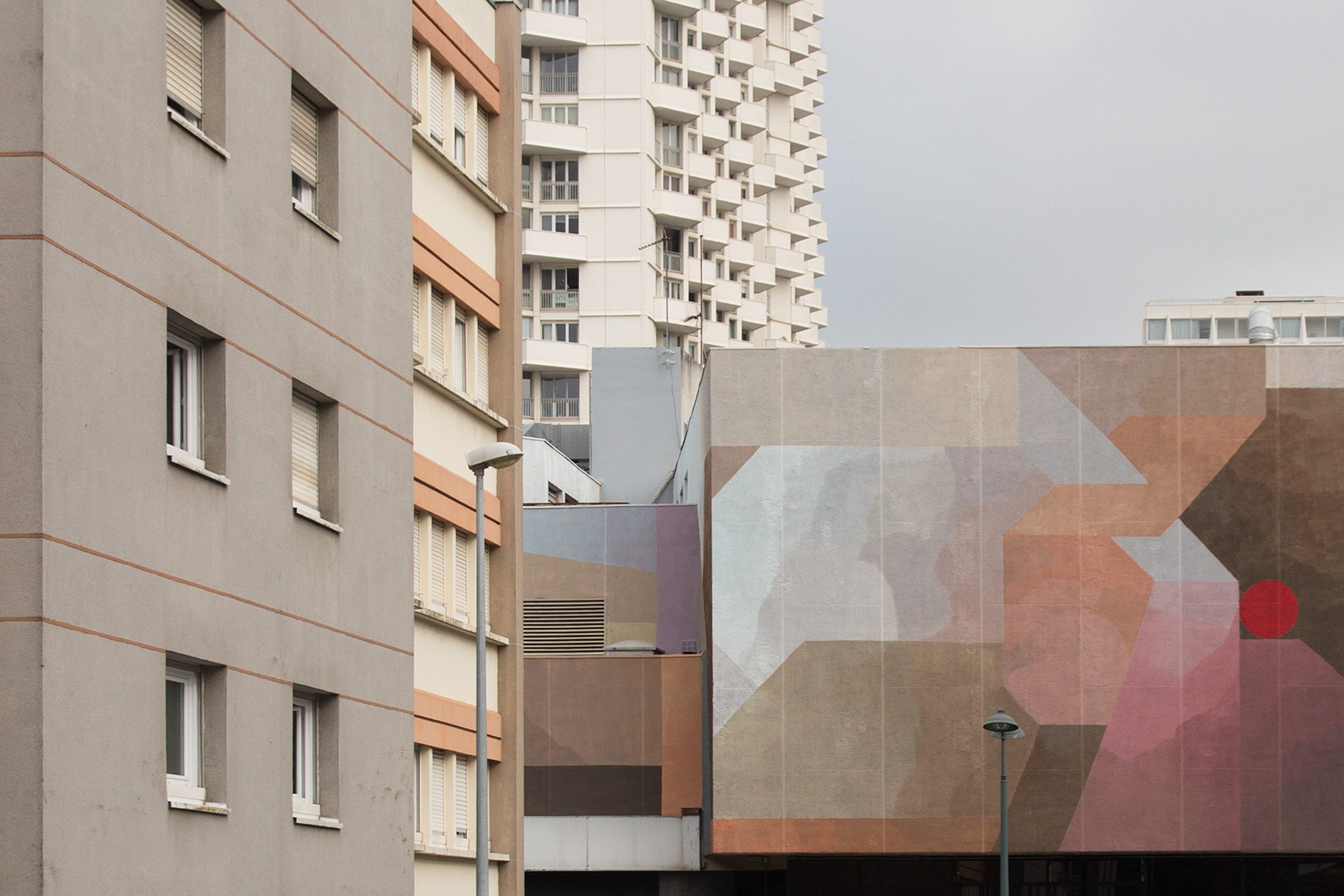
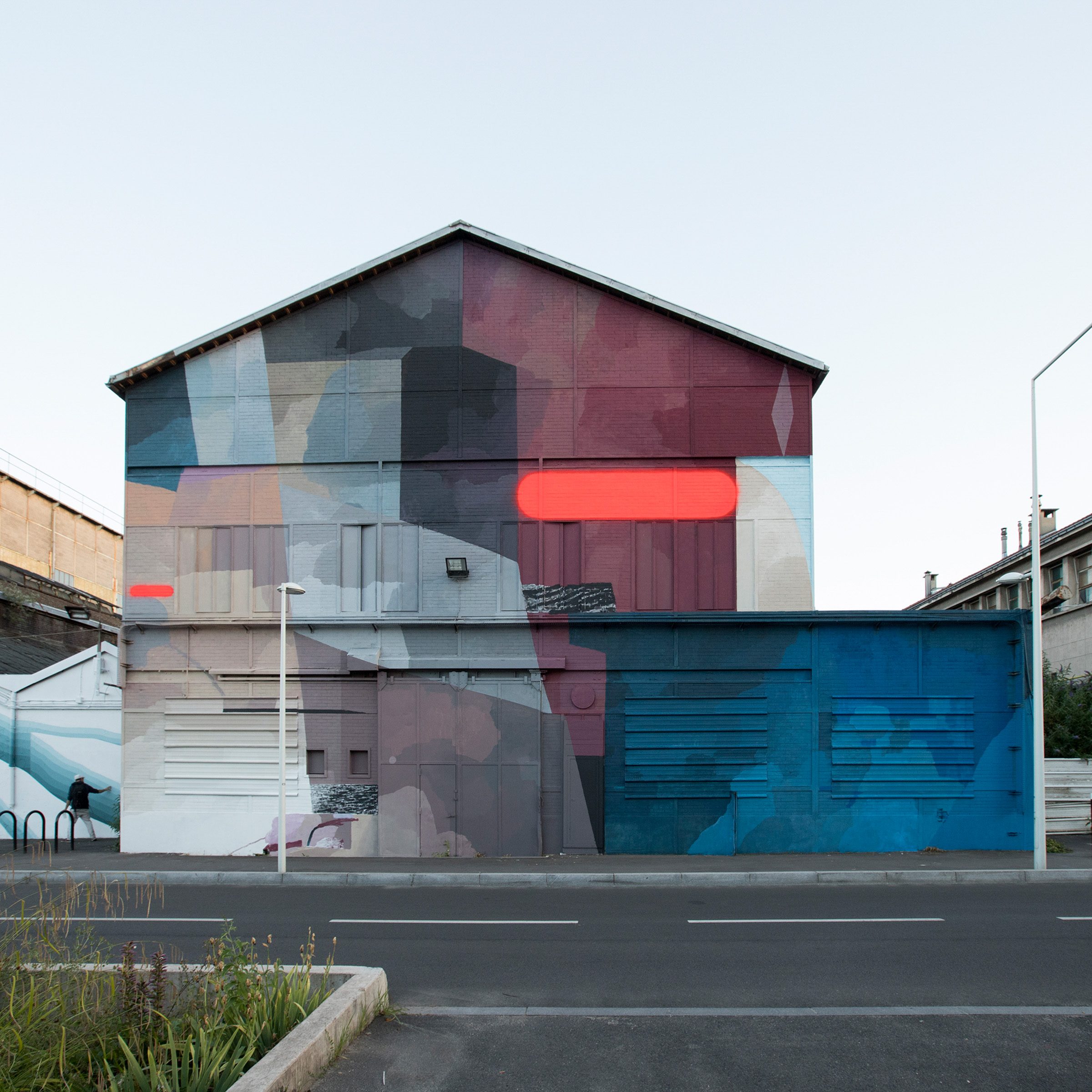
Later on, when I was invited to paint entire façades, I sometimes directly incorporated the building and its rhythms into the sketch. My compositional grid would align with windows, doors, gutters, and other existing elements, which became integral components of the painting itself.

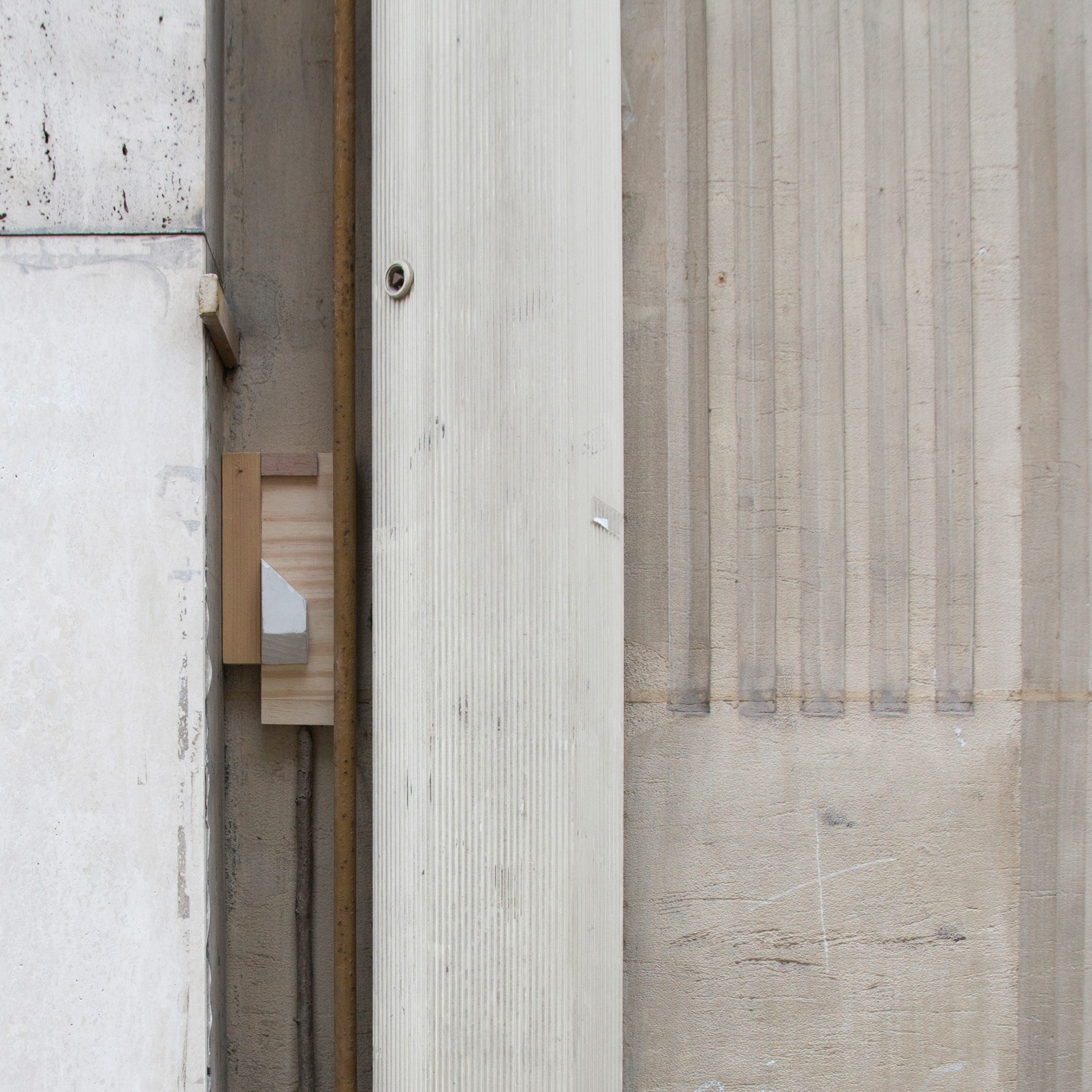
The same year you started extending your practice to three-dimensional works with assemblages. What created that need, and how is this practice linked to your paintings?
The oblique perspective present in the structure of my graffiti letters, along with my desire to engage a dialogue with architecture, naturally led me to work in three dimensions.
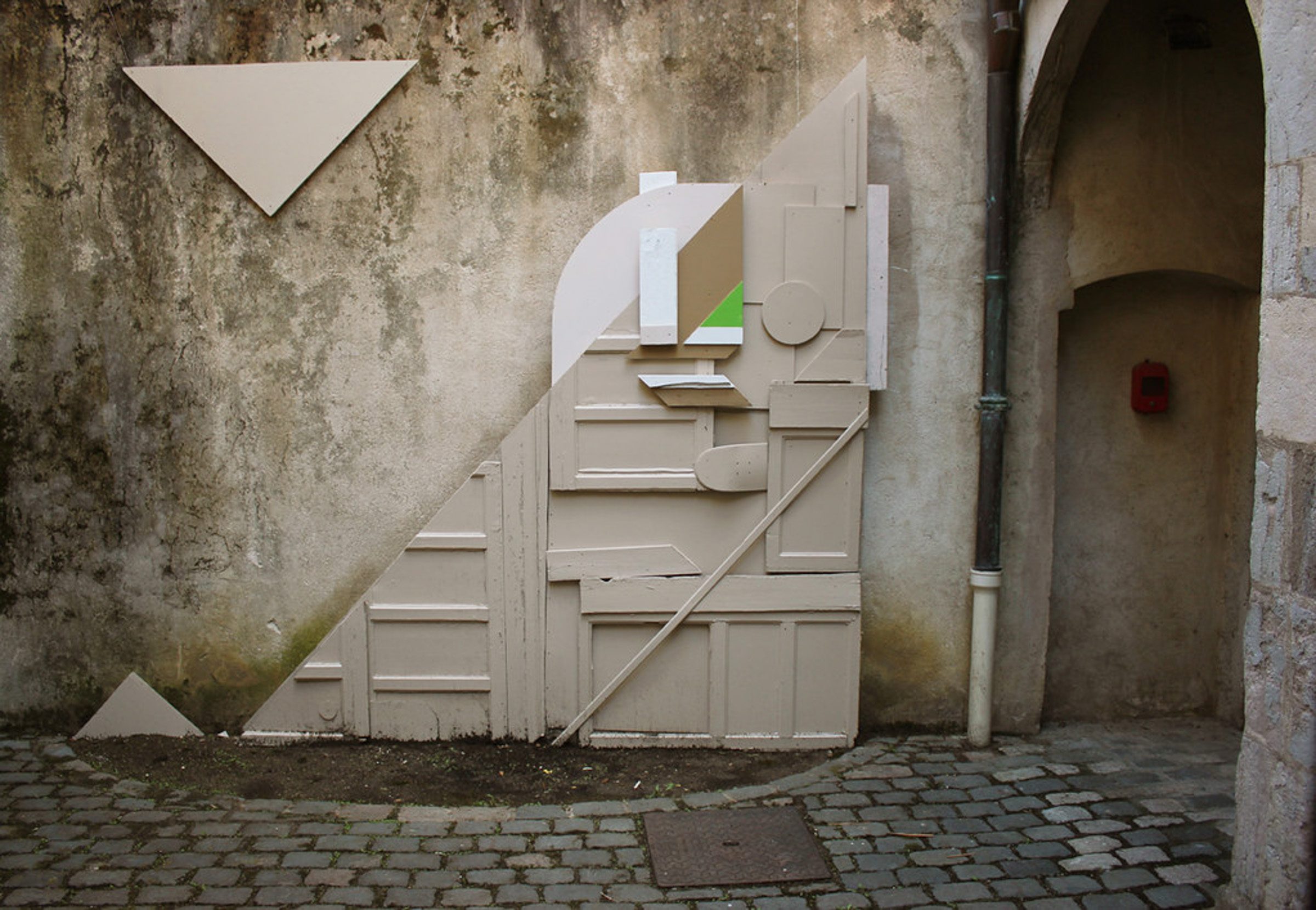
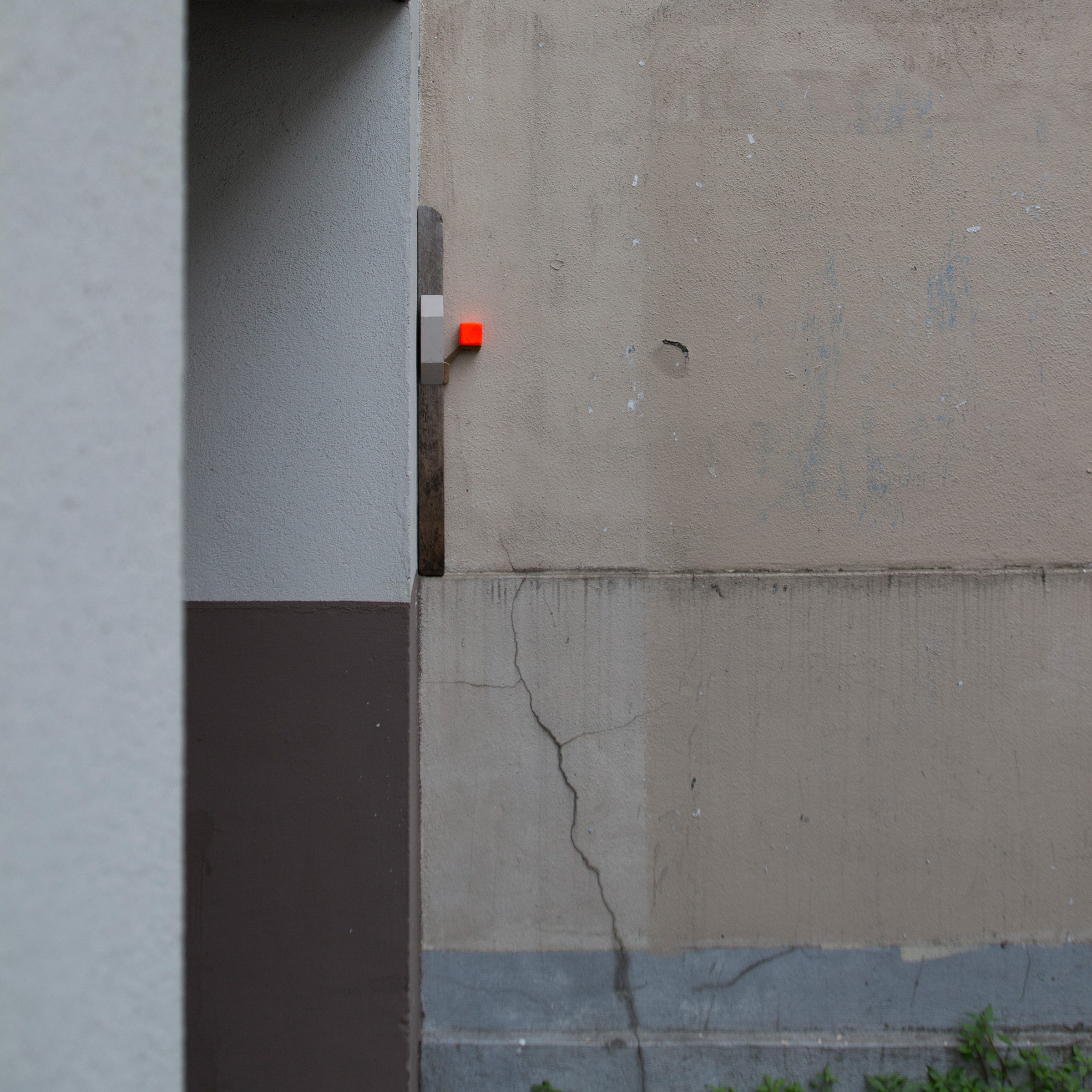
In the studio, I began using wooden boxes as if they were canvases, painting their sides as well. I then created bas-reliefs based on my compositions from that period, with certain shapes extruded, as if emerging from the surface. Outdoors, some experiments evolved into hybrid works, halfway between painting and installation, incorporating materials and found objects collected from abandoned places.
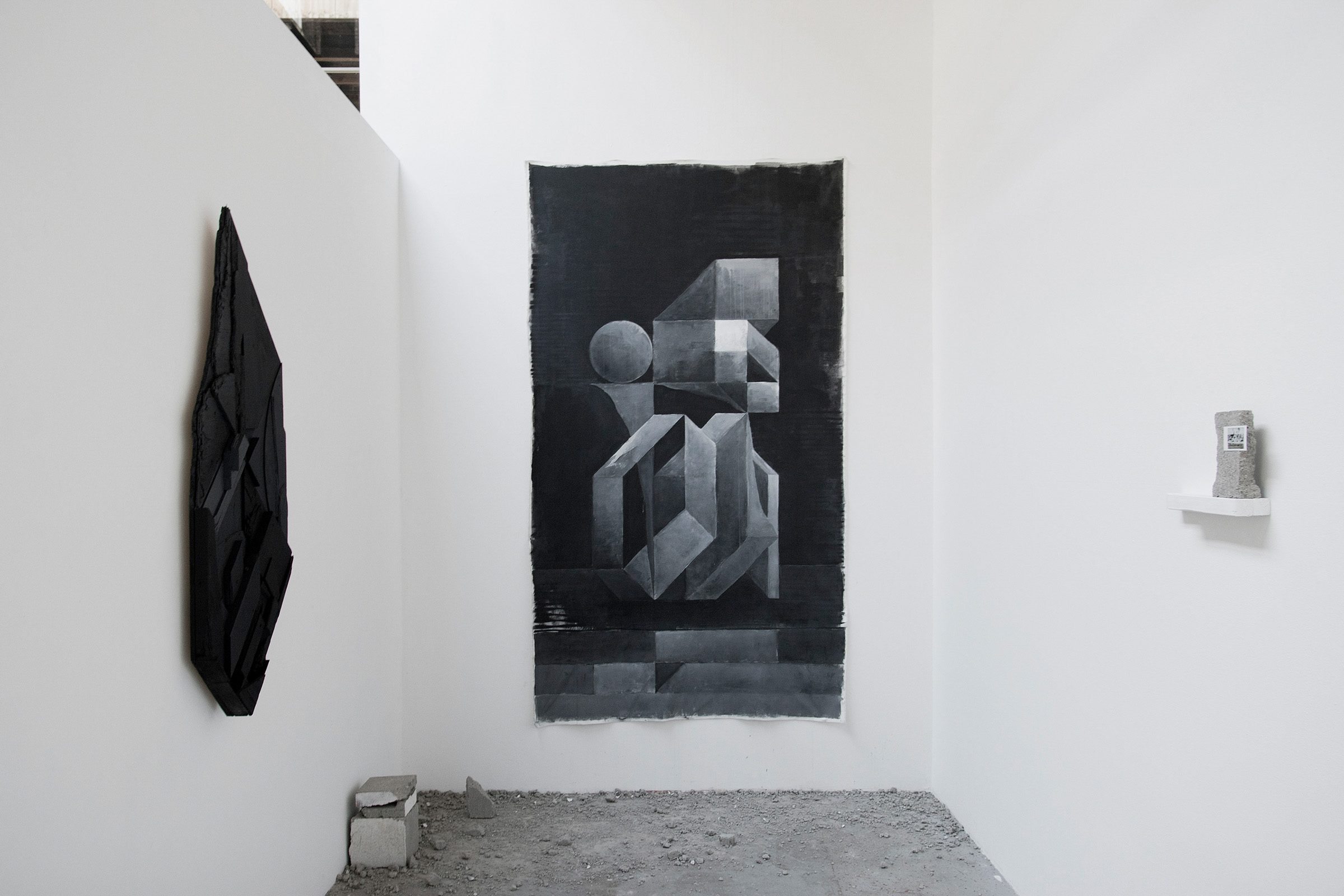
Gradually, painting became secondary within this series, sometimes even completely absent, replaced by raw materials such as wood, stones, metal, or fragments of concrete. References to Brutalism, Arte Povera, the Ready-made, and the Support/Surface movement became increasingly present in my work.
These explorations unfolded in abandoned places, sometimes in nature and in the street, but primarily in the studio. One of my motivations was to introduce architectural context and a form of organic presence into the studio and gallery space, which are often perceived as neutral, even sterile environments.
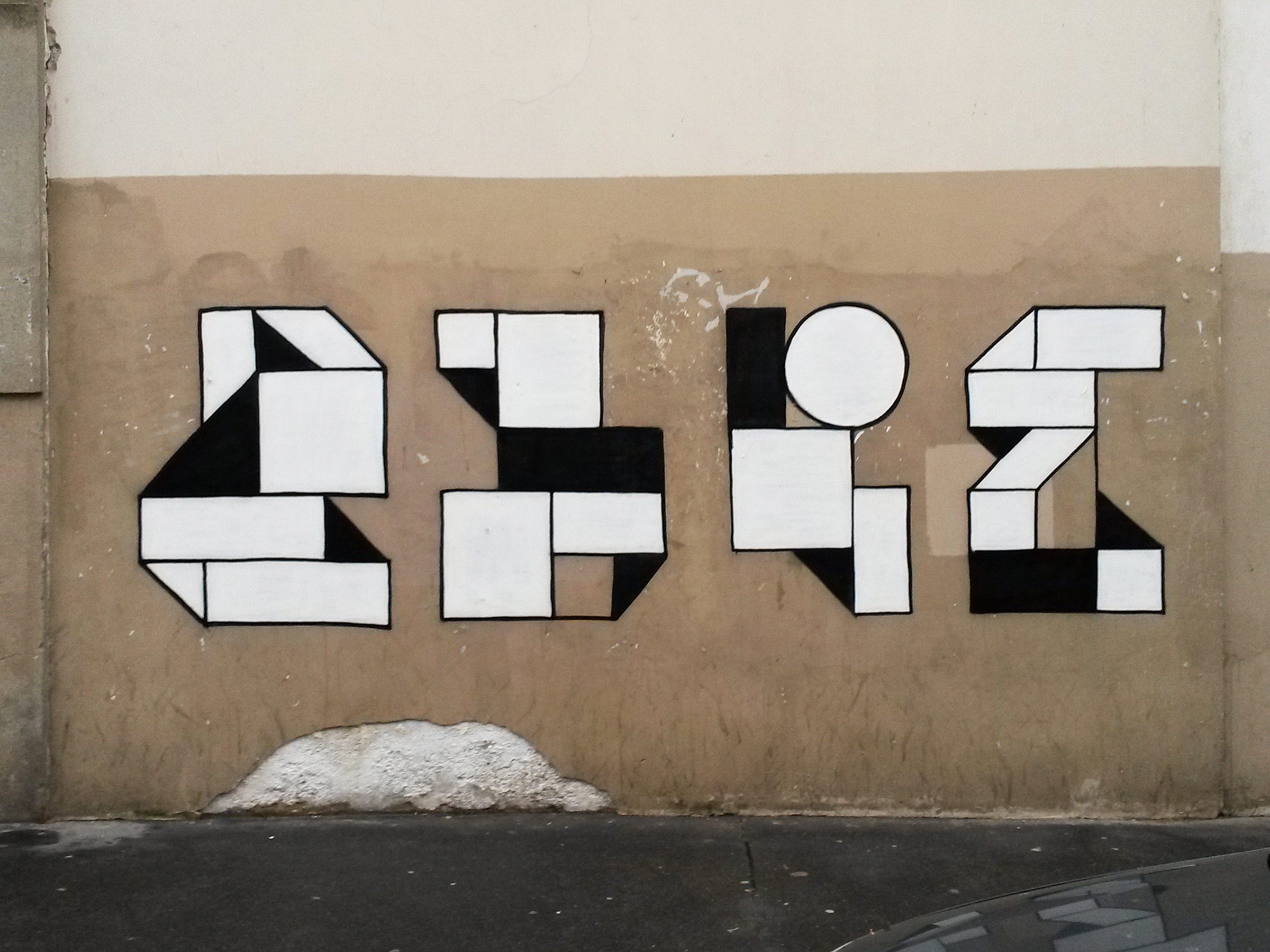
In 2012, you started your series Abstract Alphabet. Why did you come back to letters for your abstract works?
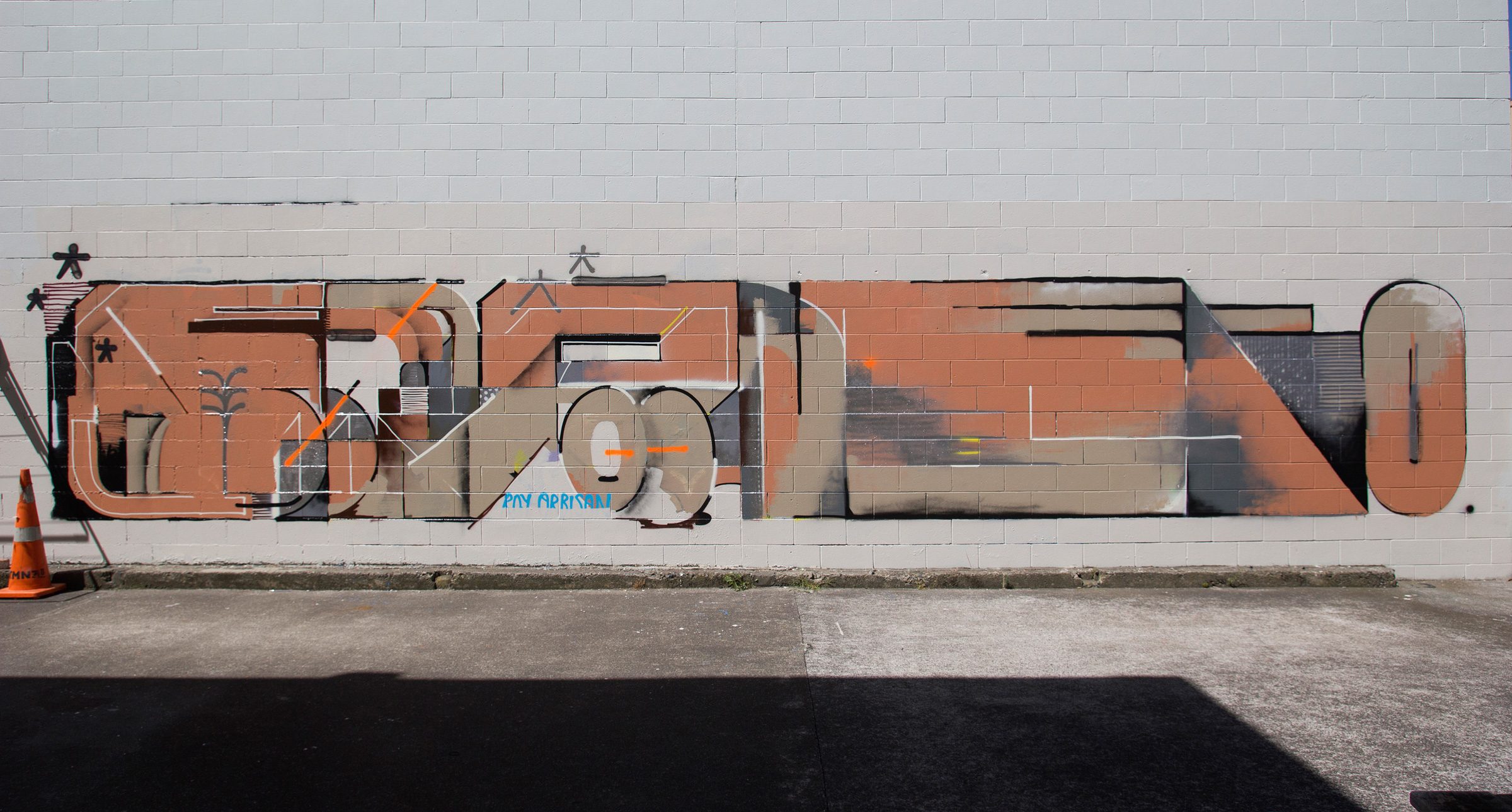
Letters, which I have never stopped exploring, lie at the foundation of my abstract practice, just like the faces. It was through their hybridization that I developed a compositional logic that provided me with a structure both solid and personal.
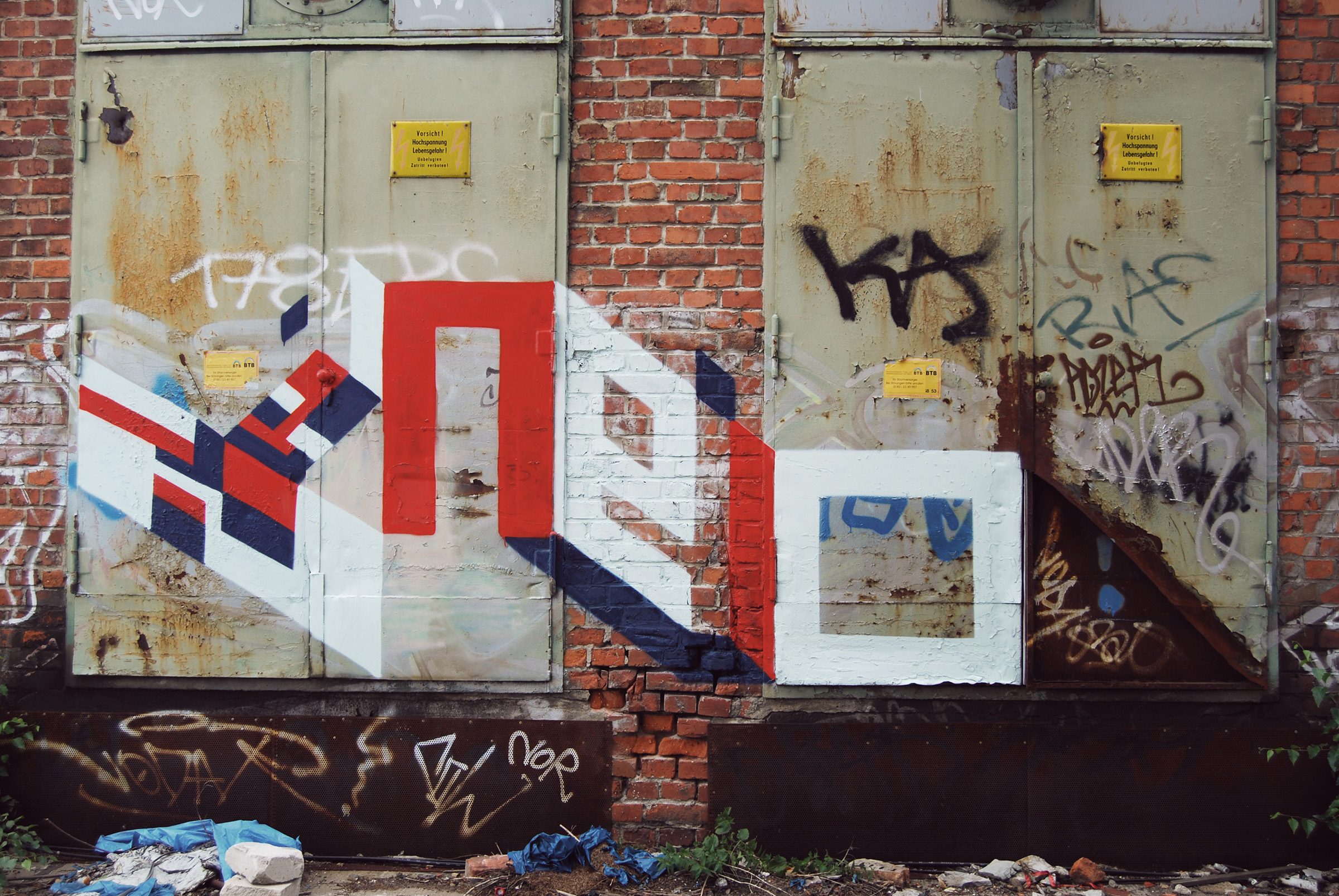
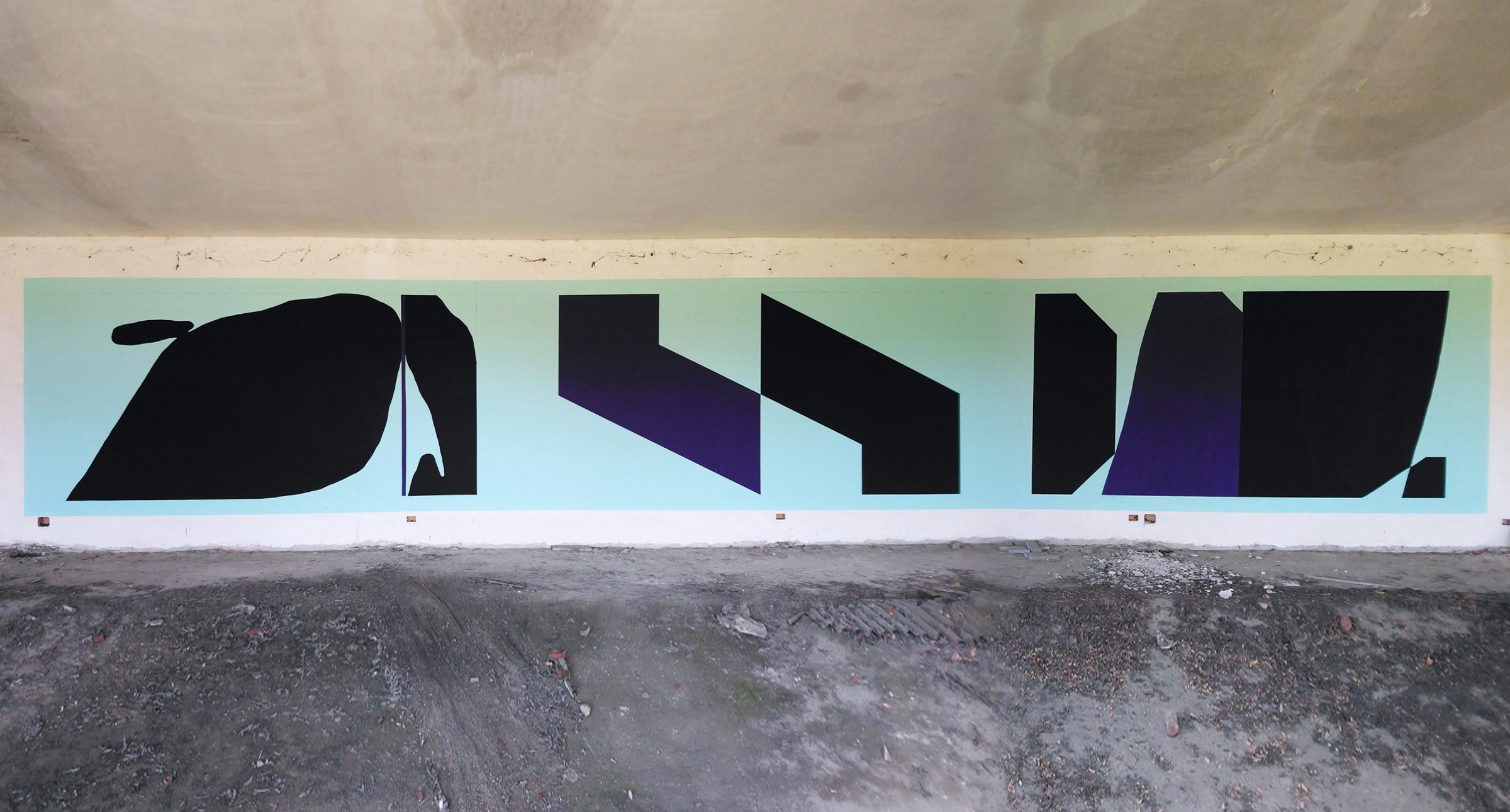
My geometric letterforms followed a similar principle of interdependence as the interlinked faces: they connected through a specific use of oblique perspective. Two letters could share the same perspectival structure yet be perceived differently, creating almost “Escher-like” spaces. This oblique perspective introduced diagonals that enriched the horizontals, verticals, and pure curves derived from the faces.
Between 2010 and 2012, when I sought to condense the fusion between letters and faces to its essence, I retained only these structural elements. They became my compositional grid. This shift allowed me to intensify the dialogue with volume and architecture while gradually detaching from figuration. The faces became unnecessary, as their symbolic meaning, the idea of interconnection, remained embedded in the continuity of the structures. The Abstract Alphabet series emerged from this process, progressively asserting itself as my visual language.
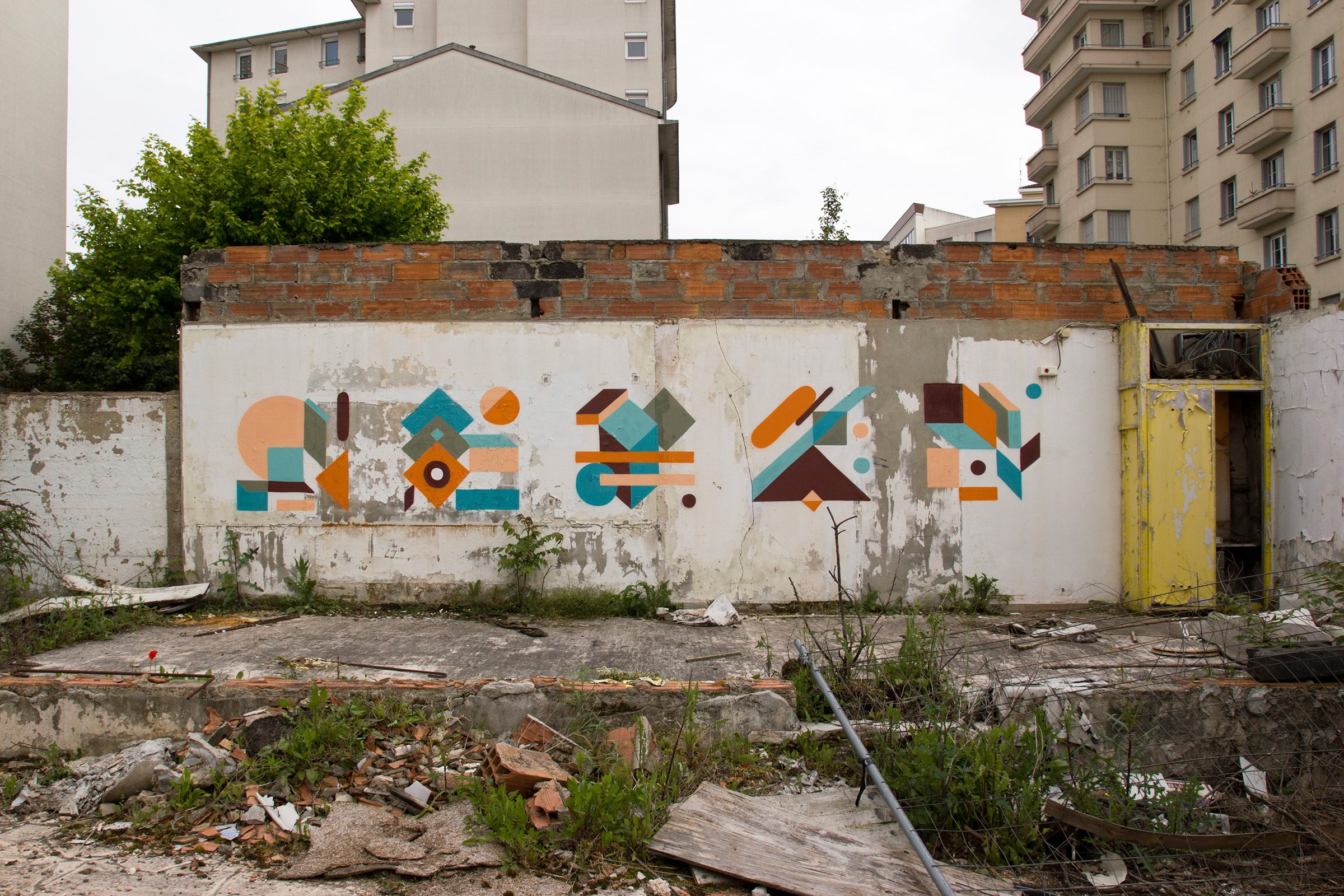
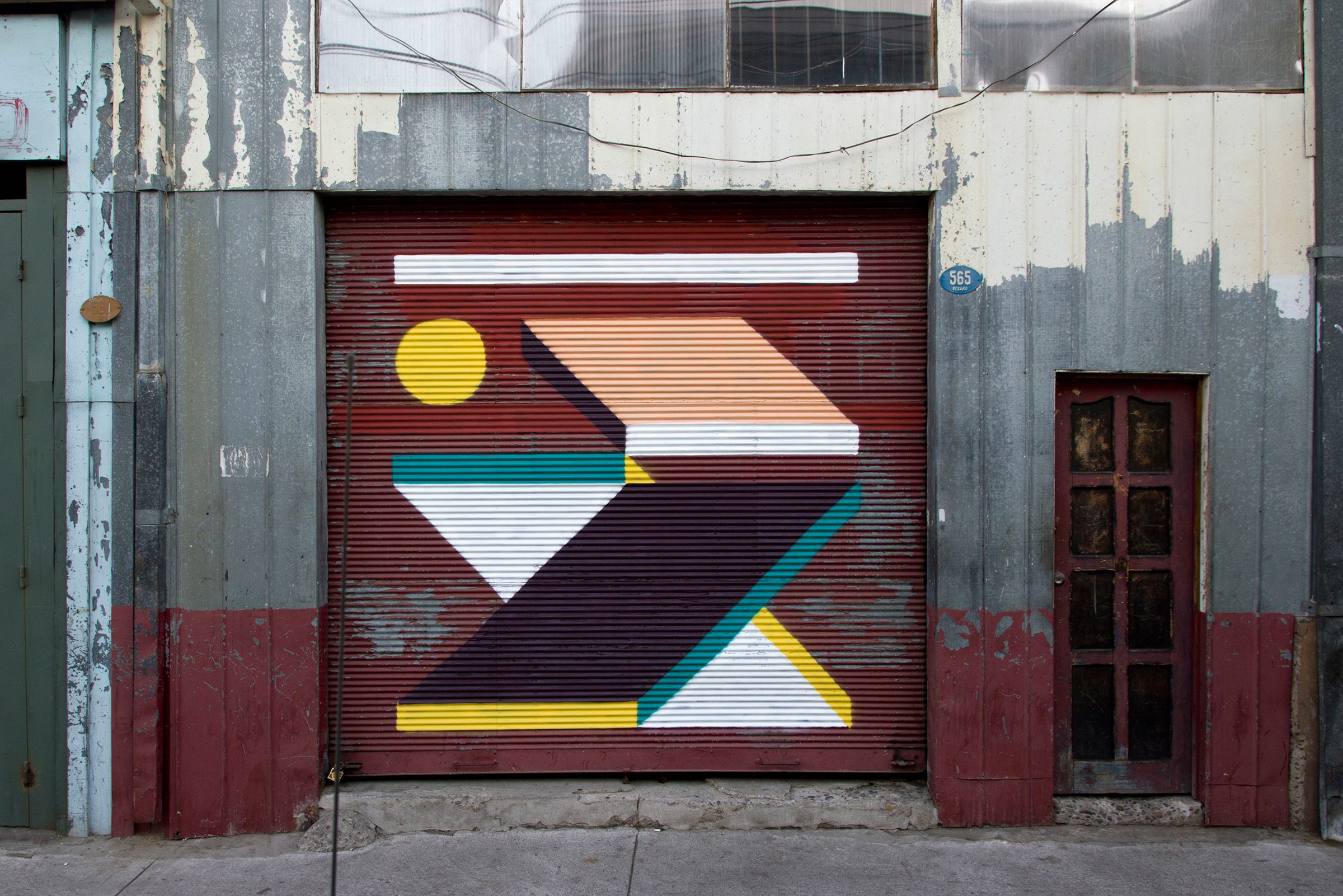
A few years earlier, I had discovered that neliö means “square” in Finnish. By adopting this elementary shape as the structural boundary of my alphabet, I no longer needed letters to write my name, it remained symbolically embedded in the very format of the work. This enabled me to maintain a link to my graffiti roots while moving away from traditional lettering. At the same time, it opened the work toward a more universal dimension and situated it within a broader art historical context, notably through a reference to Kazimir Malevich’s Black Square, often regarded as one of the founding gestures of abstract painting.
The conceptualisation of Abstract Alphabet truly took shape during the preparation of my exhibition Babel at Galerie B15 in Copenhagen in 2012. There, I deepened the connections between language, humanity, nature, and architecture, themes that had already been structuring my work.
At that time, I was also drawn to Mayan symbols and hieroglyphs. I was seeking to develop an autonomous visual language, an evolving abstract alphabet, capable of moving beyond the Latin letter toward something more universal, yet also more mysterious.
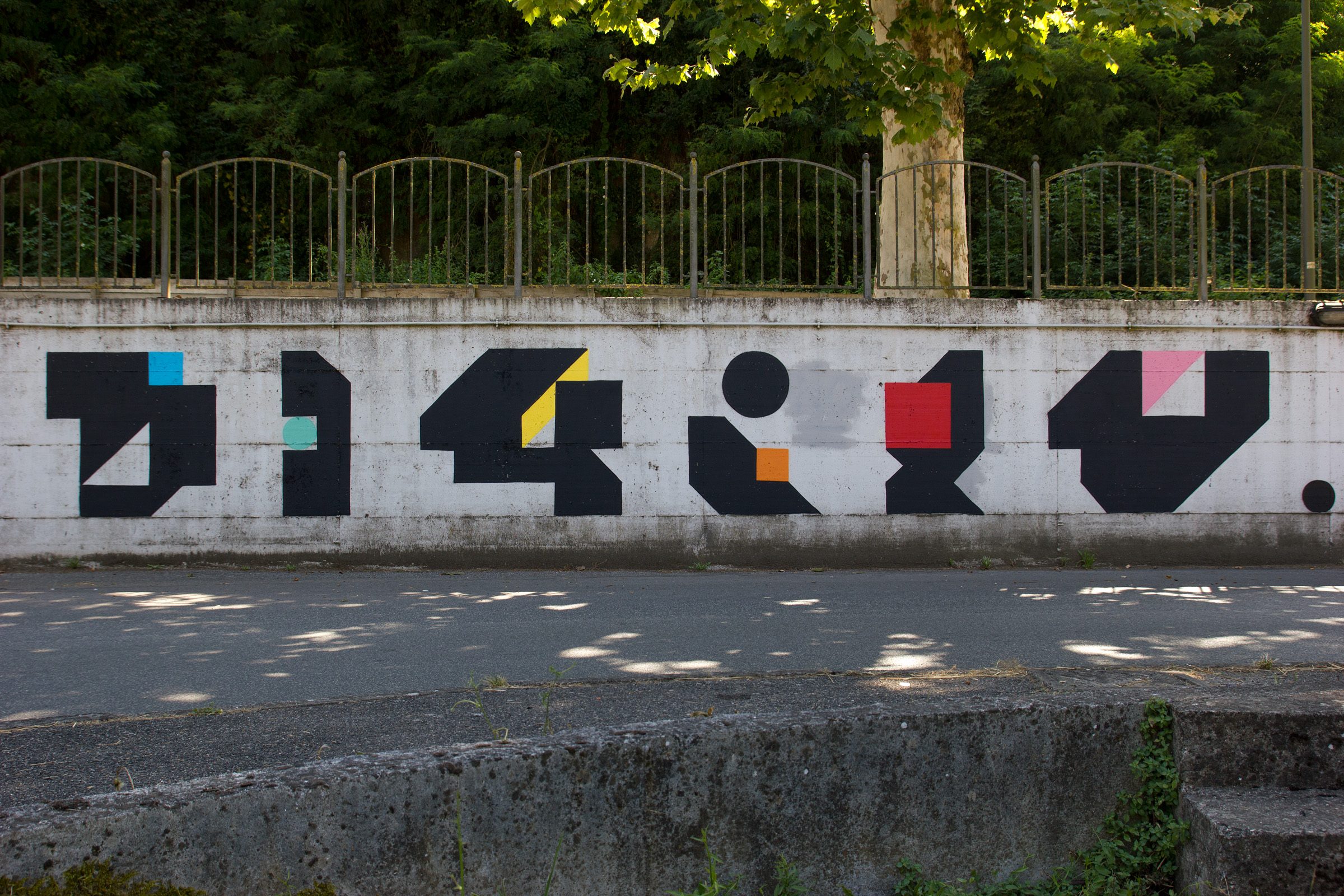
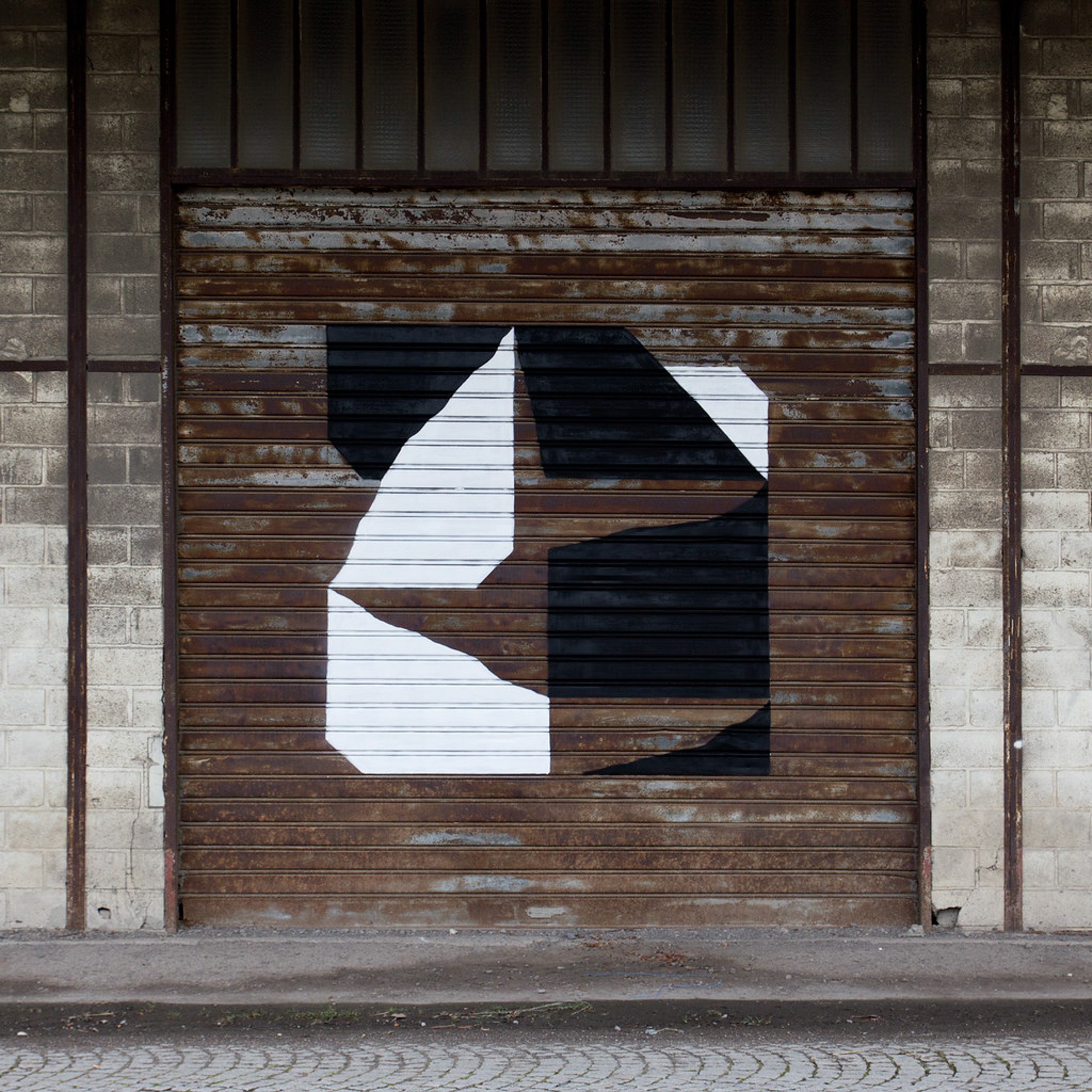
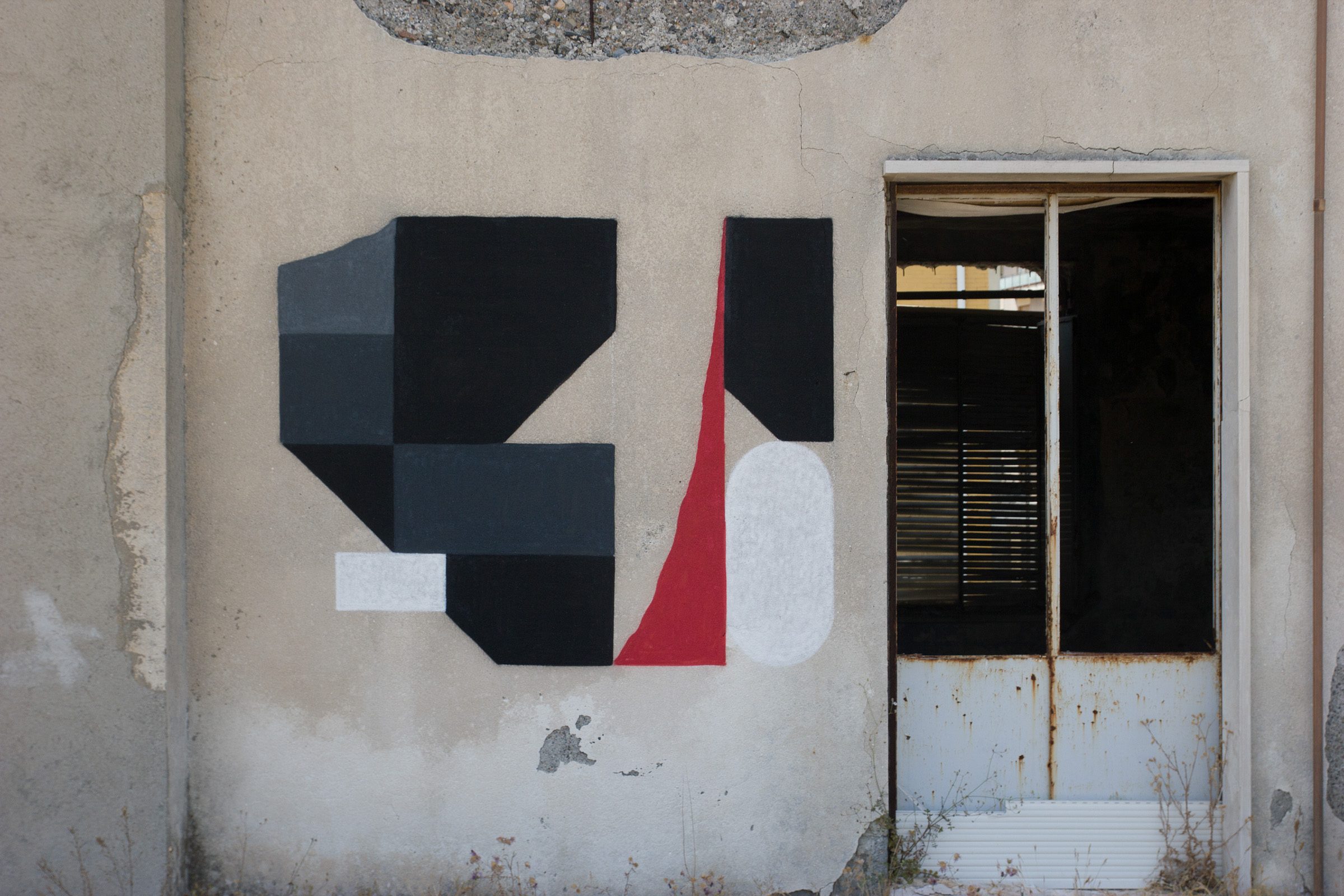
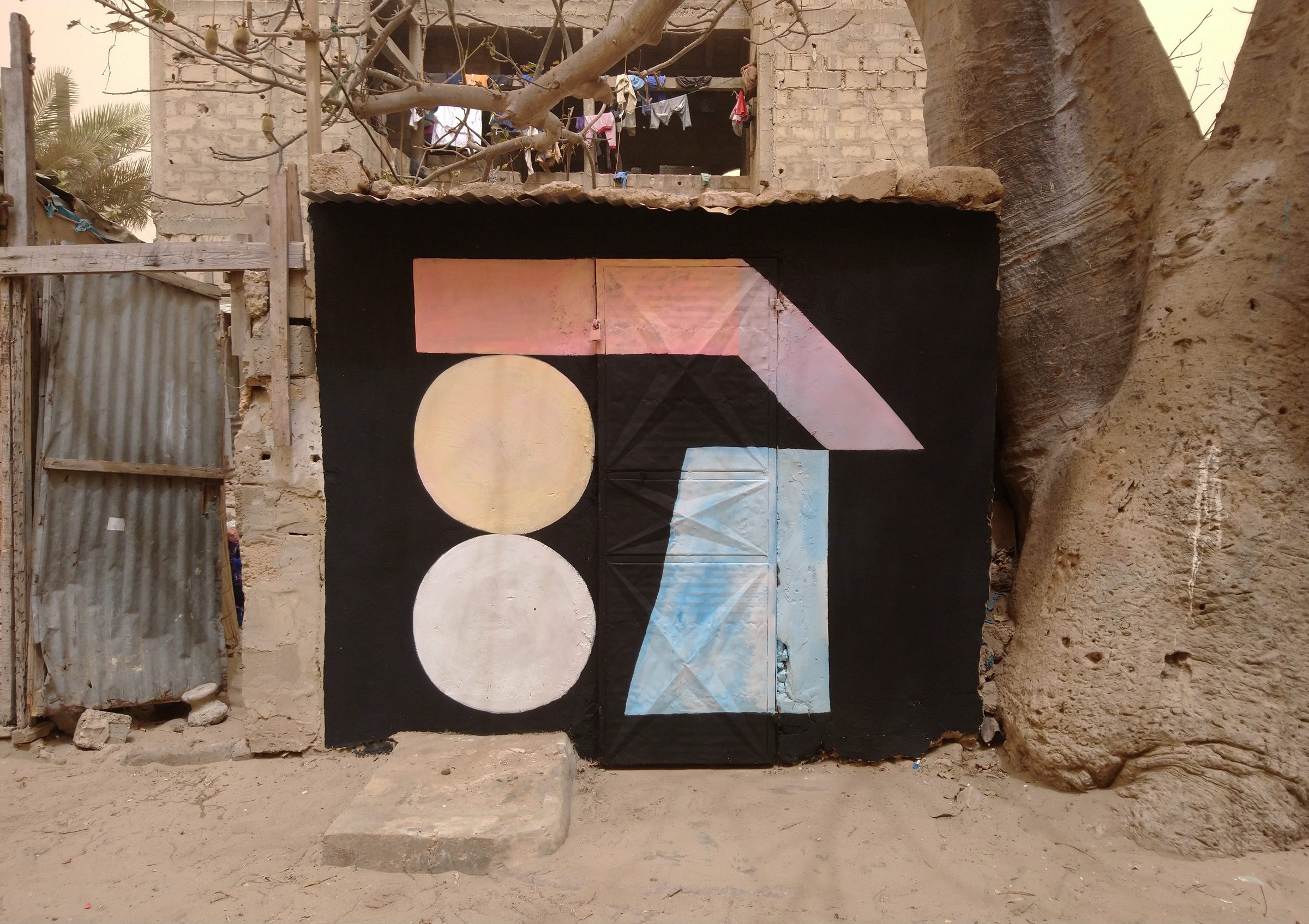
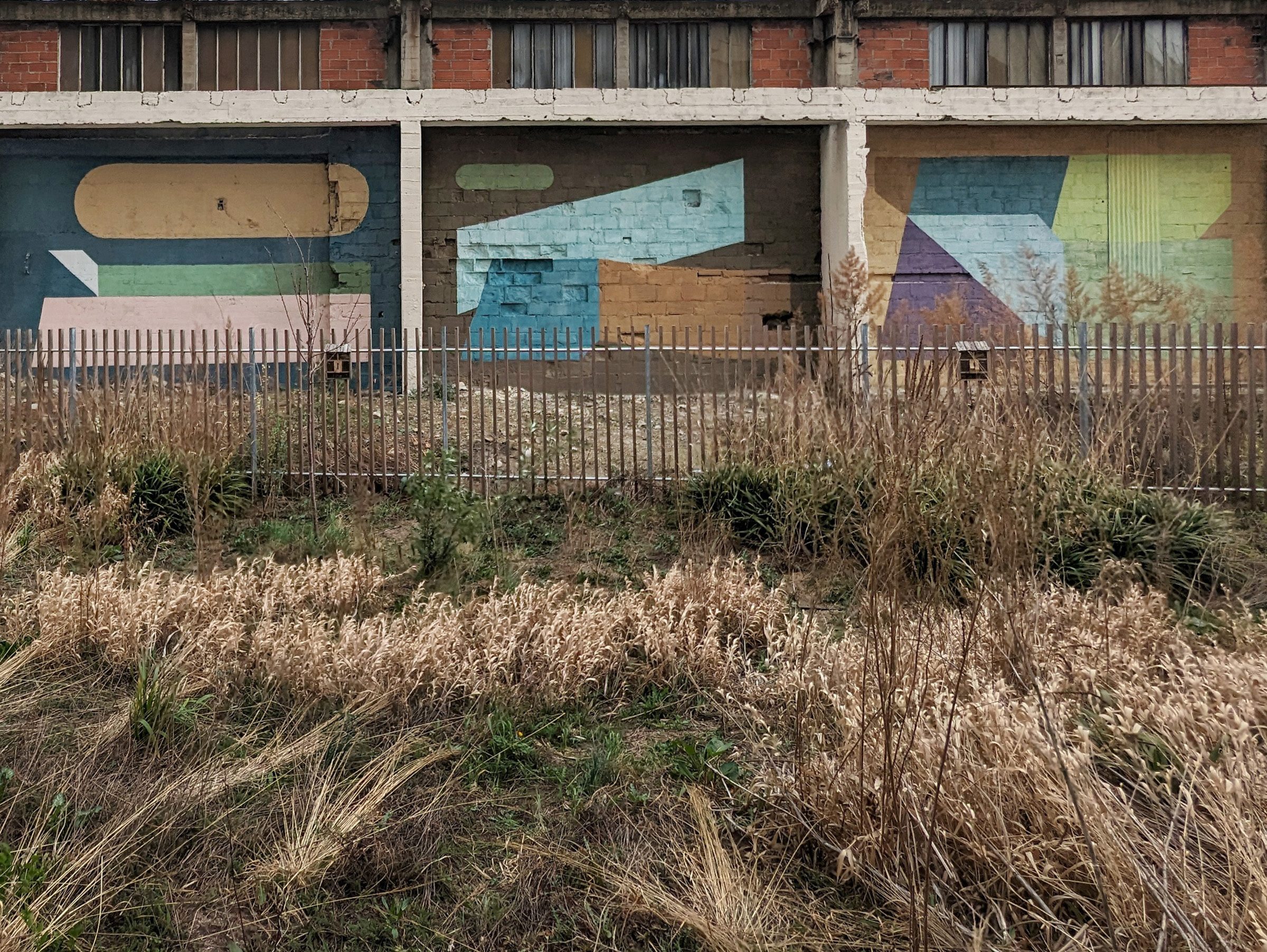
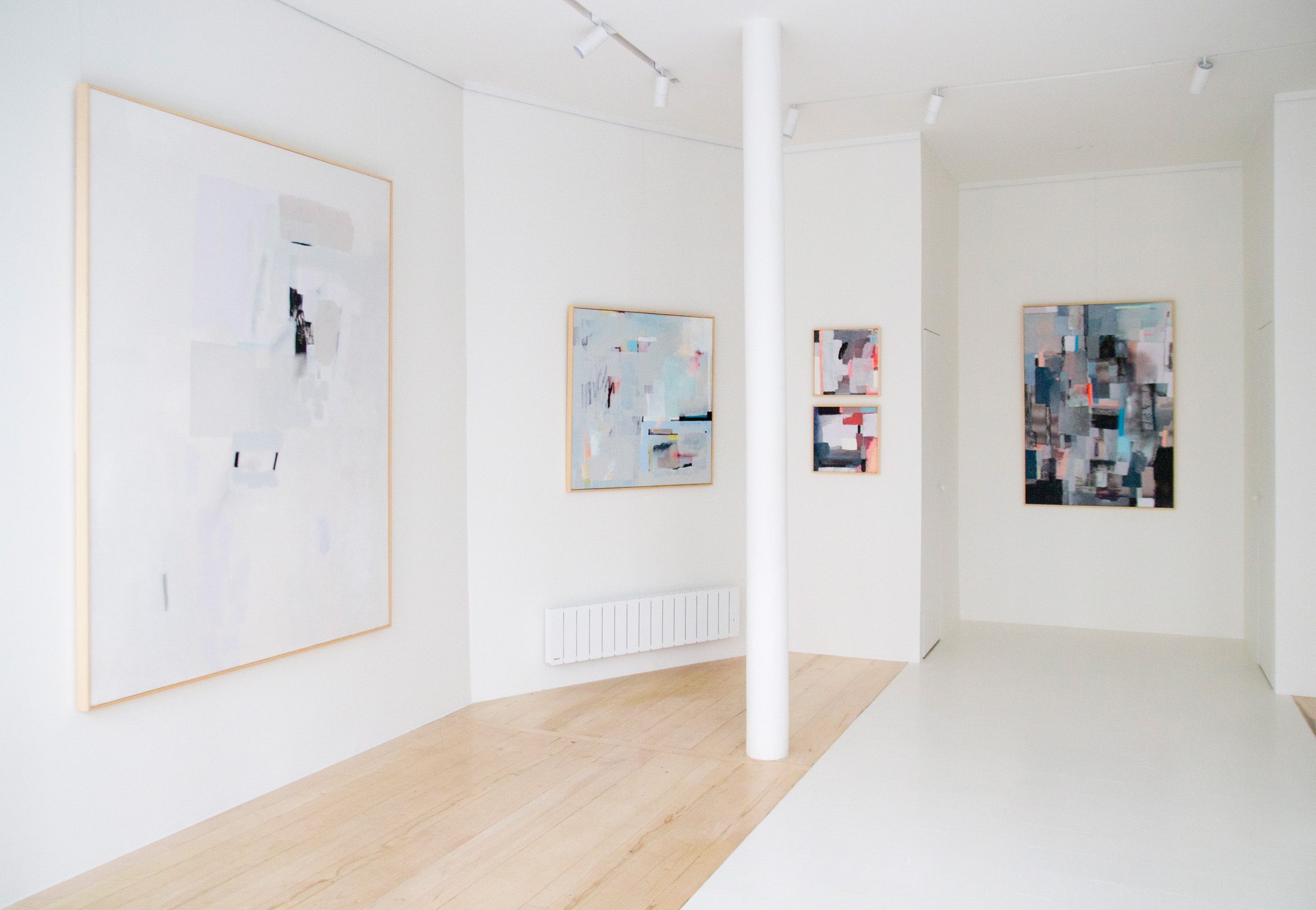
You started to develop works of the series Abstract Expressionism from 2011 on. From geometric shapes you evolved towards more open undefined forms, like colour fields. Painting more freestyle with only coloured surfaces, textures within the fields you seem to work here more on colour. Can you describe this approach and the link to Abstract Expressionism?
Abstract Expressionism constitutes the second major axis of my work. It developed in parallel, and almost in opposition, to my constructive logic based on the juxtaposition of primary geometric forms within highly controlled compositions. I felt the need to open up that system, to move toward less defined forms. At first, it was not so much about working on colour as about exploring the formless, to find an organic alternative to my usual structure.
The abandoned places where I was intervening strongly influenced this evolution. I was drawn to the contrast between my geometric flat areas and the textures shaped by time, erosion, and nature. In those spaces, there was a tension between rigidity and transformation that fascinated me.
When I tried to transpose that dimension into my studio paintings, the results felt artificial, too constructed. The textures seemed false because they did not originate from a genuine inner process. I then considered reversing the process I had been using until then; first as a form of deconstruction, and ultimately as the need to start again from zero within an opposing system.
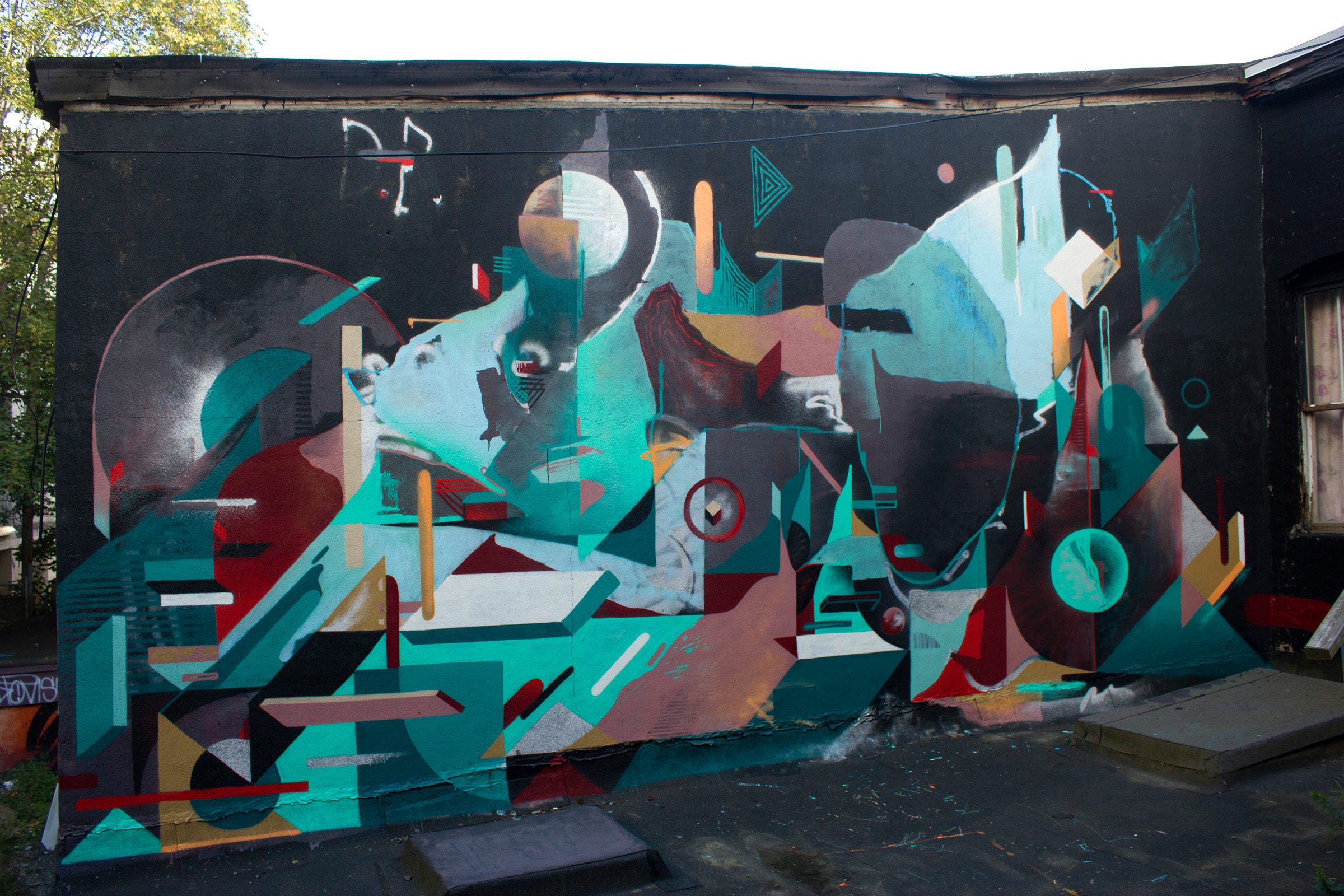
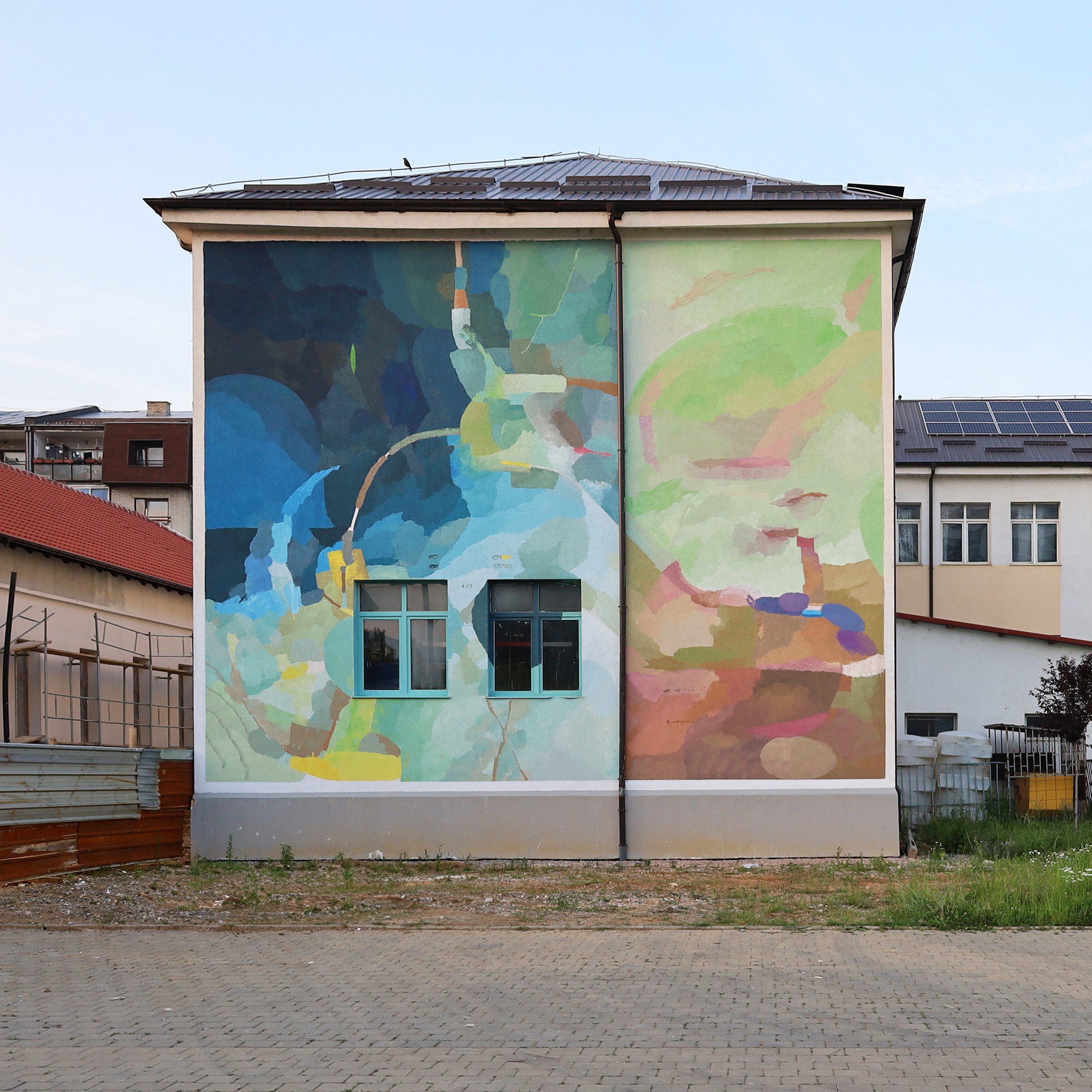
I experimented with various “unlearning” strategies: painting with my left hand, using a long stick, working very quickly, sometimes without looking. The aim was to subvert my automatisms in order to create new ones, to leave behind structured logic and open myself to something more chaotic, more unconscious, in search of the unknown. A first breakthrough occurred in Lisbon in 2009, when I began producing deliberately “bad” graffiti in an anti-style spirit. The next day, I did not fully stand by the results, yet I appreciated the raw energy that emerged from them.
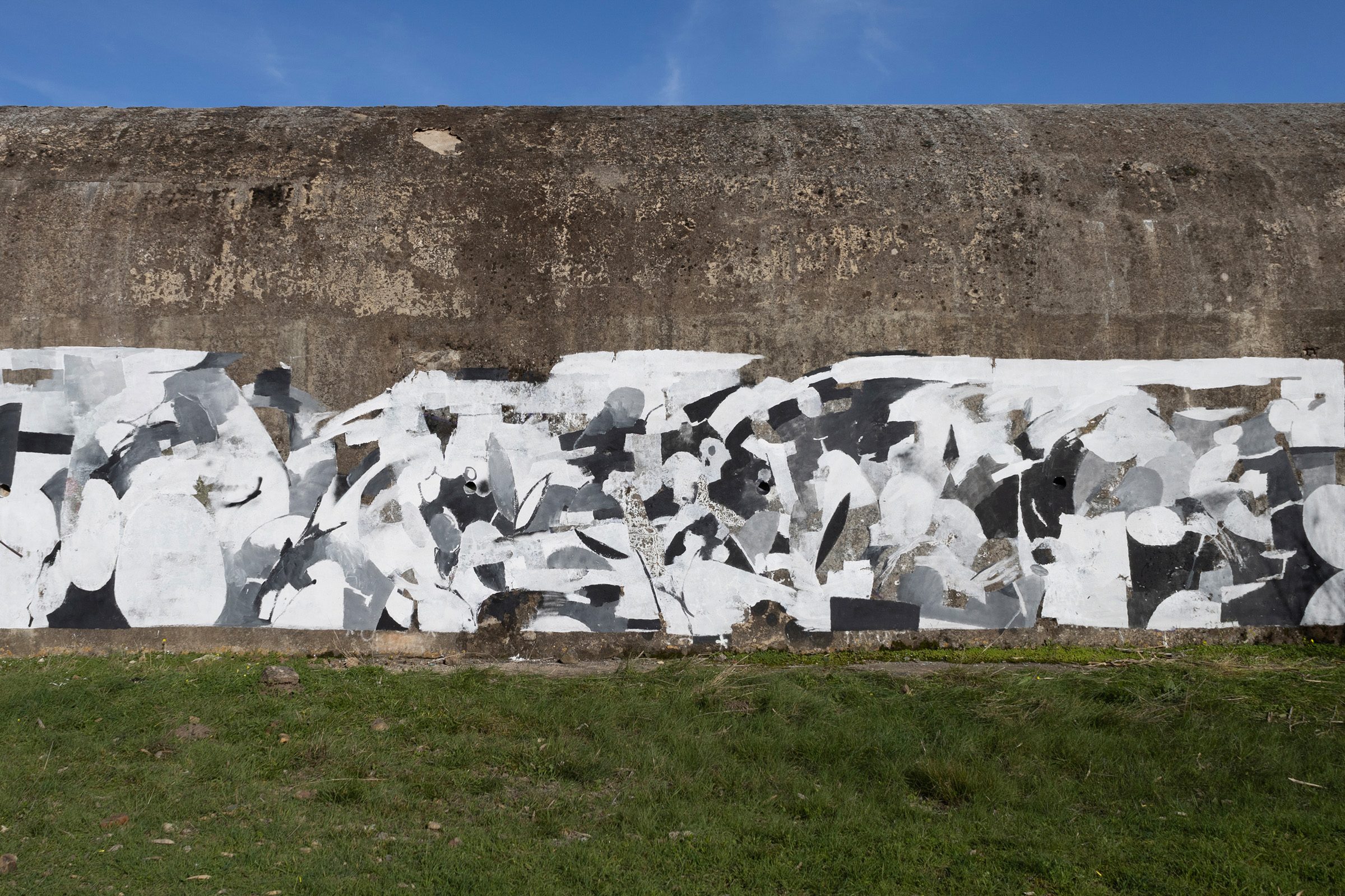
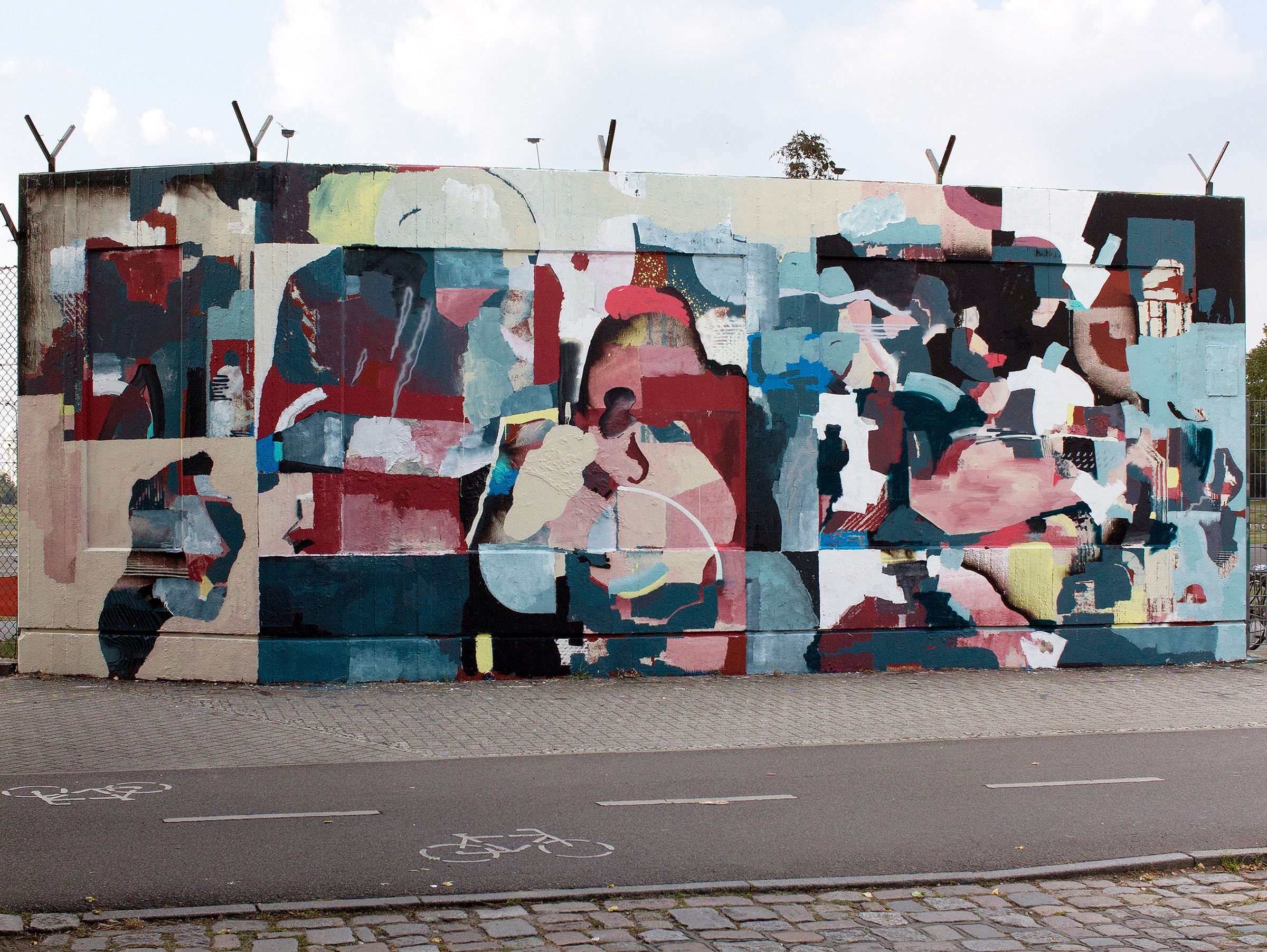
The most decisive moment was my encounter with Duncan Passmore. We started painting together in 2010. After an initial phase of juxtaposing our styles, a more radical approach emerged in 2011 during a night painting session on a rooftop in Berlin. We decided to truly merge our practices, without worrying about the final outcome. The darkness prevented us from clearly seeing what we were doing, we focused on action and movement, searching for genuine release. That total freedom, that detachment from individual responsibility, was transformative. Our subsequent collaborations gradually constructed a kind of shared alter ego. Despite the unpredictability of certain decisions, an underlying logic remained: a form of visual ping-pong in which each gesture by one conditioned the other’s response. This maintained a certain coherence while pushing the painting into unknown territories.
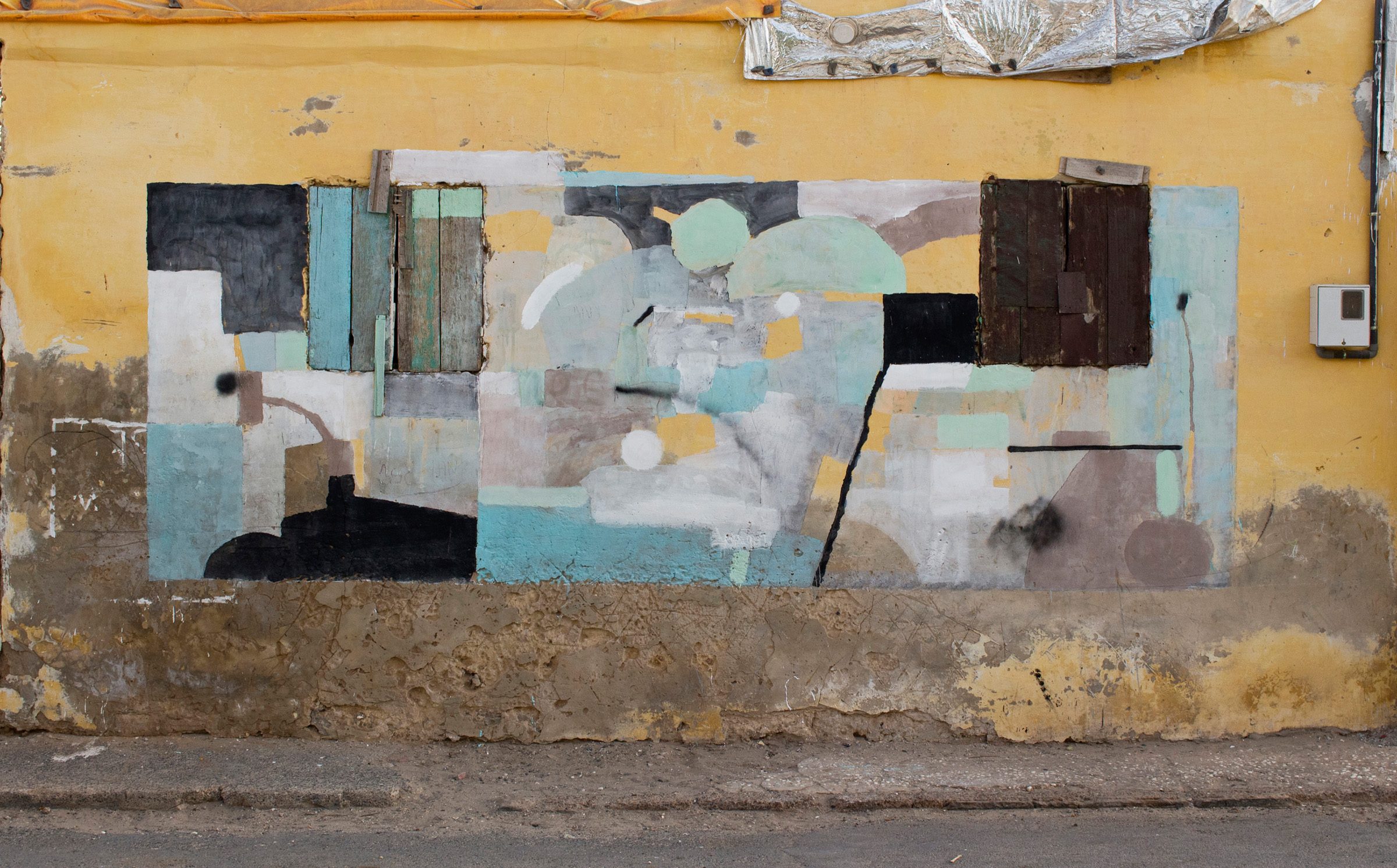
When working alone in the studio within this expressionist momentum, I sought to transpose that principle: to paint as if I were in dialogue with another part of myself, with my unconscious. Speed became essential, not only in execution but also in decision-making. I worked on several canvases simultaneously, moving from one to another without thinking. This spontaneity preserved the authenticity of my language while infusing it with a rawer energy, allowing space for accident and the unexpected.
In this context, Buff’s process played a central role; it became a true decision-making tool. Each time I stepped back, the question was simple: what should remain, and what should disappear? The painting progressed through successive additions and removals until a certain harmony emerged from the chaos.
The possibilities within this process are endless, from total saturation to almost complete erasure, each stage potentially becoming the final result. This method is both exhilarating and exhausting, as it demands constant questioning.
For me, the connection to Abstract Expressionism movement lies in the importance given to process, gesture, and inner necessity. The painting does not seek to illustrate a preconceived idea; it is constructed through action, between loss of control and conscious decision, between chaos and structure.
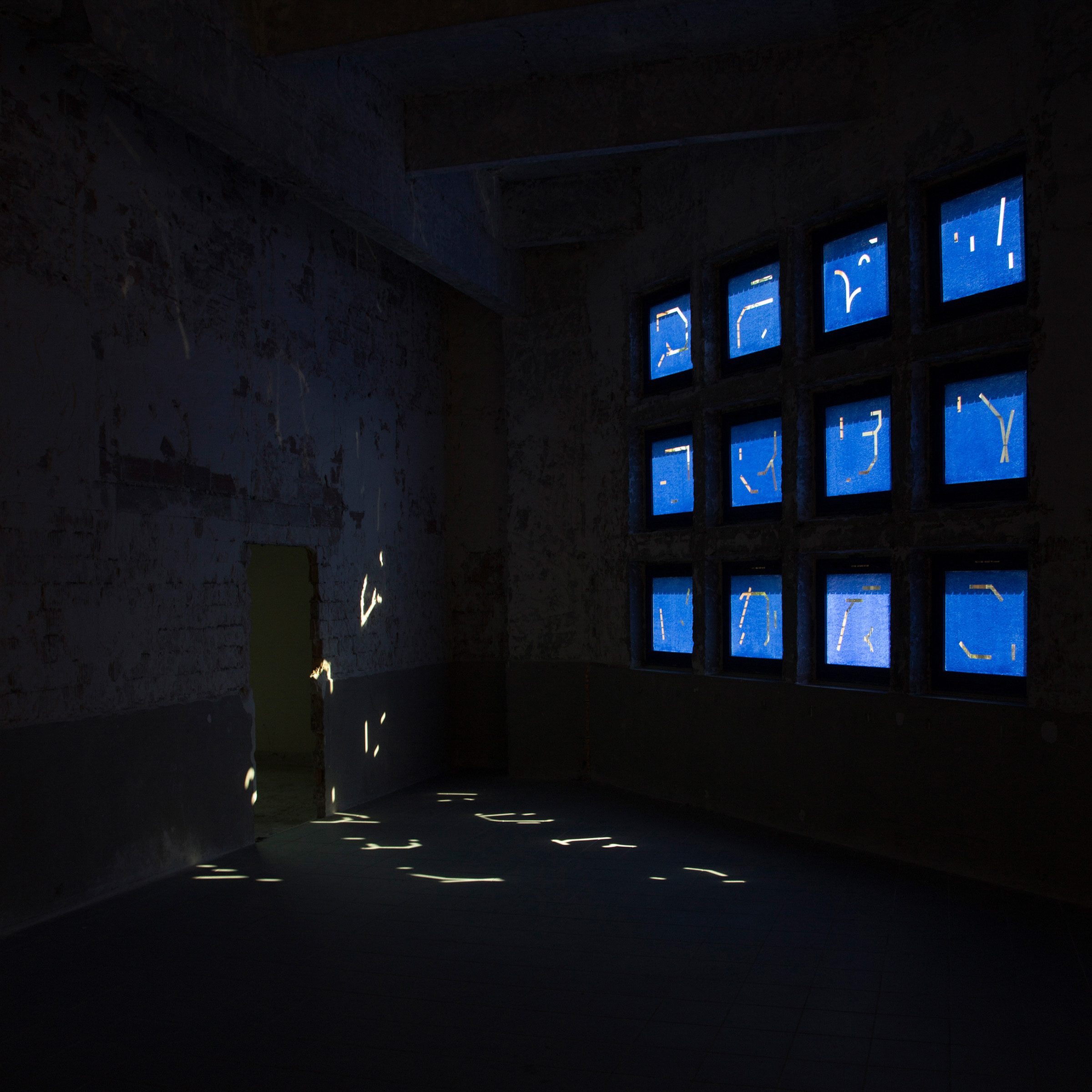
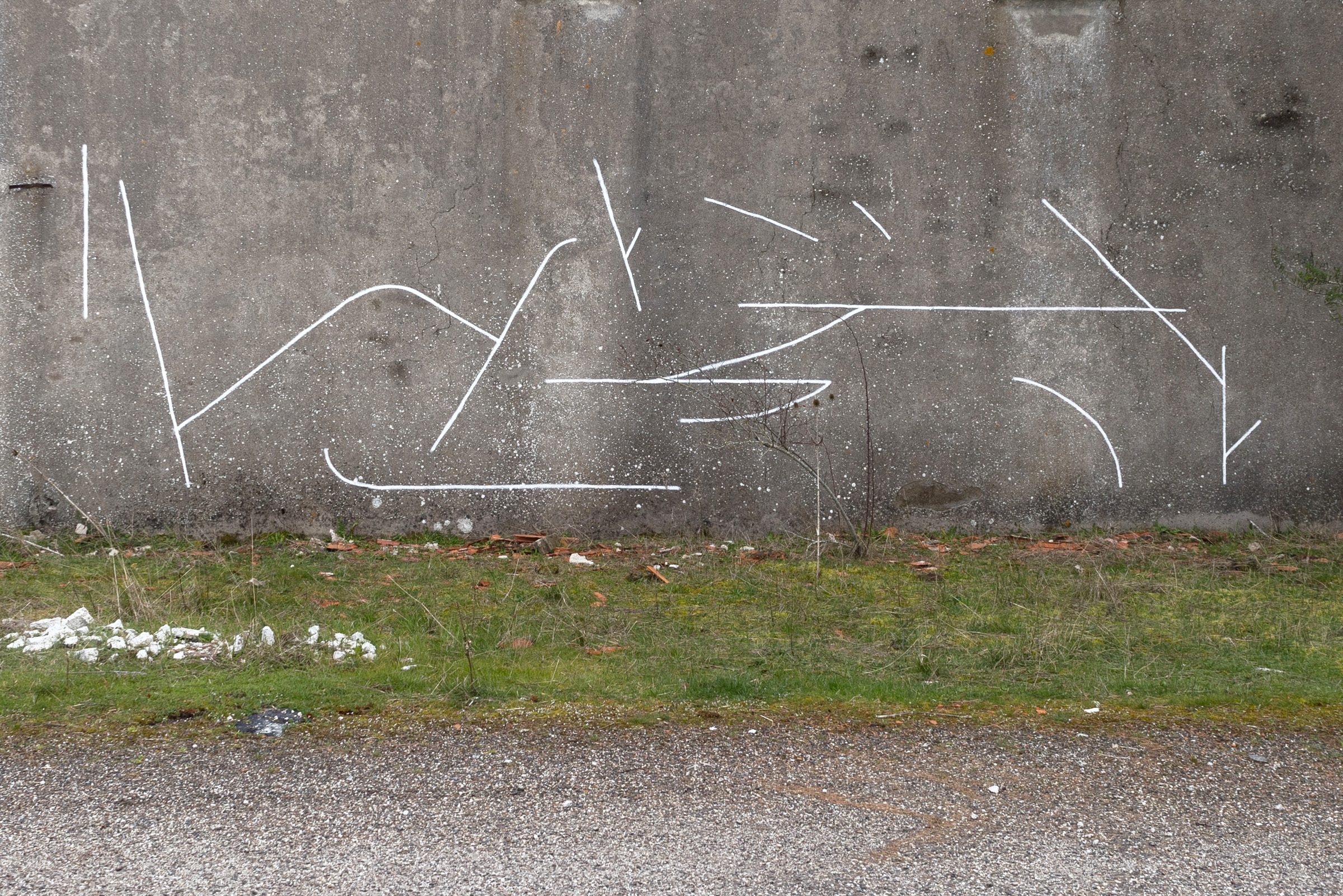
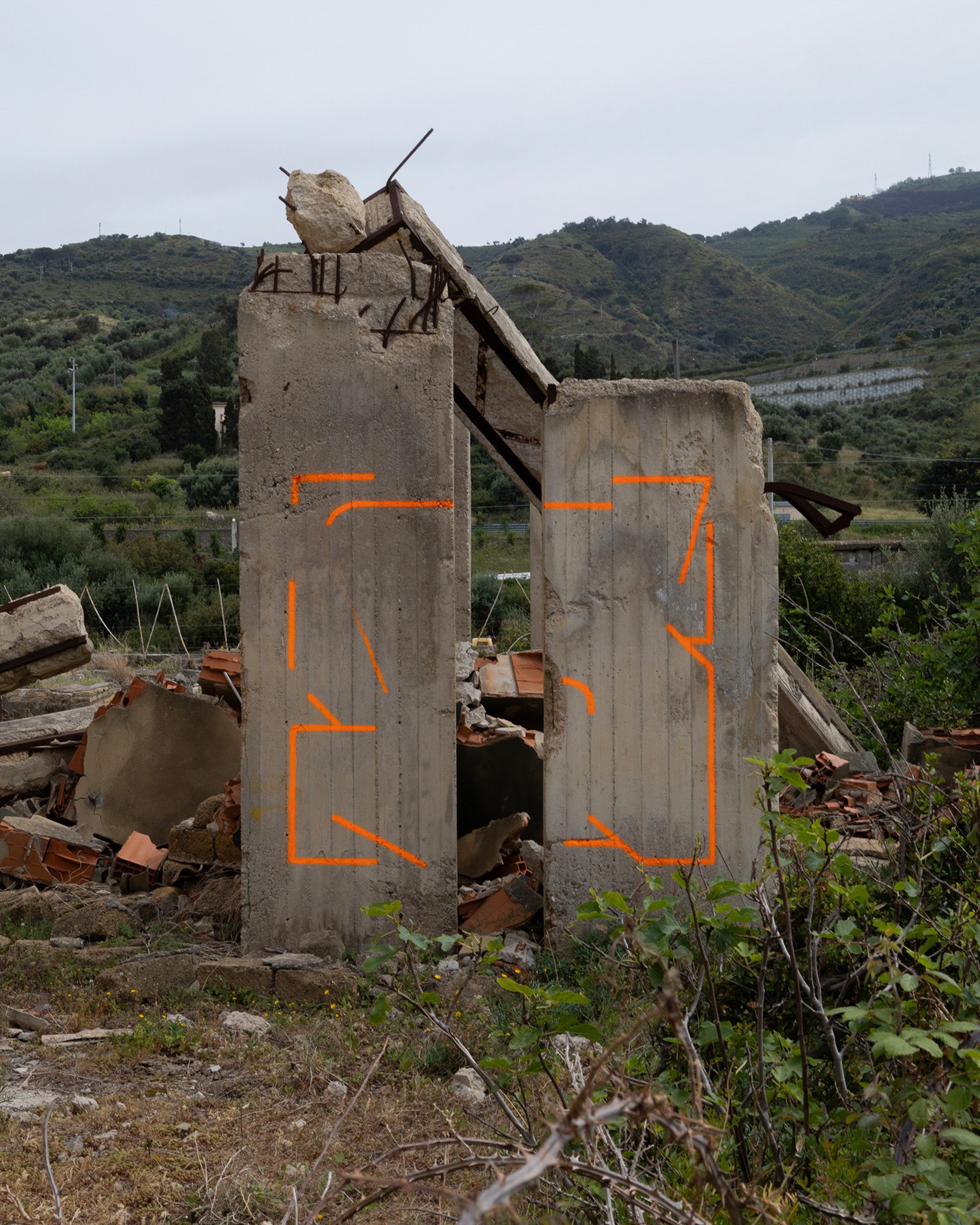
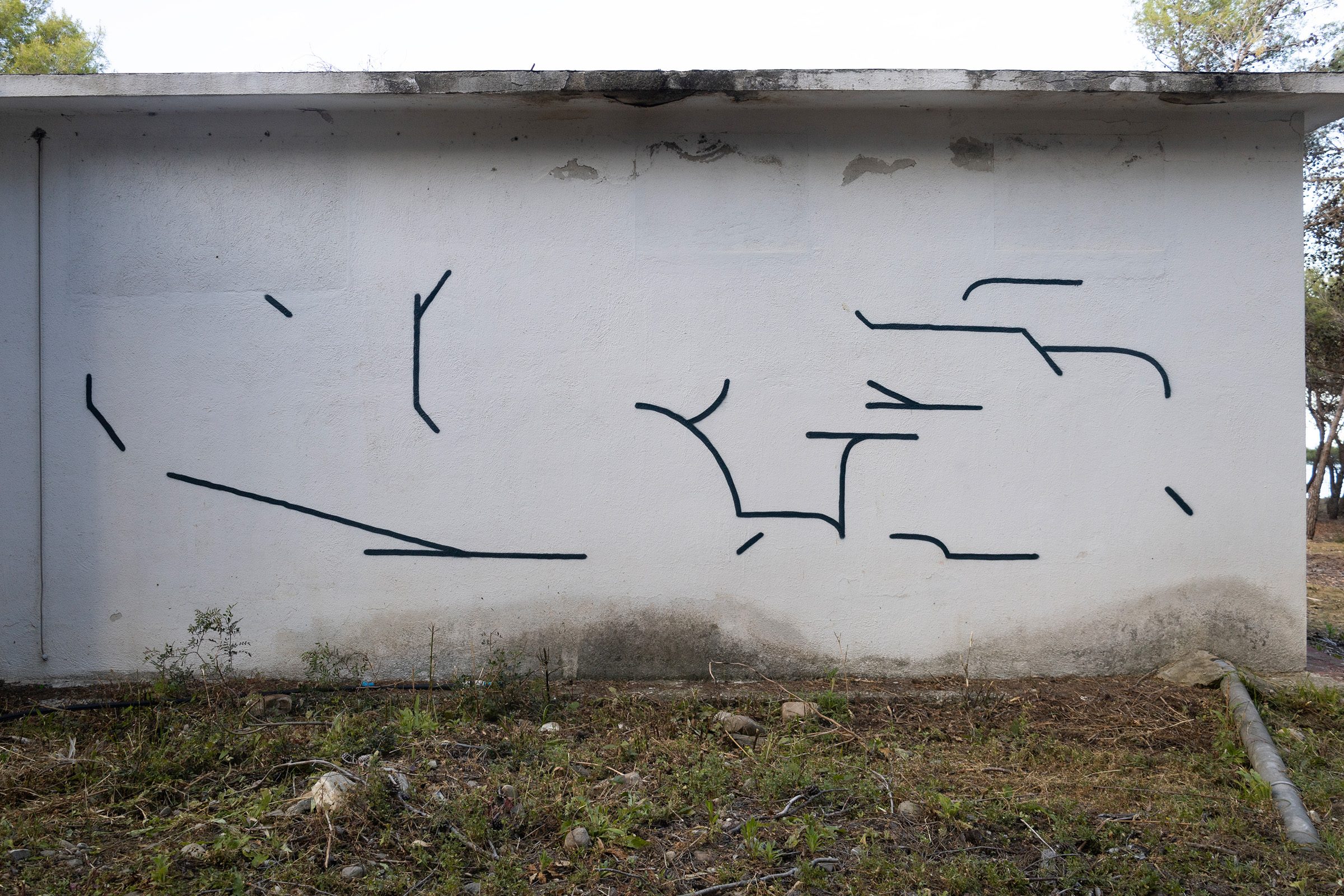
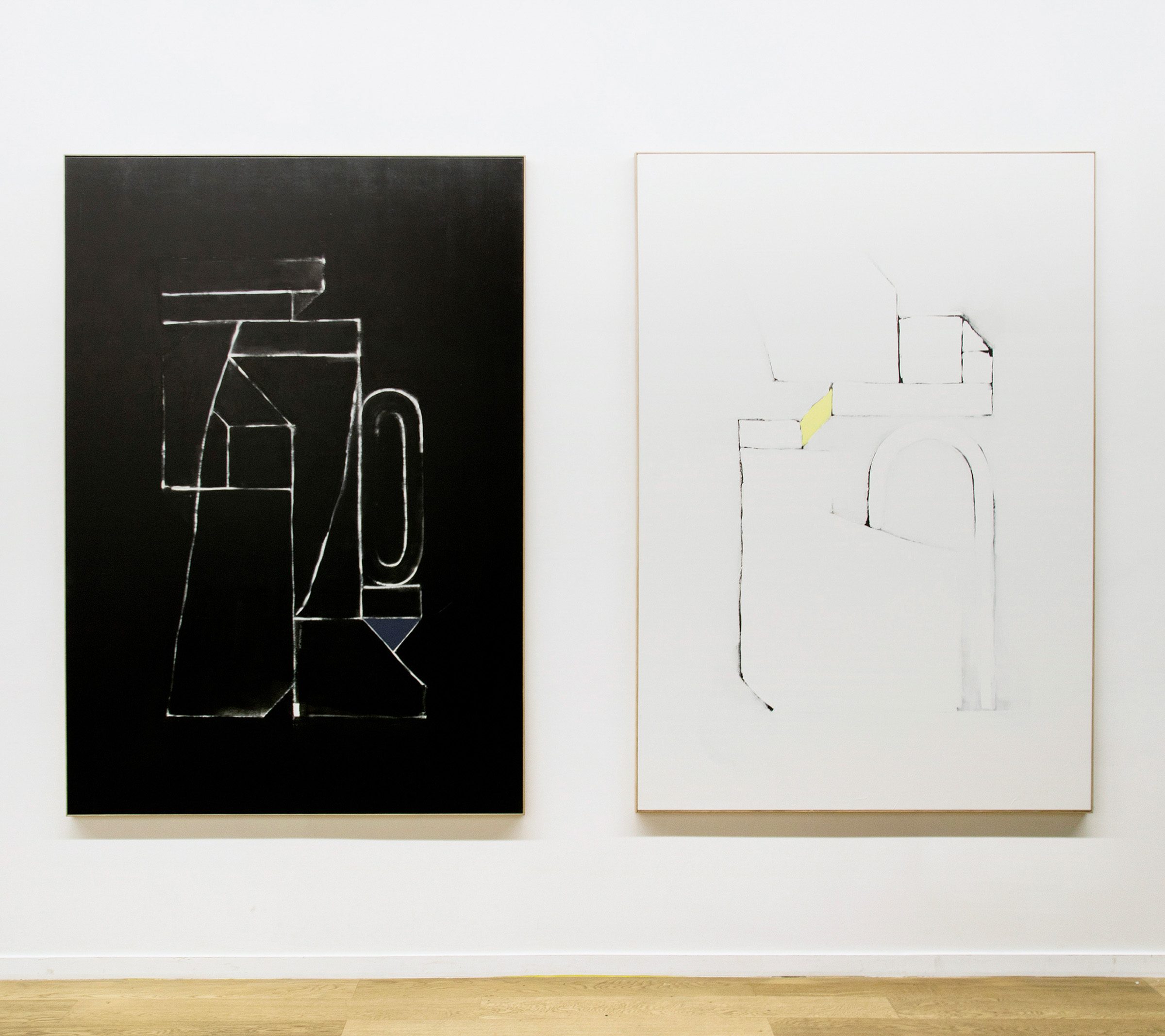
The series Erased structures (2015-now) is maybe the most graphic and minimalistic kind of work in your different series, painting only some lines of a shape, of a structure, like leftovers from an erased motif. How did you come to those results and how do you proceed for those works?
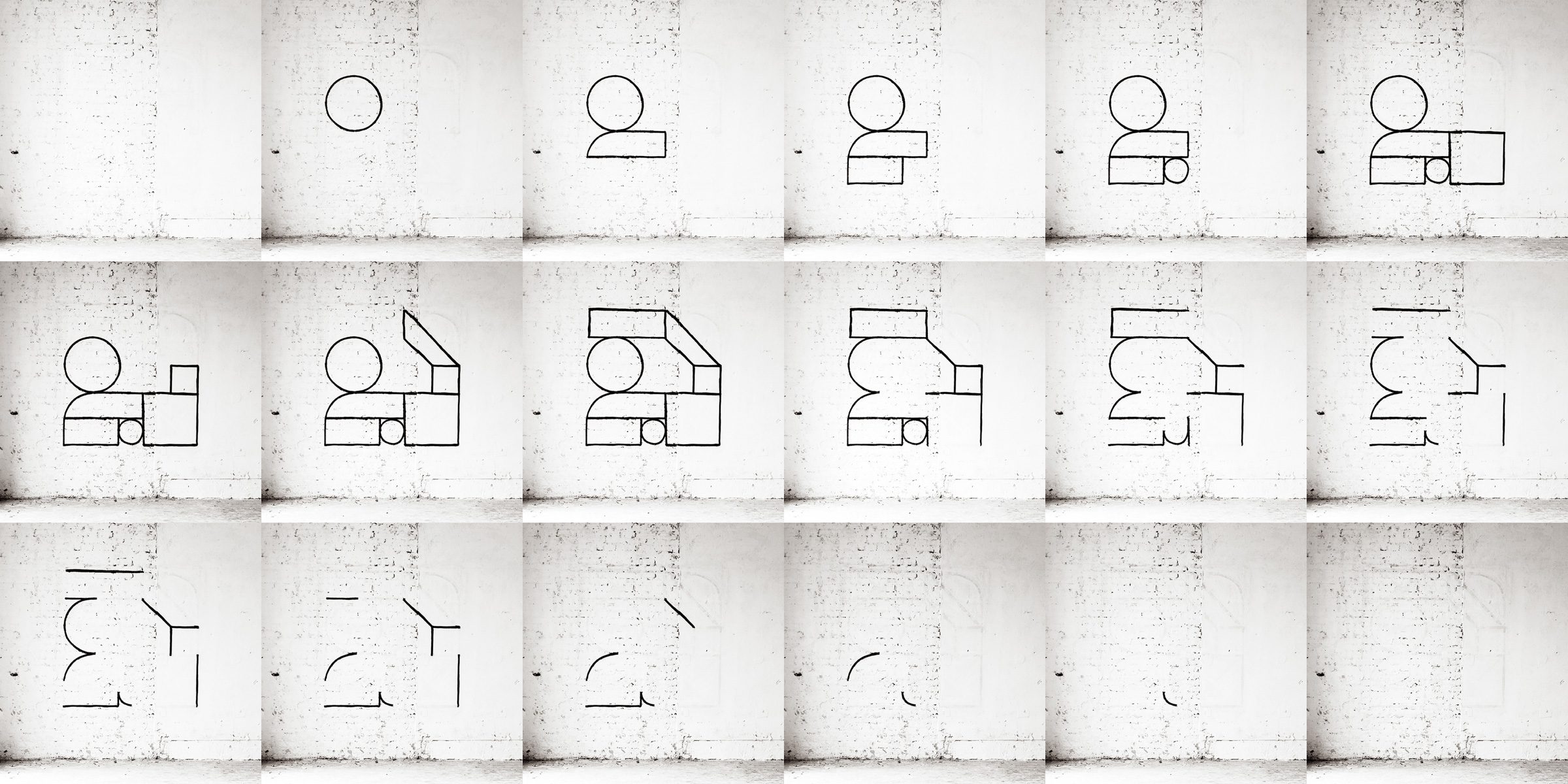
In terms of compositional logic and process, the first Erased Structures works, created in 2015 in Montreal, are drawn from the Abstract Alphabet series and from my research into minimalism through erasure, notably influenced by the Buff.
The more metaphorical inspirations come from the gradual disappearance of structures in abandoned places, where walls collapse, as well as from the effects of nature on works created outdoors, where erosion, alteration, and slow disappearance emphasize their ephemeral dimension.
Some pieces in this series are initially constructed in a fully developed form, then progressively reduced to just a few lines, or even entirely erased, while sometimes retaining the ghost of the original painting.
Other works, which I call “anticipated erasures,” function as deliberately unfinished paintings: I interrupt the composition at a certain point, without going through the actual process of erasure.
Today, the structures that make up these works are no longer influenced solely by Abstract Alphabet, but also by other series, such as my letterings or landscapes, and more broadly form part of my ongoing research into minimalism.
Another of your series is called Buff Expressionism (2015-now), combining terms of the graffiti culture and modern art. Those are in a way your abstract expressionist works that you painted over to obtain new results? How did you come up with this idea?
Buff Expressionism is a subcategory of my research within the field of Abstract Expressionism. It emerged from an analysis of my own expressionist process and from a willingness to isolate its mechanisms in order to determine its essence.
Through this reflection, I identified three main axes: speed, erasure, and inspiration drawn from nature.
With Buff Expressionism, I place emphasis on the decisive factor of erasure, through successive overlaying or removal of material. This principle opens up a field of total freedom: any experimentation becomes possible, since it can always be covered, transformed, or removed. The fear of failure disappears, instead, there is an active search for the “happy accident,” for the unforeseen. Beneath the layers of paint, experimental forms, letters, or even figurative elements may be concealed. The originality of the work is determined by the sum of these successive actions, yet its final appearance tends toward a certain homogeneity produced by the action of the Buff.
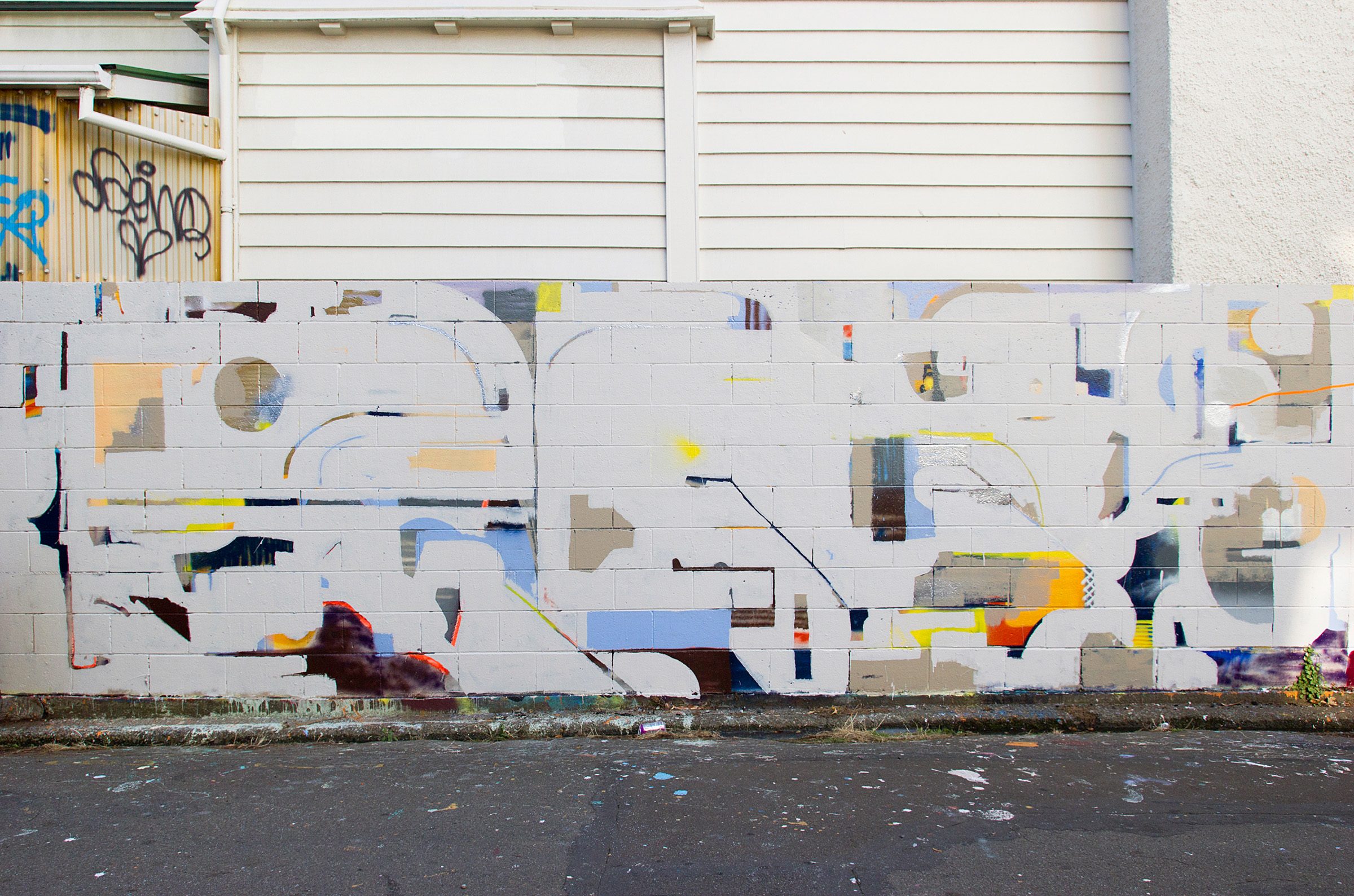
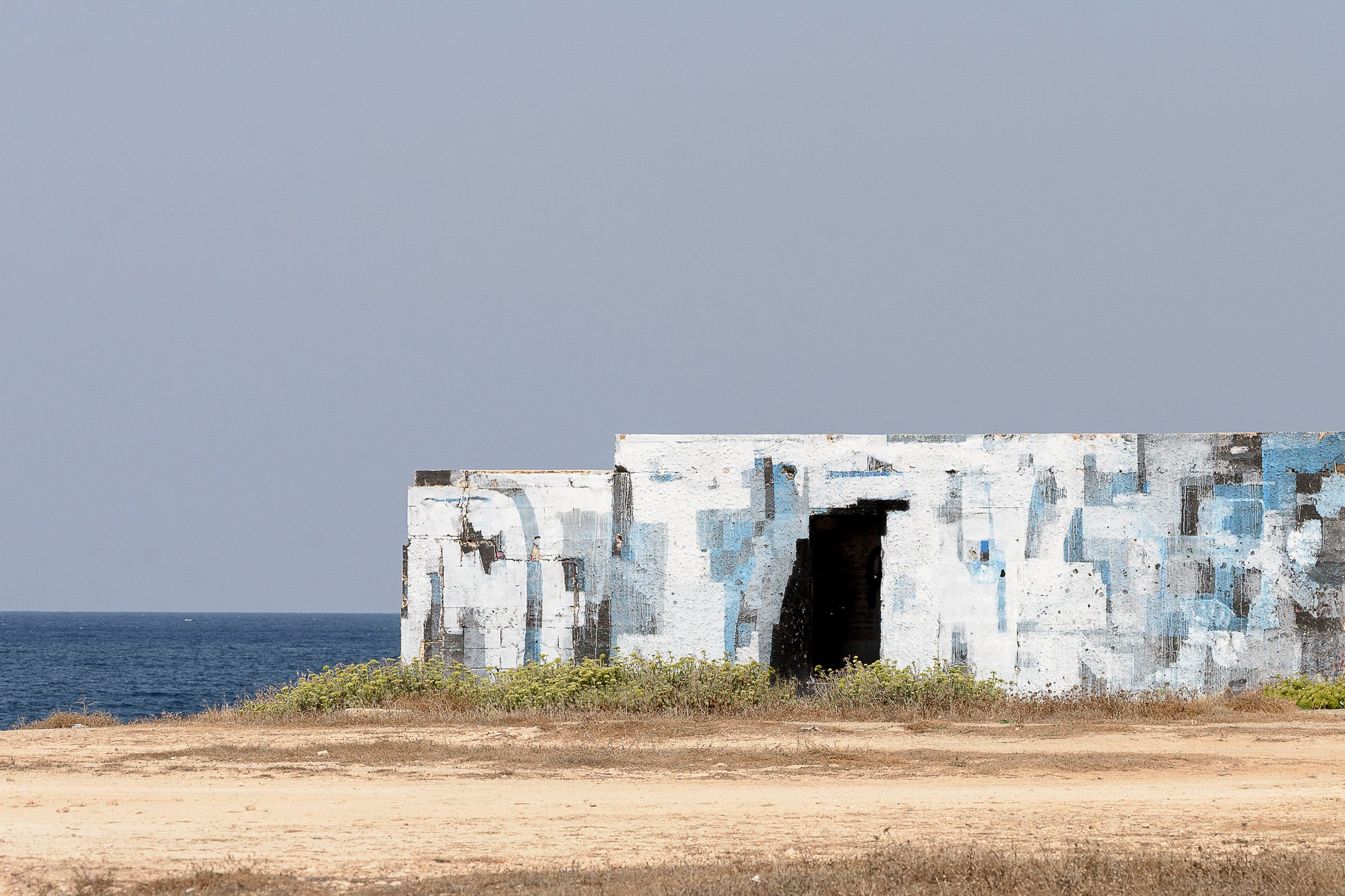
In some paintings, the Buff is even anticipated: it covers nothing, but intervenes as an autonomous gesture, almost like graffiti. It frees itself from its destructive function to become a fully creative act.
In graffiti culture, buffing is generally perceived negatively, and I share this criticism when the city imposes excessive control. The problem arises when sanctions against graffiti become disproportionately severe and when excessive public resources are devoted to removal. Such policies can lead to sanitised urban spaces where freedom of expression is stifled.
In public space, the Buff undoubtedly functions as an institutional tool of control. Yet it is also practiced by residents themselves, as an act of free will. I remember spending a month in Oakland in 2015: every day, new cover-ups appeared over the previous night’s graffiti, varying in colour and application depending on the day of the week. I eventually deduced that local shopkeepers and residents were taking turns, using whatever materials they had at hand. Some Buffs were even more visible and aggressive than the graffiti they covered. The diversity of cover-ups had a personalized, almost expressionistic quality.
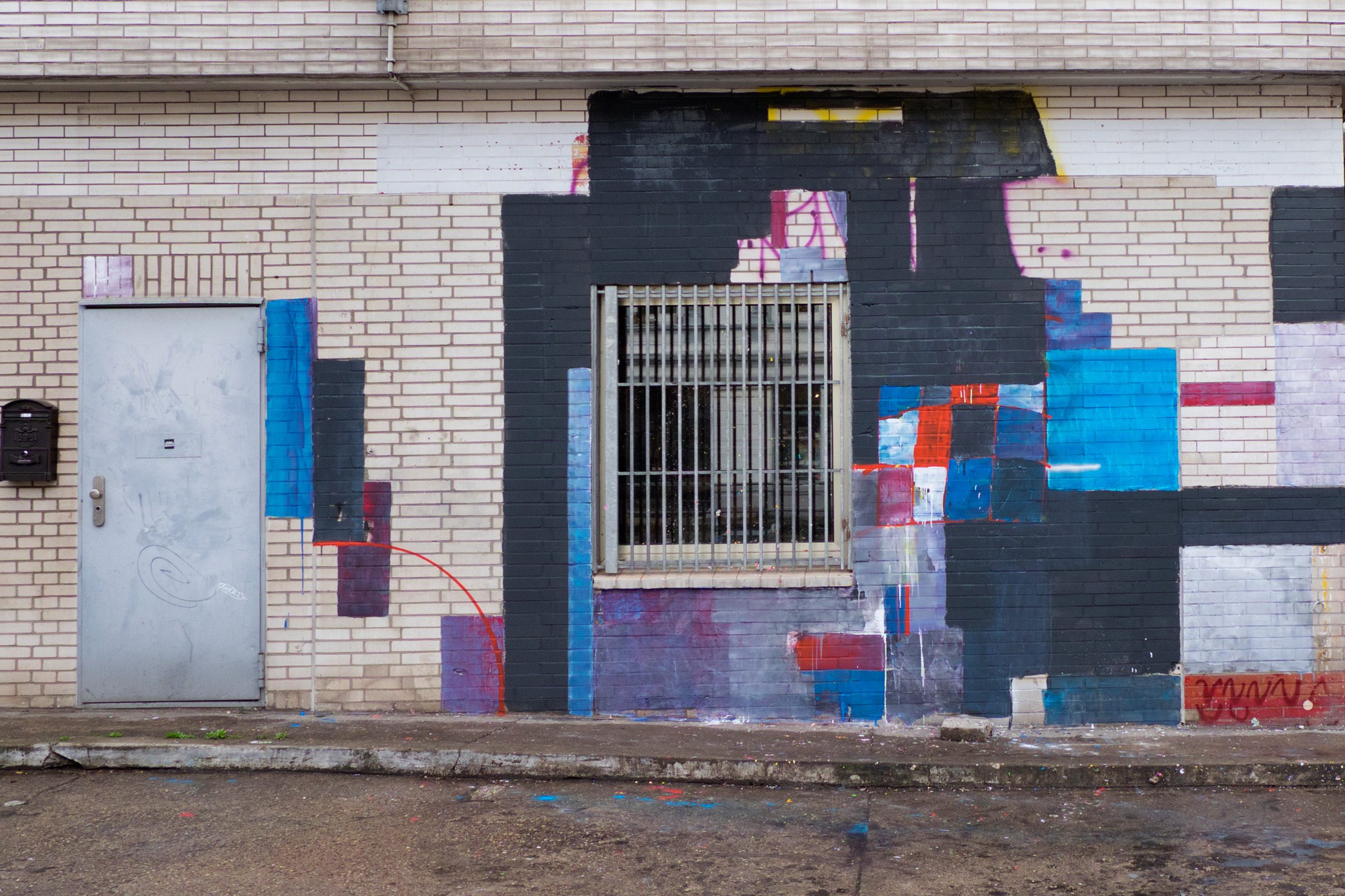
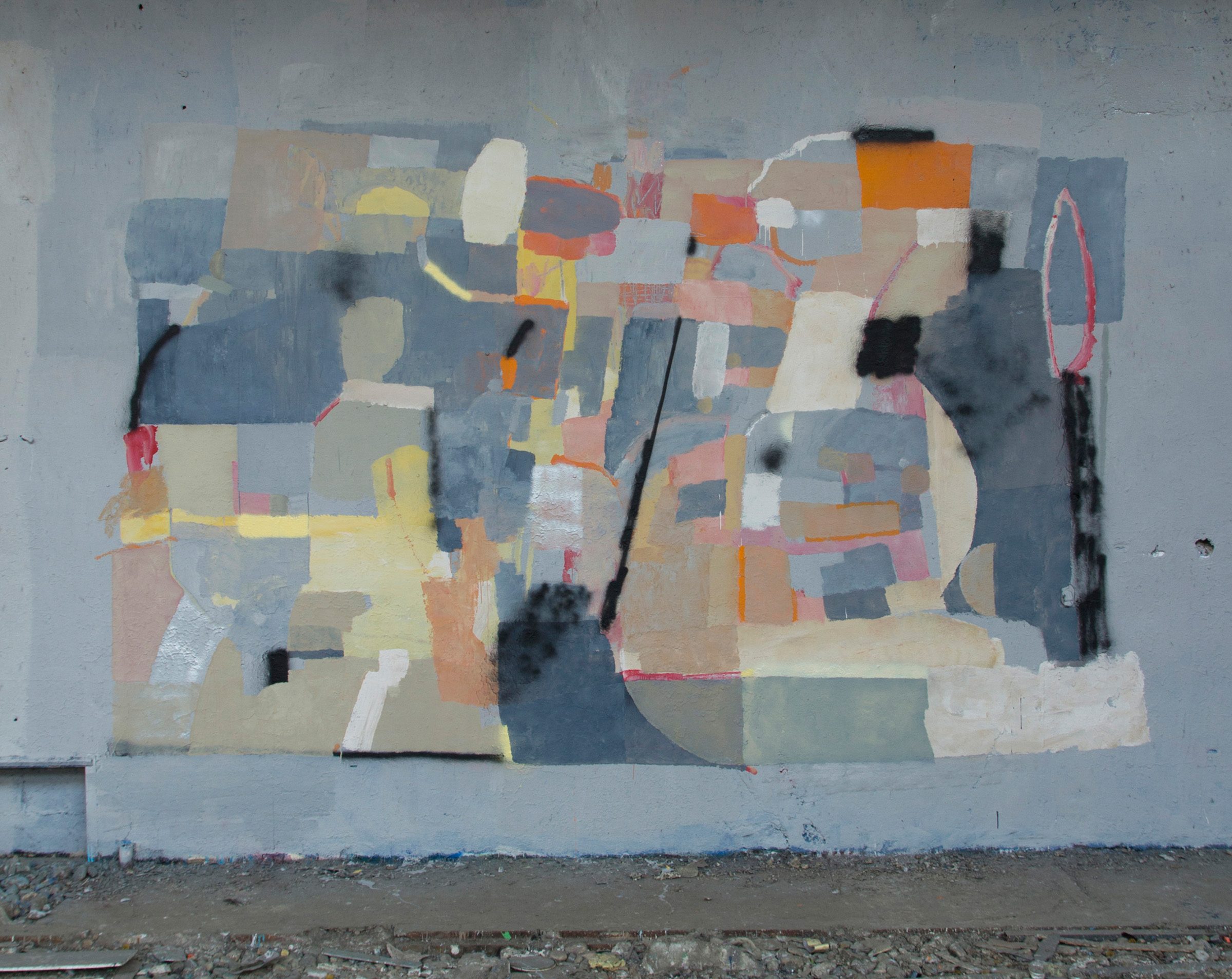
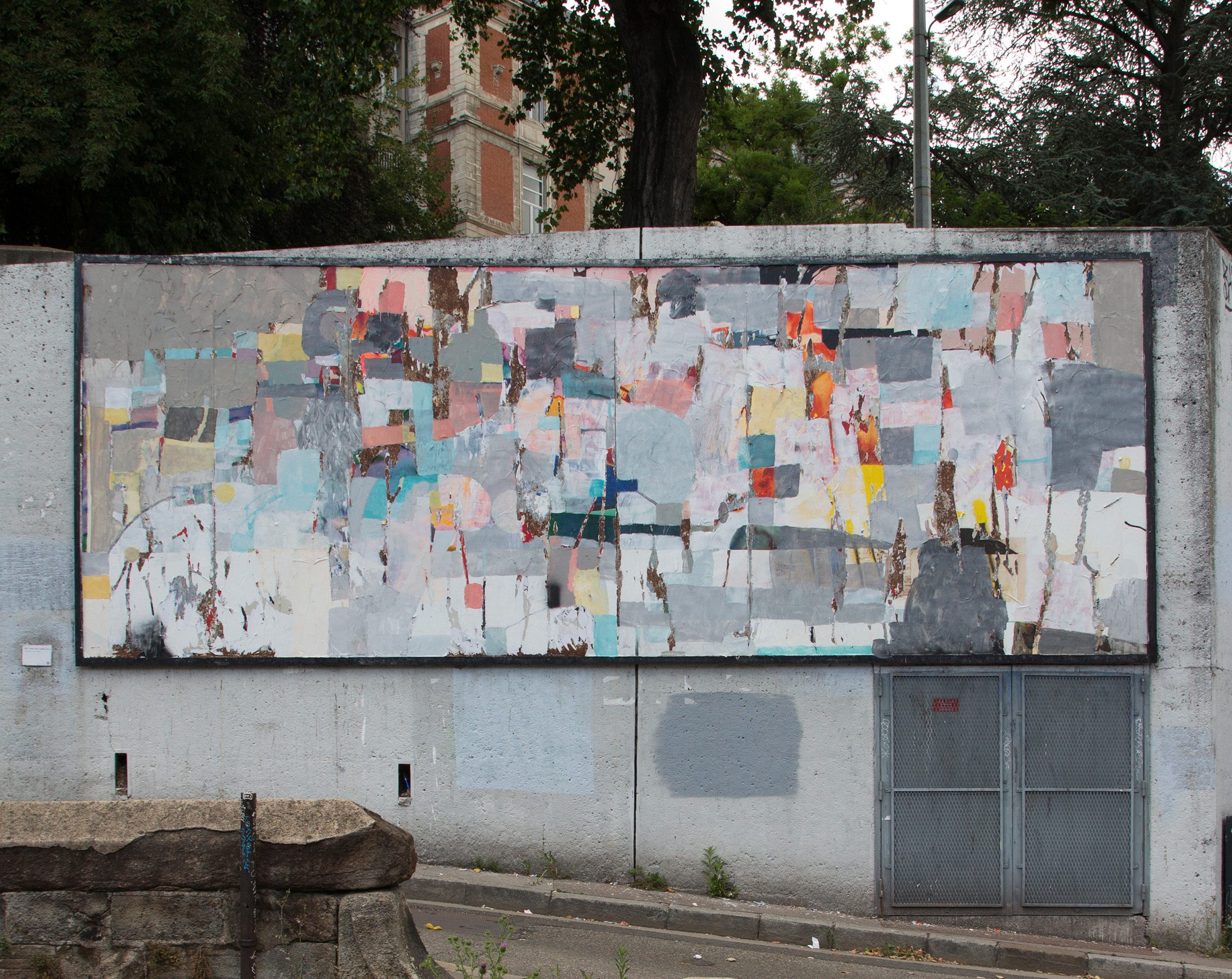
The Buff can also assume a clearly positive dimension. When confronted with a swastika or a Nazi symbol, erasure becomes an antifascist act. In that case, the destructive gesture acquires an ethical value. Similarly, Buffs applied to capitalist advertisements that visually pollute public space, contributing to a form of visual and psychological saturation, can be understood as a critical gesture. In this context, erasure does not simply negate an image, it interrupts a flow of imposed messages and becomes an attempt to make the urban environment more liveable.
Whether in the street or in the studio, the central question ultimately concerns the discernment of what should remain visible and what calls for disappearance. From a formal standpoint, it is in the manner of covering, scraping, interrupting, or partially concealing that the expressive dimension of the process truly resides. Erasure is never neutral: it is both an aesthetic strategy and a position.
Expressionist Constructivism (2017-now) is a series continuing Abstract Expressionismand Architectural Dialoguein a way and combining both. Those compositions are combining geometric shapes with colour fields and textures, and are more constructed, indeed. Is this the visual language you chose for your commission works, for bigger murals?
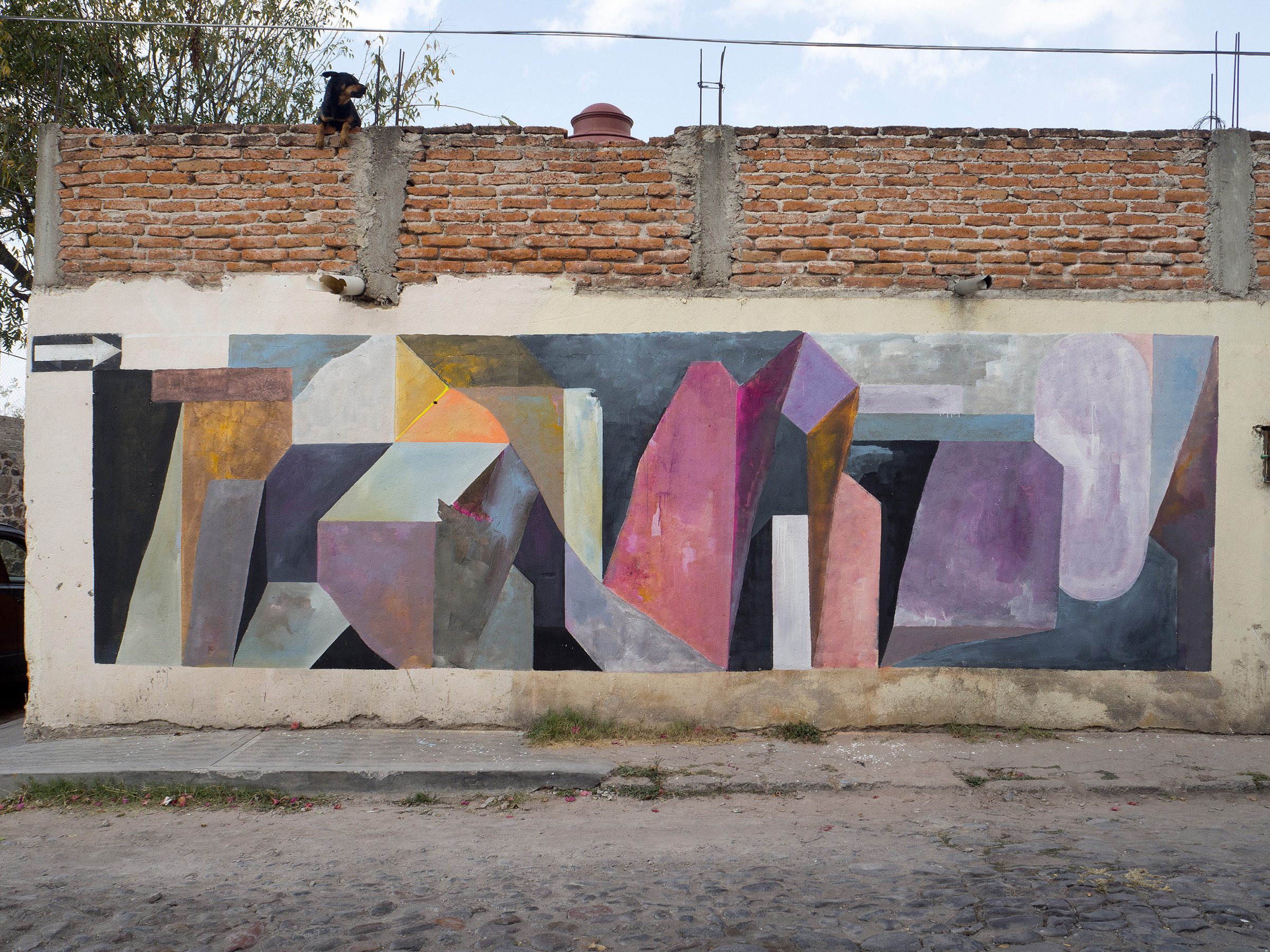
It is indeed a kind of intersection between Architectural Dialogue and Abstract Expressionism. But, as with the Lines series, it was above all a constraint that allowed me to generate a new artistic process.
Expressionist Constructivism was born during a trip to Mexico in 2017. At that time, I no longer wanted to use spray paint, and I wished to create my own colours by mixing acrylics, as I do in the studio. Due to limited space in my backpack, I only carried one liter containers of primary colours and white.
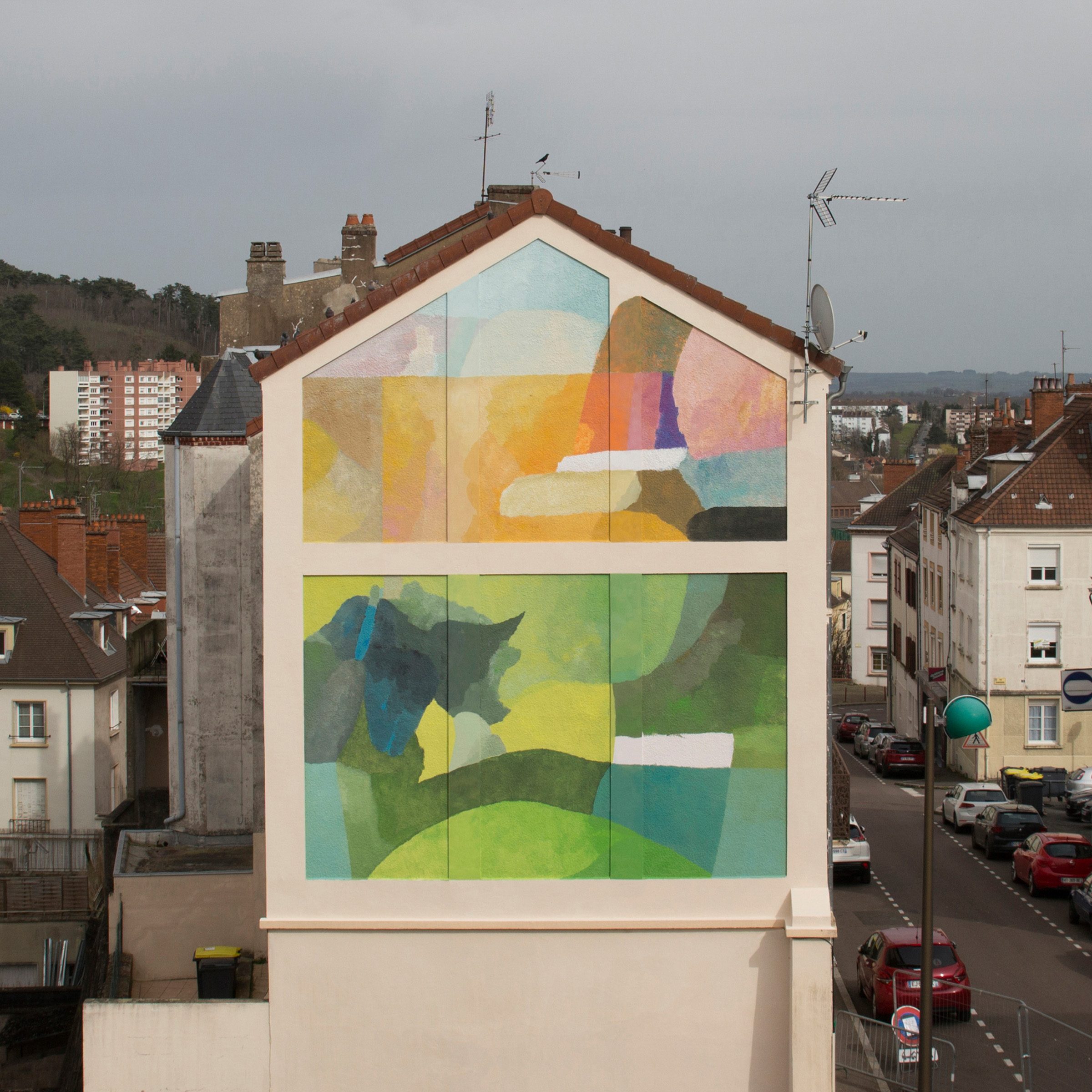
Since, I had no empty containers to prepare my mixes, I began blending the colours directly on the wall with a roller. The textures that gradually appeared, until the desired shade was achieved, suddenly made sense. They were neither arbitrary nor decorative; they traced the path of the colour as it was being made.
This method finally allowed me to embrace the textures I had long been seeking in the studio, in order to integrate the influence of abandoned places and walls weathered by time, without artificially simulating them.
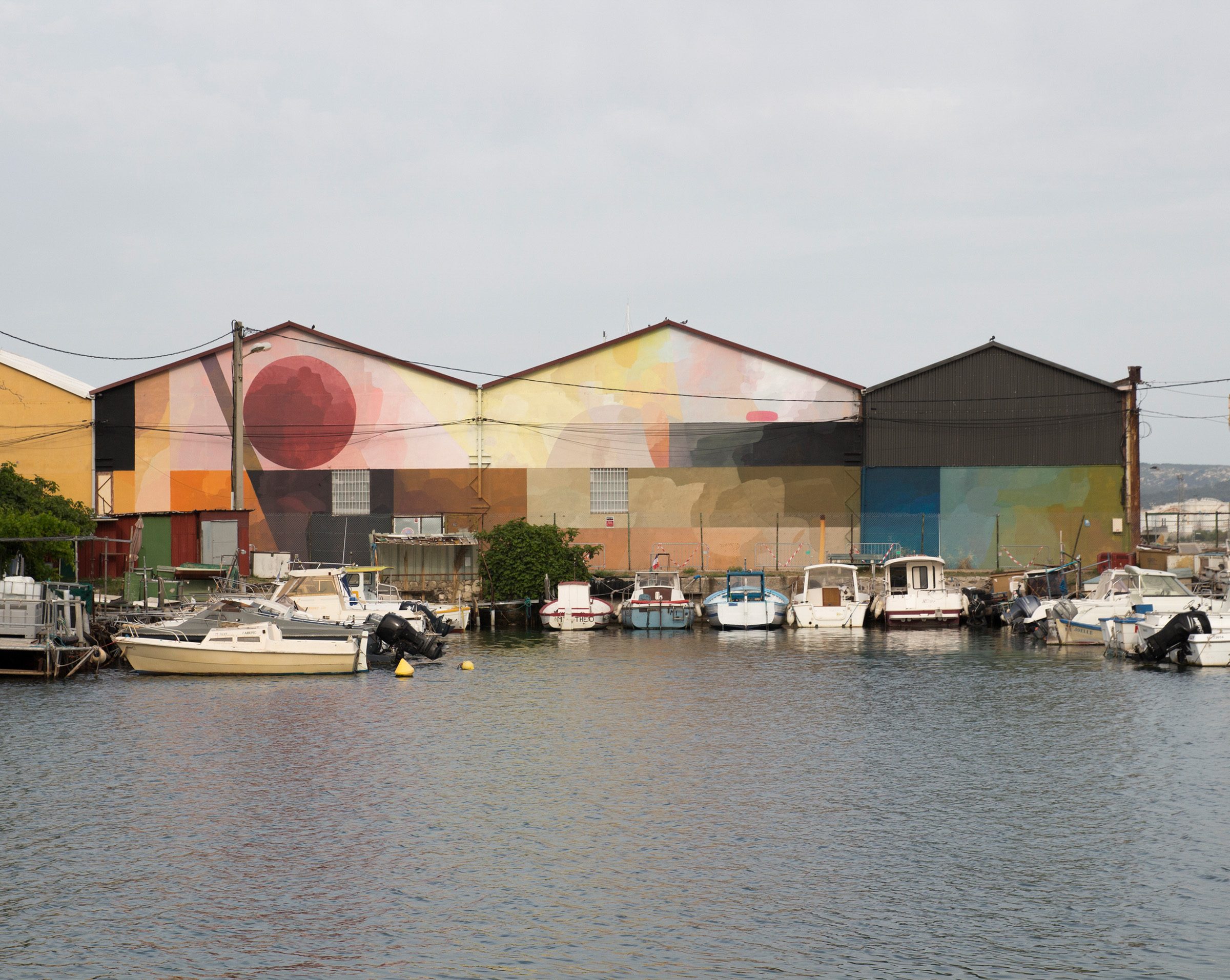
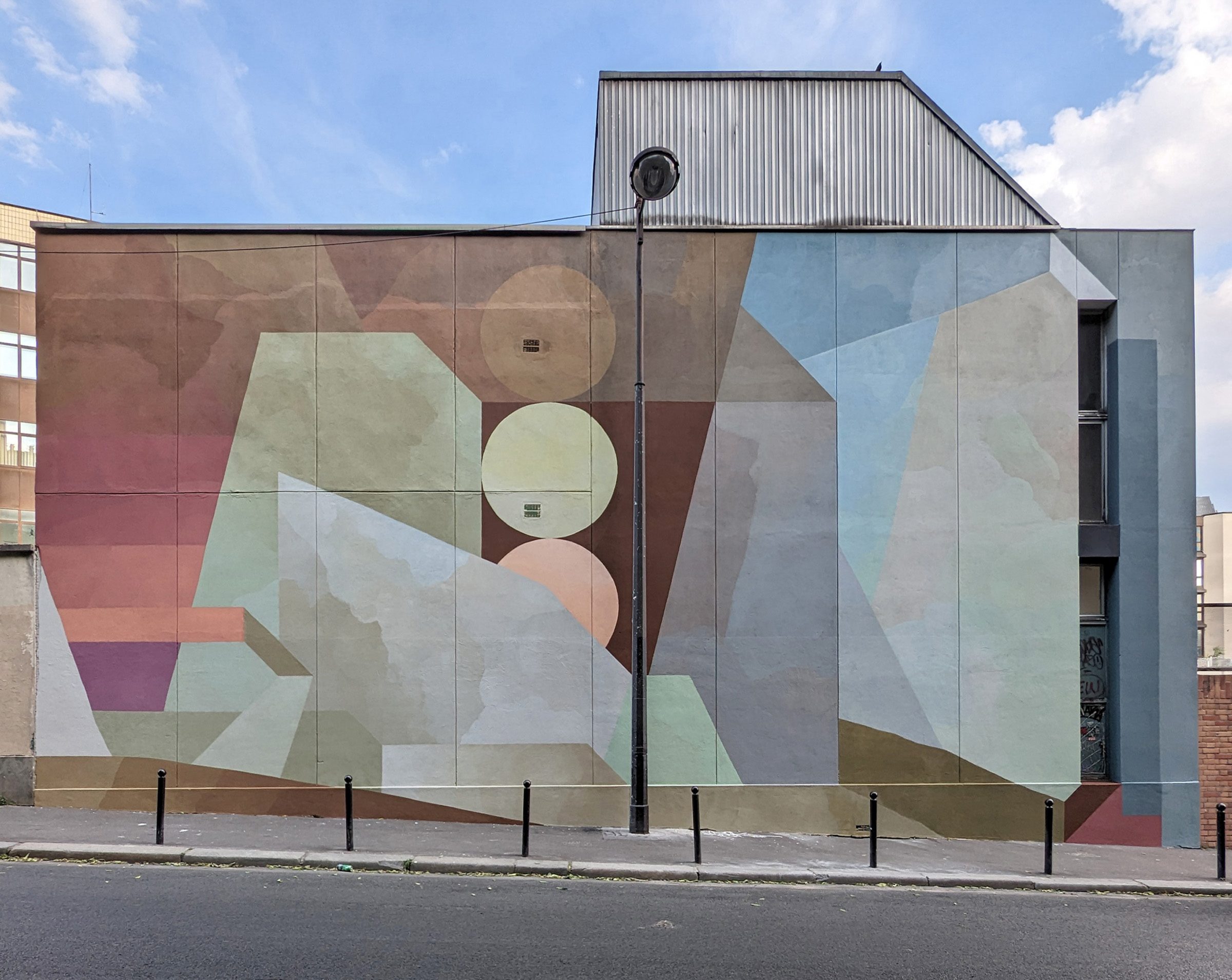
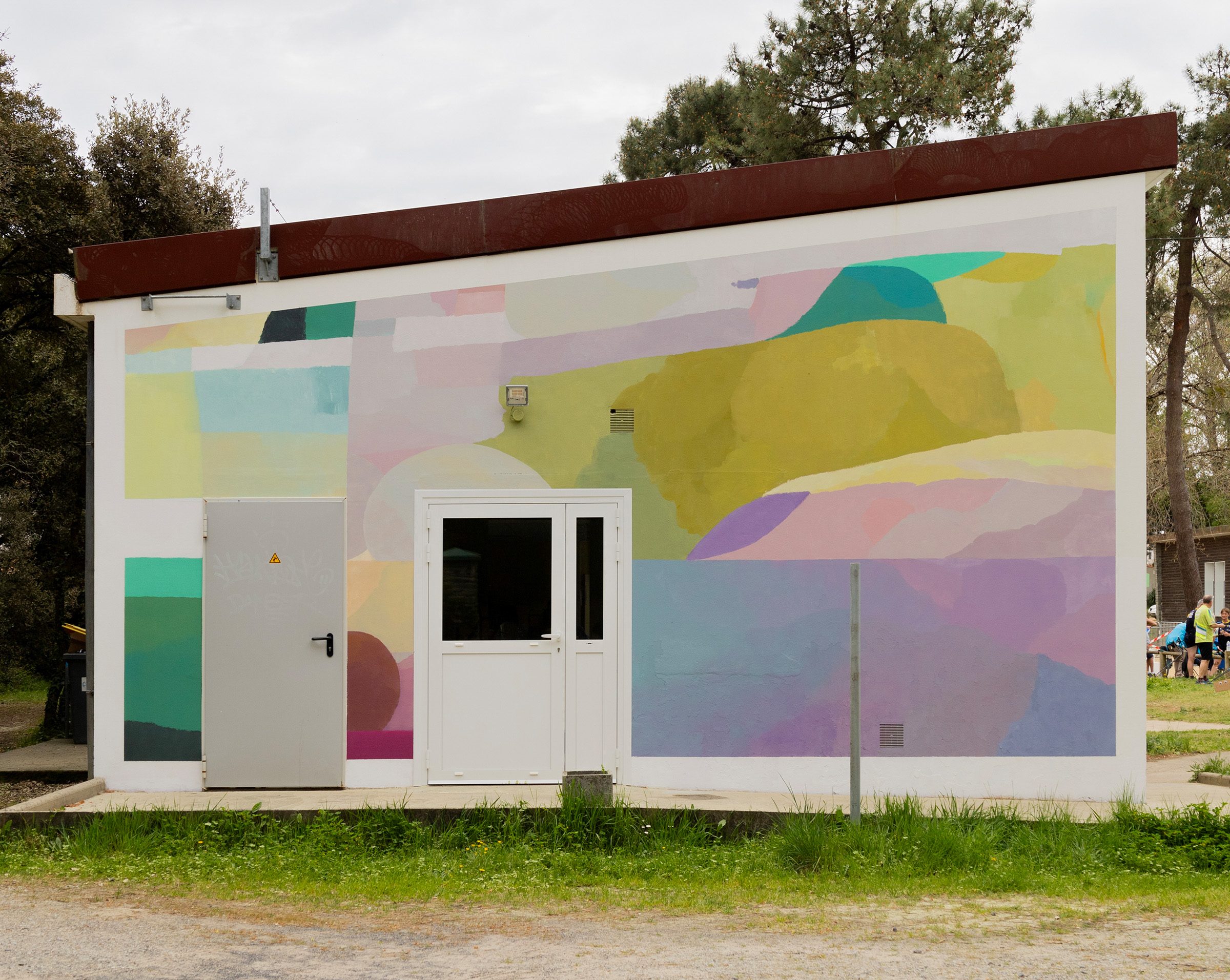
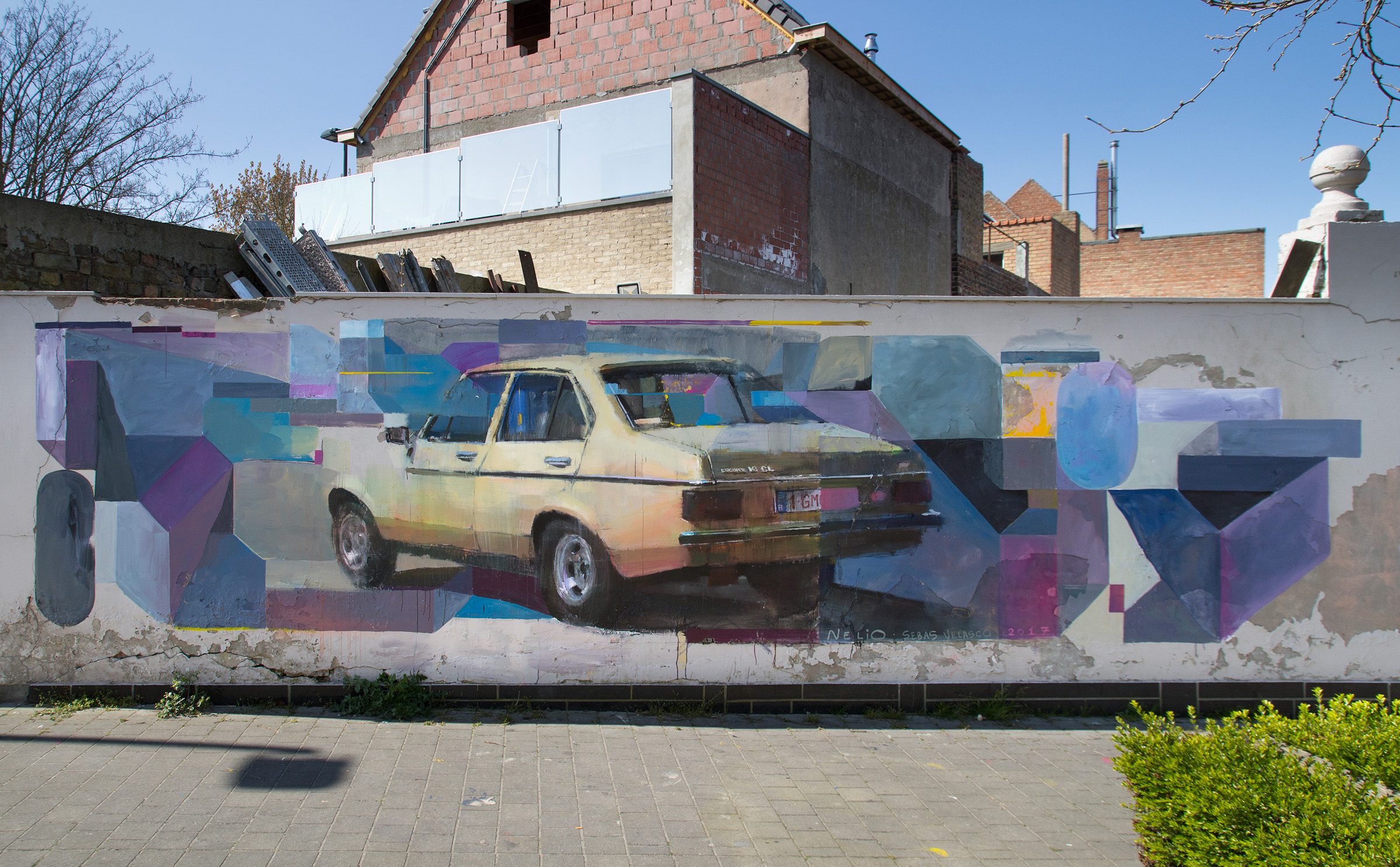
In this series, I continue to draw a structured composition beforehand, which I then fill through an intuitive and spontaneous application of colour, using more organic gestures. This generates fluid, almost cloud-like gradients that disrupt the geometric rigour. In a way, the particular application of colour acts as a partial erasure of the structure, or at least as a way of putting it under tension.
The year it was created, I produced many spontaneous street paintings using this technique, before later applying it mainly to larger-scale walls and commissions. For these specific projects, this direction allows me to retain a degree of creativity at every stage, from the initial sketch to the execution on the wall, with room for improvisation and freedom once on site.
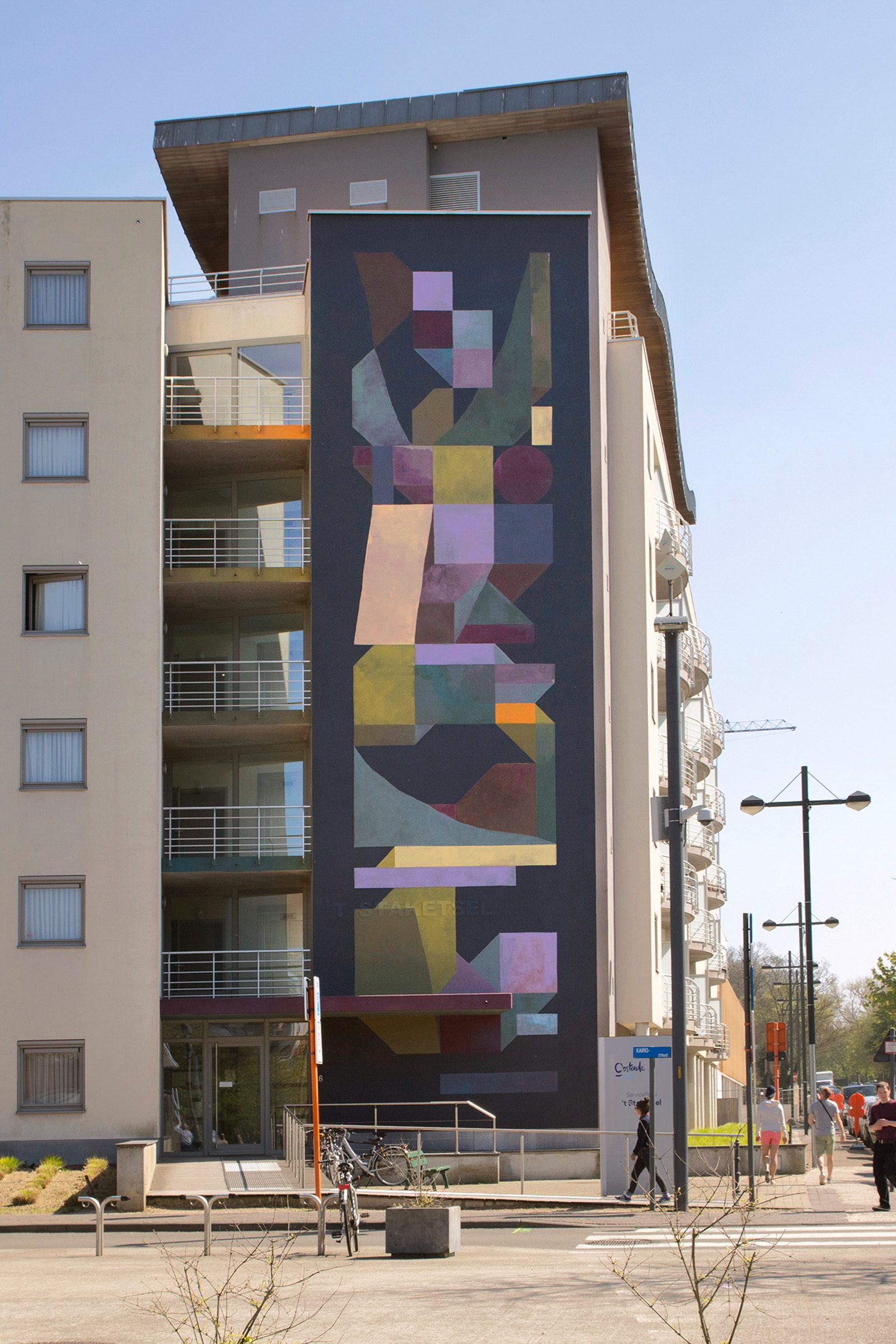
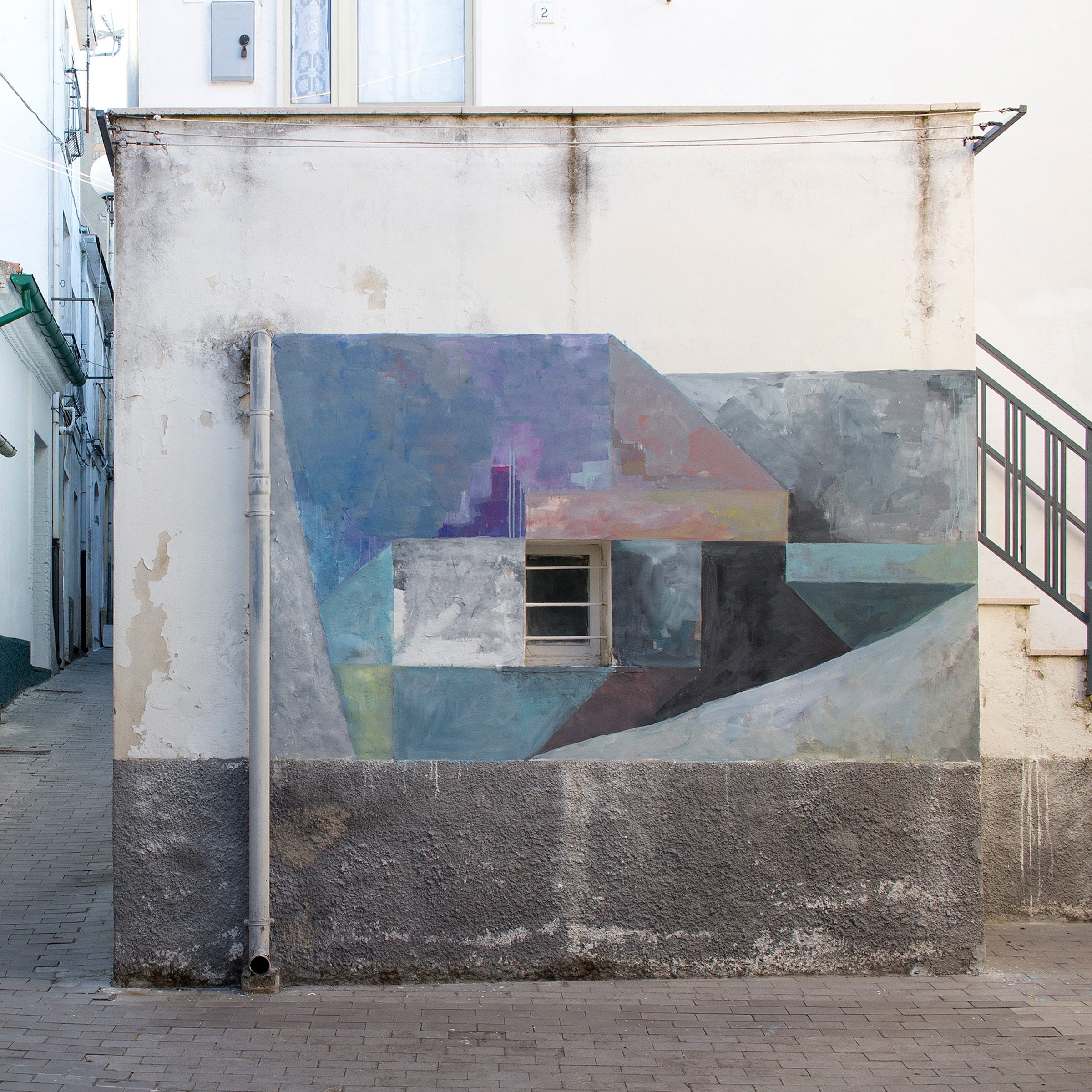
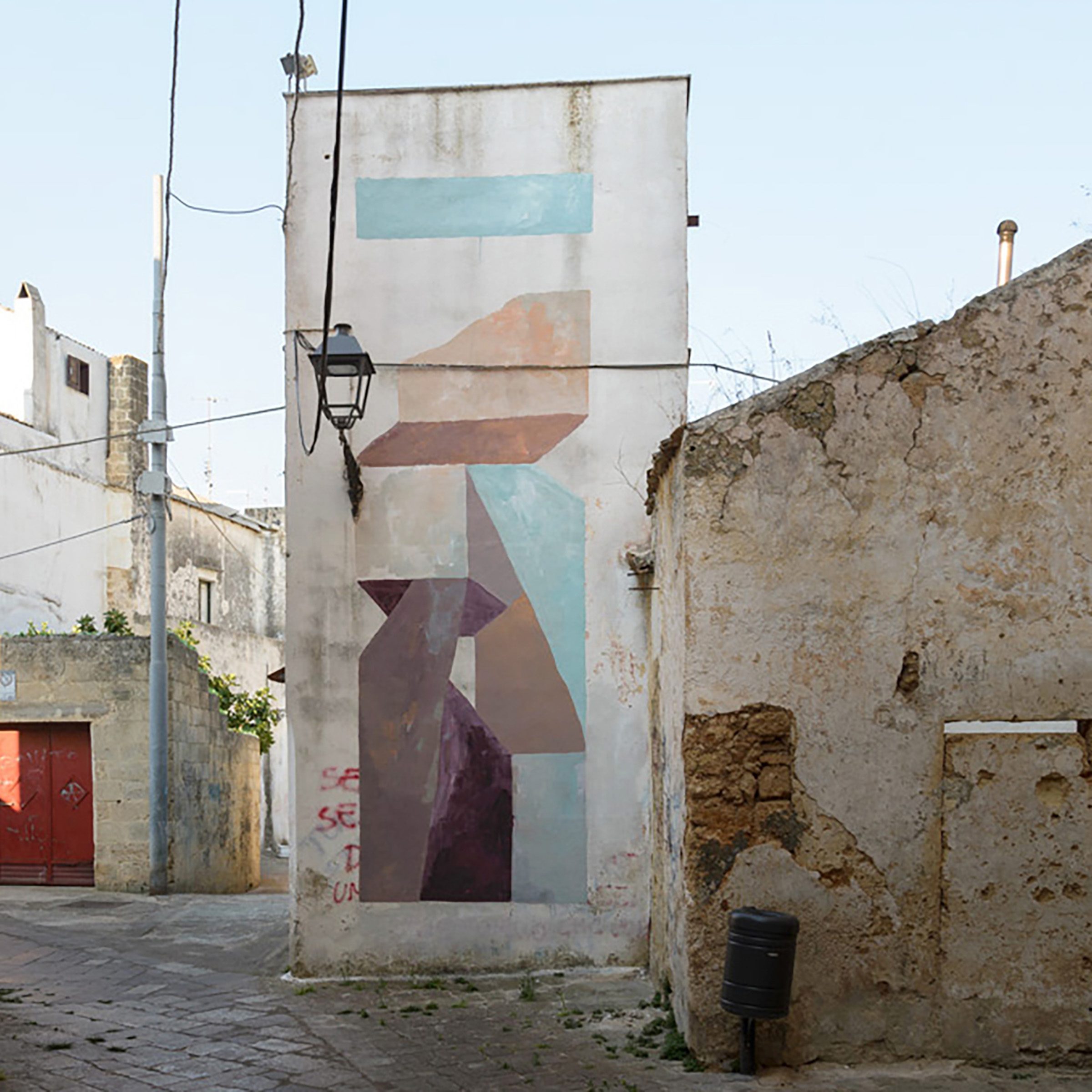
Then appears also works of the series Buff Color Fields (2017-now). Those compositions seem to have reduced the colours fields to only square surfaces in a composition of tone in tone colours. Like we can observe from buffs of tags and graffiti in the streets, that are happening randomly. Is this your inspirational source?
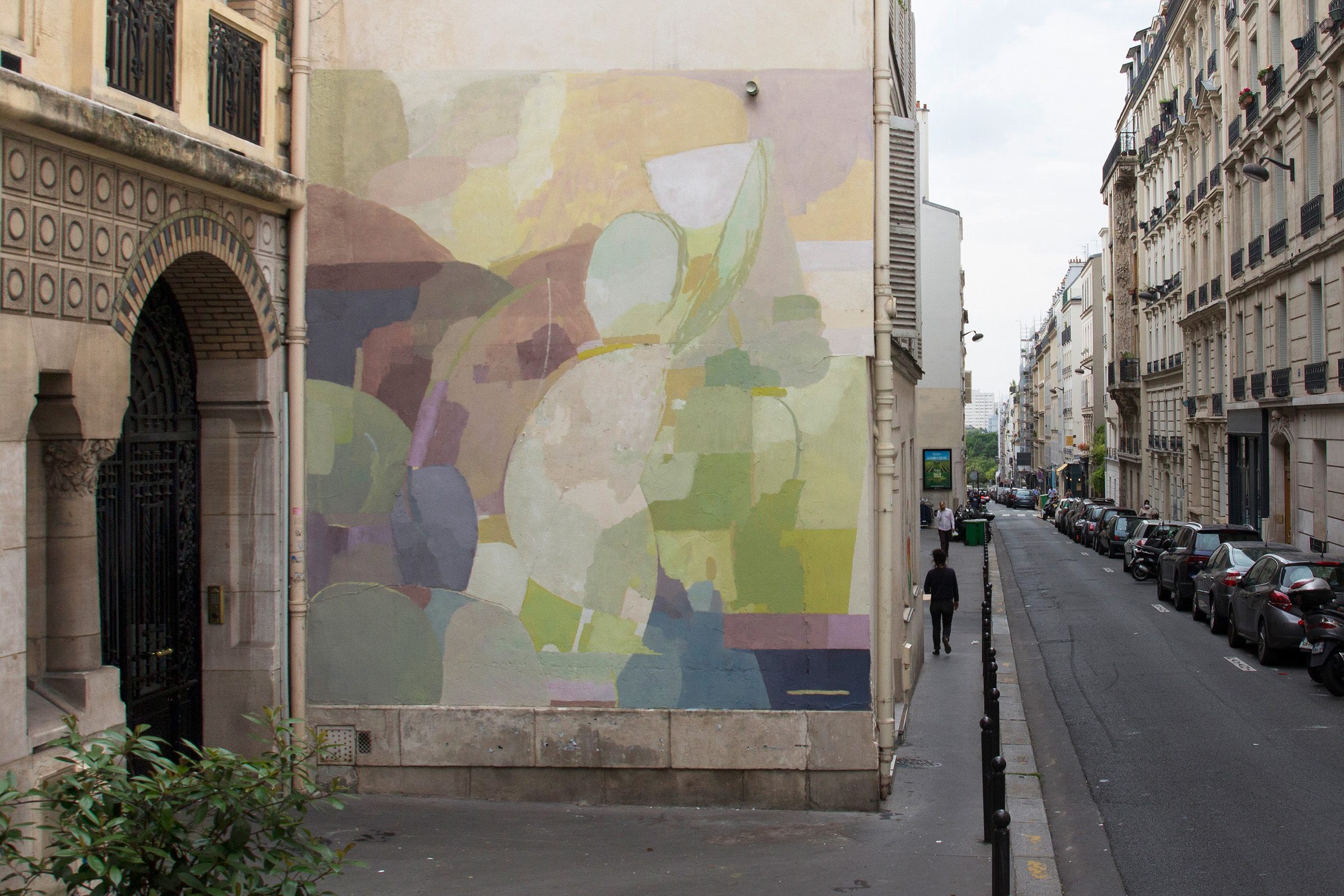
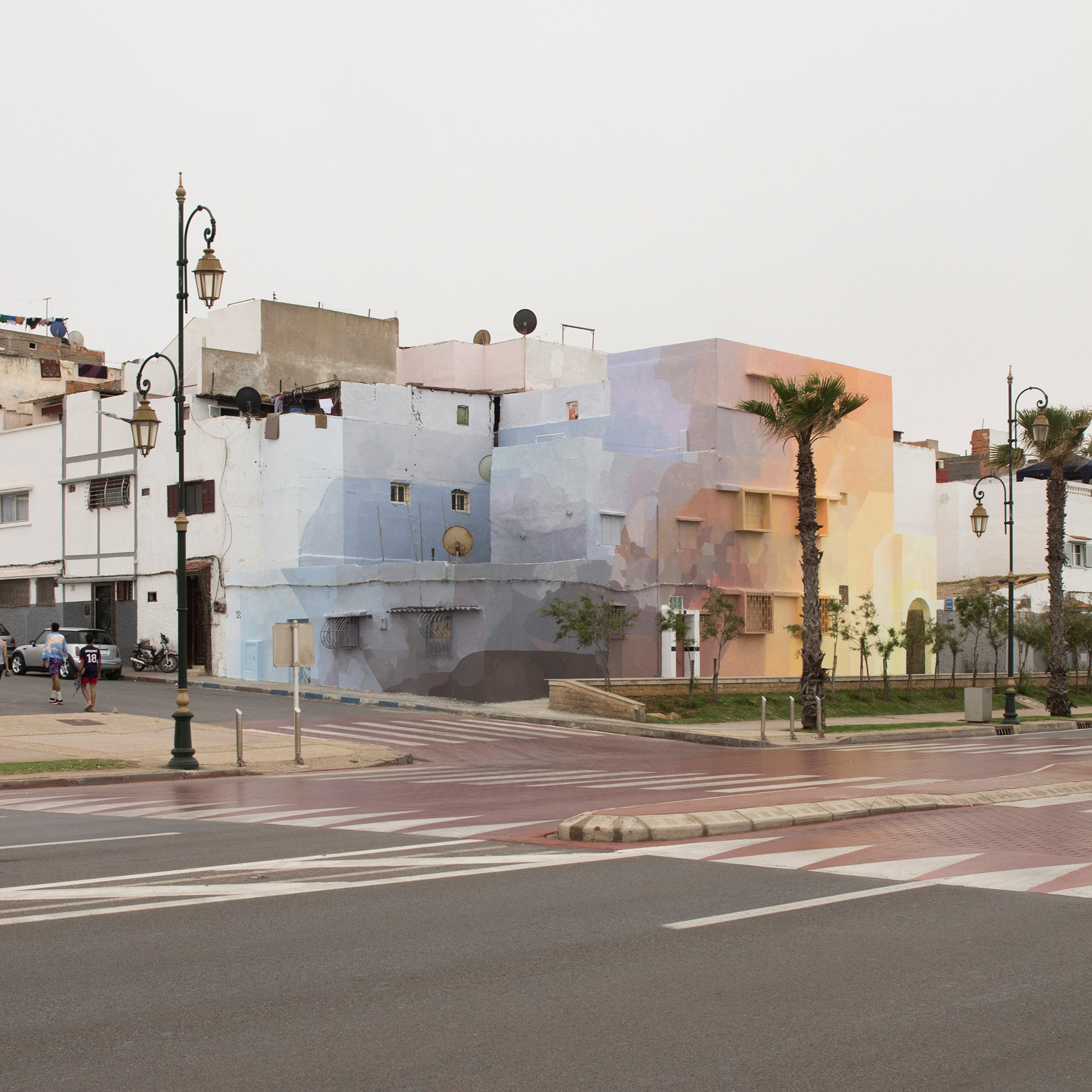
This series, which can be linked to Abstract Expressionism and Buff Expressionism, emerged from a process of reduction of Expressionist Constructivism. It is as if I had zoomed in on a fragment of the work, going one step further in the erasure of geometry in order to focus primarily on colour and its mode of application.
Whereas Expressionist Constructivism maintained a tension between architectural rigour and organic gestures, Buff Color Field marks a shift: colour no longer inhabits the structure, it dissolves it. The grid becomes underlying, almost ghostlike.
It was both the atmospheric quality that emerged from certain paintings that led me to group them under this title, and the direct connection to certain urban Buffs created through the superimposition of slightly different tones, when workers attempt to match a wall’s colour without ever reproducing it perfectly.
I also use this category for certain large-scale murals that, in a way, erase the building itself, such as the one created in Rabat in 2022. By entirely covering the architecture in an expressionist gesture, with gradients executed quickly and in a deliberately raw manner, a chaotic energy appears in the close-up details. But from a distance, the whole becomes fluid: the architectural lines fade, the building loses its rigidity, and it almost turns into an autonomous field of colour.
Buffs seem to have inspired many graffiti artists and the post graffiti generation. Did you know any other artist working like that in 2017?
Yes, particularly through certain encounters and collaborations with artists sensitive to this aesthetic or process, such as Ed Bats, Ekta, Johannes Mundinger, Myshel and Duncan Passmore, to name a few.
Saeio also used a creative Buff to extend and develop his painting when someone else tagged over his pieces.
In a different process, there is also Mobstr, who maintained a direct dialogue with graffiti removal company by creating evolving works that were often humorous and insightful.
Blu’s video Muto, in which he progressively erases each of his paintings to transform them into a stop-motion narrative, can also be seen as part of this idea of the Buff as a creative process. Blu also chose to buff his own murals in Bologna as a radical response to real estate speculation and the commodification of urban art. In doing so, he showed that the Buff can operate as a critical and ethical stance.

In 2020, you started the series Paysages (landscapes), focusing also on the nature around the wall you paint. Can you tell us your approach to landscapes?
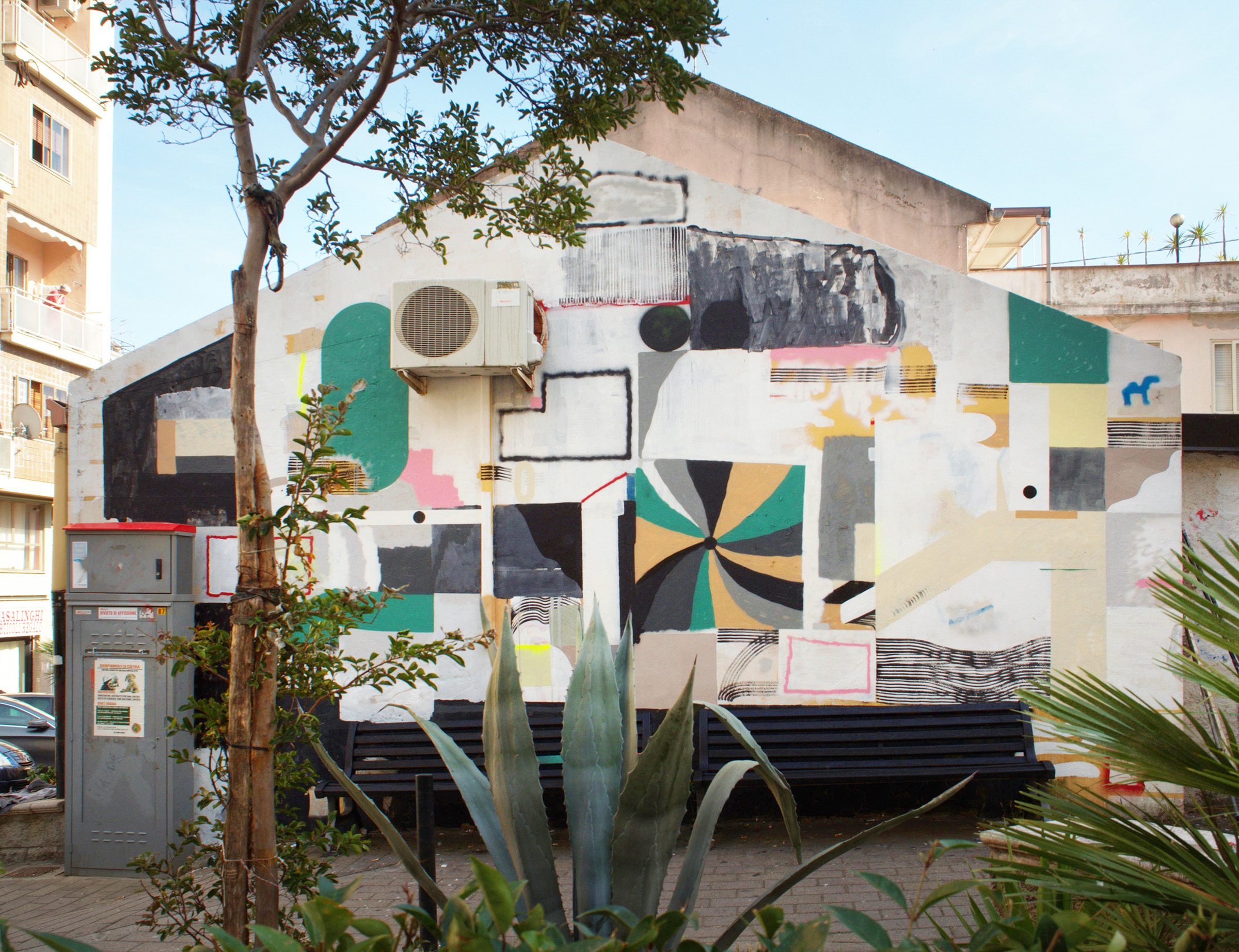
With the development of my Abstract Expressionism series, I began to perceive landscapes in certain works, like aerial views of coloured fields, or sometimes when a hint of a horizon line appeared. I wanted to remain within abstraction, but I appreciated this subtle evocation: it introduced an additional depth, almost narrative, without tipping into representation.
Since 2017, I have been living in the Ardèche Mountains Regional Nature Park. Being surrounded by nature on a daily basis inevitably influences my perspective. I have always photographed landscapes extensively, both in Ardèche and while travelling. In the summer, I also spend a lot of time outdoors, with periods devoted to observational drawing. Sometimes the drawings are relatively realistic, but more often they remain very minimalistic, almost like landscape logos.
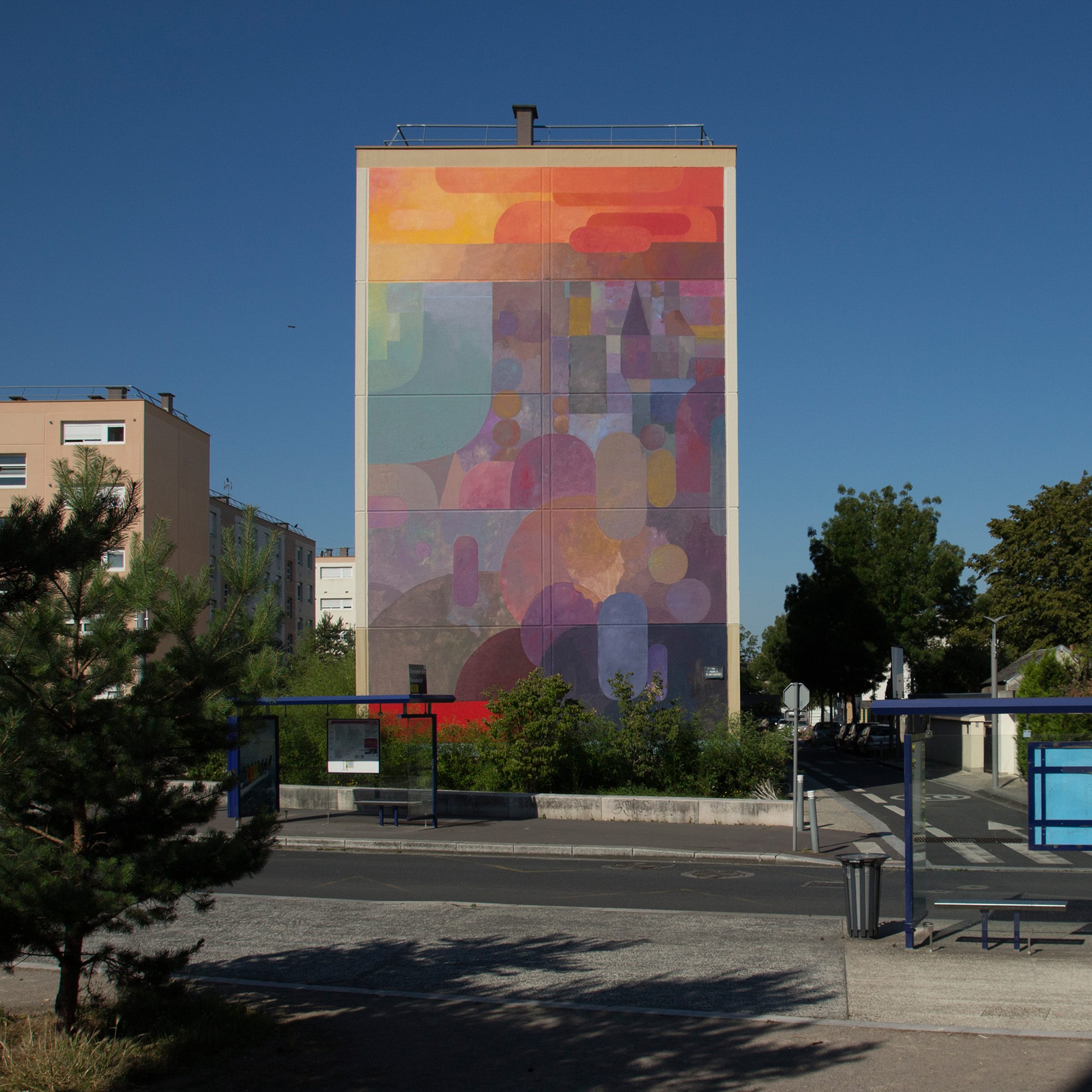
I thought about different ways of integrating this approach into my painting. For a while, the simple sensation of landscape present in Abstract Expressionism was enough for me. It was only in 2020, during a project in Rouen and through discussions with curator Olivier Landes, that I took a step forward by fully embracing the creation of a landscape on a wall.
Since then, it has become a series in its own right, allowing me to introduce more context into certain murals. However, I do not wish to confine myself to it. I see it as a new field of experimentation, an additional area of research, resonating with other series such as Abstract Expressionism, Erased Structures, and my reflections on Land Art.


Reviewing all of your works, I can feel the influence of modern art, especially modern painting. Some works by Paul Klee and cubists came into my mind. Are there any particular modern or contemporary artists/movements that inspire you more than others?
Having not pursued extended academic studies, I initially had significant gaps in my knowledge of art history. My earliest references came from popular culture derived from graphic design, notably the Bauhaus, as well as from the post-graffiti scene. Artists such as 108 and Eltono have partly influenced my transition from lettering and figuration toward abstraction and minimalism.
Later, my numerous collaborations with Duncan Passmore deeply shaped my development. With him, my experiments around abstract expressionism became increasingly process-oriented rather than result-driven. Many reflections emerged from this dialogue, particularly around the notion of the Buff. It became a shared protocol in our paintings, and more broadly in collaborations with artists working within a similar dynamic, to the point that developing an artistic manifesto around this practice might have been relevant.
Regarding art history, I gradually developed a strong attachment to modern art, which I continue to discover in museums during my travels. Being self-taught, with an empirical approach rooted in process and everyday experience, I sometimes followed paths similar to those of modernist artists without being fully aware of it. Often, it was only afterward that I recognized these affinities, which led me to explore their work more deeply and consciously embrace these filiations.
I could mention the influence of Piet Mondrian and the De Stijl movement in the transformation of my interlinked faces as they transitioned onto canvas and later onto painted doors in the street. The impossible constructions of M. C. Escher influenced my connected letters through their shared perspectival logic. Kazimir Malevich and El Lissitzky accompanied my move toward a more constructivist vocabulary. Paul Klee and Richard Diebenkorn, my two favourite artists, represents for me a subtle point of balance between geometry and expressionism.

In my more gestural studio paintings, even when this influence is not formally explicit, Cy Twombly, Joan Mitchell, and Willem de Kooning have been important references. This approach later evolved toward the question of landscape, where I perceive affinities with Nicolas de Staël. For the Buff Color Field series, Mark Rothko is also a significant reference.
On the minimalist side, I greatly appreciate the work of Ellsworth Kelly and Donald Judd. My Erased Structures series can also be considered in relation to Incomplete Open Cubes by Sol LeWitt.
For assemblages and installations, the work of Kurt Schwitters and Gordon Matta-Clark inspired me, as did the Arte Povera and Supports/Surfaces movements. The trajectories of artists such as Frank Stella and Gerhard Richter have also encouraged me to more freely embrace the exploration of parallel, sometimes contradictory directions within a single practice.
The notion of erasure, central to my work, though primarily rooted in the Buff, abandoned places, and natural erosion, can also be related to Erased de Kooning Drawing by Robert Rauschenberg.
Finally, regarding the Buff itself, beyond what I observed in the street, I was deeply struck around 2005–2006 by the video The Subconscious Art of Graffiti Removal by Matt McCormick and Avalon Kalin, which I discovered in an arthouse cinema in Montpellier. This simple yet poetic work profoundly nourished my thinking at the time.
What do you like the most in abstraction?
The freedom to experiment and the constant questioning it involves.
Do letters still play a role in your actual works ?
I still draw and paint letters, although less so than before. This continues to influence certain series.
You seem to like lost places, what kind of places do you prefer (old ones or modern ones) and how do you discover those?
I prefer ruins. In some places, I take photographs without even feeling the need to paint there. The site is complete in itself, an intervention would not necessarily be relevant. But my passion for art often takes over, and I end up intervening, usually in a minimalist way, sometimes with natural elements found on site, like stones or charcoal. When I lived in the city, I used to explore by bike, searching for abandoned factories. Nowadays, it’s mainly road trips and hikes through the countryside that inspire me. I like taking back roads, discovering places that seem timeless, where nature has reclaimed its rights over human constructions.
With which technique do you like to paint on walls?
I use mainly acrylic with an extension pole and roller, and for some special works like the Erased Structures or Lines series I use spray paint.
How are the steps for your painting process on walls, and how long does it take (except the commissioned murals)?
It depends. For paintings in the Erased Structures series, for example, I prefer to prepare a sketch beforehand and carefully choose its placement on the wall; the execution can then be very quick.
For more expressionist works, on the other hand, it is always an improvisation on site. The time required varies: from just a few minutes when the intervention remains minimal, to several hours if I take the time to apply many successive layers.
How important is sketching and drawing for your work anyway?
Drawing remains at the core of my practice, even though I no longer use sketches for most of my studio paintings or for my spontaneous outdoor works. I produce many series of drawings that I don’t necessarily show, but that I feel the need to make, almost as a form of catharsis. This regular practice always feeds into my work in one way or another, whether it is visible or more subtle.
How important is freestyle in your work?
Essential. It implies freedom and often introduces the unexpected, leading to new discoveries.
How do you work to find new forms/shapes ?
Through automatic drawing, speed, assemblage, negative space, reduction, erasure, and observation of nature.
You collaborated very often/regularly with others artists for wall paintings. What does this impact? Can you name the most impregnating collaboration you did?
I have always enjoyed collaborating with other artists. It’s a way of learning together, experimenting, testing ideas, but also sharing a good time.
In the process, I distinguish three types of collaboration. There are those where each artist paints side by side, seeking to establish a dialogue between the works. Others where styles are juxtaposed and blending in places while remaining clearly identifiable. And finally, those where identities truly merge to give birth to a third entity. I appreciate all three approaches, but the most significant ones are those based on total trust, where each artist accepts being painted over by the other, even if some parts they were attached to disappear.


With Duncan Passmore, we realized that by moving beyond simply adding or blending our styles, and by adopting a more radical stance inspired by the Buff, systematically covering anything that asserted our individual identities too strongly, the painting took on an entirely different dimension. It ceased to be the meeting of two signatures and became an identity in its own right. This process becomes even more intense when we paint as a group of three, four, five or more. In those situations, control almost completely dissolves; the painting evolves so quickly that it seems to acquire a form of autonomy, as if it were becoming alive.
What do you think about this post graffiti evolution towards abstraction, domination the scene since more than 15 years now? Different terms were used, Graffuturism at first. Did you follow up this evolution and this evolution of terms being used?
Post-graffiti has drawn inspiration from graphic design, the Avant-garde, modern art, and contemporary art, and it continues to evolve in dialogue with its time: it is a deeply living practice. There are multiple variations, both in terms of processes and formal research, aesthetics, narratives and ethical positions. This diversity makes it difficult to establish a true overview of the scene, and even more so to group all these artists under a single label.
Let’s talk about your studio works. Since when do you create studio works? How important is your studio practice for you? Seems you are more active outdoor?
I have been painting on canvas since 2006. It depends on the season, but overall I would say that 70 to 80% of my work is done in the studio, mainly in the form of experimentation and research. Aside from works on paper, I do not produce excessively, I recycle a lot. For example, I have canvases that I have been painting over for years. All of this research feeds into my outdoor practice.

Can you name the different techniques and approaches for your studio works?
I work extensively on paper: drawings connected to different series, sketches to develop future ideas, observational drawings, others closer to a drawing-painting approach, as well as collages. I also paint on canvas, on wood, and found materials. I create assemblages, sculptures, installation tests, and I practice photography as well. After scanning or photographing certain works, I used them on the computer to prepare sketches for commissioned projects or for publishing work, particularly in screen print. I have organized several distinct spaces in my studio: one for painting, one for drawing, and another dedicated to assemblages and sculptures. I also keep a wall on which I hang works that I consider finished. This allows me to verify whether they truly are, and to observe the connections that emerge between them. I like to live with these pieces for a while, letting them influence me, either to extend an existing direction or to create intermediate works that would establish links.
Are you working in series as well? Did you create studio works of every series you did outdoors?
Do you call those the same as your series outdoor?
All the series developed outdoors are also worked on in the studio. I even experiment with way more ideas and directions there than I do outdoors. Some of this research leads to specific exhibitions. Others remain in an experimental state, either because they are not yet fully resolved, or because they are too far away from my main axis to be accepted openly in parallel. Sometimes they need time to infuse, to influence other series and help them evolve. At other times, an intermediate series must emerge to create a link and make the transition more natural.
This interview is very detailed and great, thank you so much for your time NELIO!


Leave a Reply