

Hello GOAT543, I heard you are based in Russia? Where were you born, where exactly do you live and where and how did you grow up?
Hello Katia, thank you for the good questions and for your attention in general. I really want to give detailed answers to such questions. Many people can create, but only a few can talk or write about it. I grew up in a simple and energetic family. My creativity began when I was teached embroidery at the Kindergarten. My dad gave me a piece of marsh-coloured tarpaulin, a needle and black threads. Then I embroidered a cat on it, but what to do with that tarp is still an open question. At home, I loved spending time on the balcony most of all, there was a lot of light, it was great to fantasize and play there, there were a lot of all kinds of accessories and pieces of plywood in the closet. I also watched different clothes drying on the balcony after washing. My mother used to cover the entire balcony with them, and at night, when the street lighting was turned on, a lantern standing directly in front of the balcony illuminated these fabrics, forming light shapes. Thus, every time I went to bed, I was presented with a new installation of light and fabric, consisting of shapes that shone through in different ways. Also, in the late 90s, a computer appeared in the family. I really checked out the early 90s video games with old-school graphics. At school, my favourite lessons were labour and drawing geometry, where I made my first sketch around 2004. It was the font “ALEX” drawn in the drawing album. The teacher gave an average grade.
Since when do you paint outdoors? How did it start?
I’ve been living in the city of Korolev, in the Moscow region, all my life. This is the city where the spacecraft control centre is located, a city that was obsessed with space in the past, but now the focus has shifted to other rockets. Space mysticism has greatly influenced graffiti in the city. In the early 2000s, there were a lot of cool graffiti pieces in the city, consisting of Wild Style, 3D-Style and characters dedicated to space or sports from the Korolev Graffiti Block team and other visiting writers. Now, remembering those walls, these places feel lifeless without graffiti, but in some places there are still dinosaur artefacts. Graffiti could be found on garages, basketball boxes, stadiums, railway lines. These were also car enamel drawings at a very high level, the paint had its own specifics, different colours of different companies were painted in different ways. It was rare to reach a level in those conditions. With the development of graffiti culture and its commercialization, the level of graffiti has decreased a lot, and the new tools made it easier to paint with.
With what names did you start graffiti writing and were you active in any crews?
I started around 2006. There was a time when the early wave was already ending and remained a shadow, and a wide variety of stuff appeared, from dirty mayonnaise styles to even dumb bombing. I also started drawing. I listened mostly to metal and skate punk, I was not into hip hop and I painted the letters Rains543 in a careless style. In 2009, we created a good crew called HEL, which also included MANER, RAVE, and GRAEF. We often painted on the periphery and garages with different colours. Then there was a period of several years when I painted Pizza543, later I wrote 543. This is the first number I received in the hospital when I was born, it was a tag on my leg. Then there were the words GOAT or BOMG, but they related to different projects, for example, when a wall consists of three segments, you can make a 3-letter word, and when a wall can be divided into four parts, you can use a 4-letter word for the composition.


Are there many graffiti writers and muralists active in your city/surroundings?
There are artists in my city who have tried to come up with some interesting styles. At one time, we even joined a workshop, hung out a lot and painted, it felt like a separate trend called “Korolёv city Style”, which stood out for the activity on the walls. It was held separately from the movement in the capital. As for muralism, for example, we have the writer SCHON from that very early team, he can be distinguished because he used his very own style in writing.
Are there any graffiti writers that inspired you particularly?
I was mostly interested in trash style. From my city, I can single out the old style of the MANOS , chrome pieces on iron. The thrash style of DEBUT was also very influenced by his pieces on the railway line and whole-cars from Iron Curtain magazine. When I travelled to visit my aunt in Odessa, I was very shocked by the local early ugly graffiti. The Korolev graffiti block, made our childhood, and especially SCHON, who organized for us – the youngsters-, the painting of large boiler rooms on a space theme. There were also tags and throw ups by a very technical HARDWEAR writer on the roof of the house where I used to live. I can also add the writer ATAKA, who once joked that I shouldn’t pick up spray cans, I remembered it for a long time. And special respect for Kandy87, with whom we have been painting as partners for a long time. In the last decade, there were many active writers who now also continue to paint on walls.


What did you like the most in style writing? Did you practice also Wild Style?
Two facets of my being always come together in me: one expressive, the other focused and restrained. Over the years, you can trace how the transition between them occurs. At first, I did more dirty, expressive thrash-style works. This was noticeable when I was painting with someone next to me. The pieces lined up in a row, we were competing to see who would paint more vigorously. It happens that such pieces no longer looked like something stylish, but rather look like hysteria. Or vice versa, if someone refuses to play this game, then the drawing begins to stand out with other properties, looks unfinished, or dimmer, not clear. There were also discreet things in the trash style. Like the piece called „airport“. It’s funny when punks with such styles try to paint something restrained. But in general, such works still completely ignore their surfaces. Often the primary idea or sketch. In fact, the styles of what is called ugly/trash are similar to Wild Style or bombings in their approach in ignoring the wall. We can conclude that it is mainly a desire to express oneself of a vivid ego. But if you look at it closely, the hysteria will disappear, the features of the atmosphere and the walls in this atmosphere will appear. If you practice seeing such things, you will get a piece that is solved with the wall. This is where the concept of “building style” arises, and although this style speaks more about the canvas, it still remains uninformed and has forms taken from the style. Often such graffiti can be on the verge of perception, they may not be recognized as a piece, which means that instead of being visible from far away, you need to look closer. It’s about the atmosphere.

In Russia, there is a big difference between the seasons, and the patterns look different during each season. I usually paint more in winter because there is a lot of snow around the objects. The snow is as white as a blank sheet, and there is a lot of light in the piece that lingers. When the weather is clear, the light plays and shimmers. I use chrome and silver drying oil to show how the light reflects on the object. The reflected light contrasts with the rusty and peeling surface, and it comes to life. I strive to show this contrast. When the painting is turned away from the sun, it begins to shine, the chrome begins to reflect brightly in the shadow. When the weather is cloudy this light is less intense.
I am interested in painting in isolated spaces. It seems that the painting lives its own life and has changing properties. It can change due to the atmosphere, or it can be ruined, like street paintings, they are very fragile. I use special techniques to interact with the wall. For example, I leave empty spaces inside the letter or outside the piece to create a counter shape with a surface texture. This is also called “inverted” оr “reversed” graffiti, it’s like painting with a sculptural approach, when they somehow cut off excess paint from the wall, so that it turns out that the entire fill is outside the letters, and the letters are the remaining surface. So in some works, I add a small volume using building materials. I recently tried to draw above the surface of the water to make a drawing with a mirror image. I also use an abstract technique of bypassing the subconscious mind, when work is done blindly, and you don’t expect how it will turn out. It is obtained if the area that will be the painting itself is covered with paper, and you paint where there is no painting. When you remove the paper or tape, you get a random result.


Since when do you call yourself GOAT543?
I started writing Goat when I started combining painting and architecture.
Did you study art or graphic design? If yes, when and where?
When I was just starting to get acquainted with graffiti, I went to study with SCHON, who showed me interesting techniques like monotype. During those courses, the rest of the guys stopped coming to the courses, because they thought that this did not apply to graffiti. Later, I studied at the experimental training workshop of the ADmast studio, which was founded by Boris Mikhailov at the MHPI Institute, where the focus was on shaping students’ individual artistic vision. We studied publications, painting, architecture, analysed the plastic languages of different artists and formed our own. Since 2014, I have been studying carpentry on my own.
How often do you create works outdoors?
I try to paint twice a week, usually more often in the winter.
Do you go paint alone or with others?
When I was painting in a more expressive style, I usually painted with several writers who were similar in style, and we created the YOB crew to assemble the pieces into productions. We went somewhere and painted together in interesting places on the outskirts. Then, in order to move away from expression, I had to pause YOB, the participants went to different countries, and I went deeper into the technique. Also, at some point, I met Maekk85 from the NEK crew, this is an old trash graffiti team, they have existed since 2001. I’ve seen photos of work done with construction materials with lots of smudges before. We painted quite a lot, and even made YOBNEK connection.
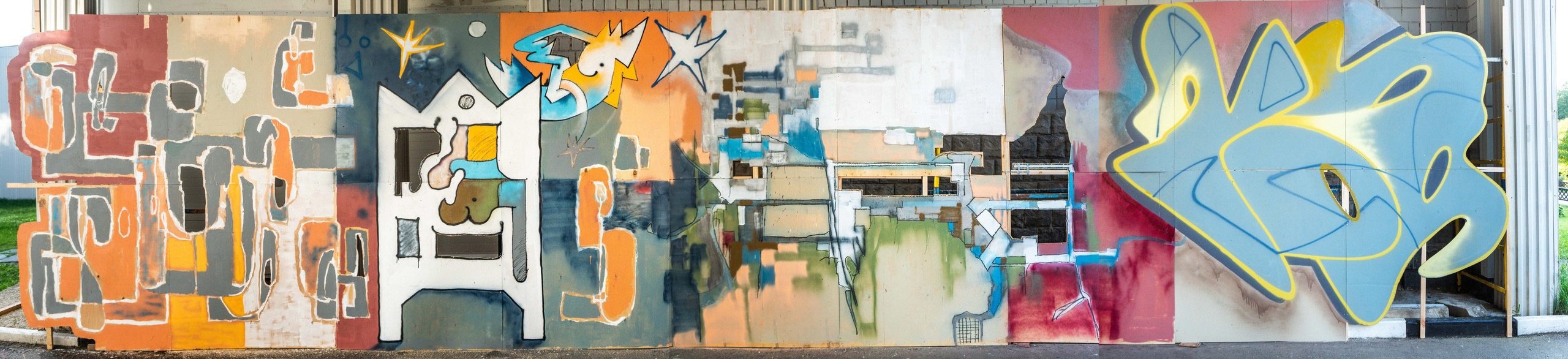
It’s more efficient to walk around alone, you can ride a bike or walk fast, I just love walking long distances. Walking is very important, you have time to understand the terrain while walking through it, it’s like meditation. I plan a route using maps and read out an interesting area with a trail, where there may be a large field, river, or hilly terrain. Sometimes, I write down the path I’ve travelled in applications, so that I can remember later, looking at different photos with views taken. It’s cool when I succeeded to photograph a dog with an industrial background, or some kind of horse, such compositions. It’s funny that the impression after the completed route always does not coincide with what was imagined before.
When I paint, I often fail the first time or in one day, and I have to go back. Also, in different weather conditions, photos with a pattern are obtained in different atmospheres. If you take someone who likes to walk with you, you can share the experience, But you don’t do what you want to do before you get there, if someone is tired or their shoes are wet.


Outdoors, how do you choose the spots you are going to transform? It seems like you are attracted to fences and old little houses, why?
I’m looking for obscure architectural forms, such as those found in self-built vegetable gardens. In Russia, there has been such a phenomenon since the 60s to the 80s, when urban residents made vegetable gardens behind factories or on empty land, next to water. People found building materials somewhere, made small houses and sheathed it all with iron sheets from the roofs of former factories. Usually there you can find a lot of home-made wind turbines made of bottles to scare away birds or paths lined with carpets. These are such free buildings without much experience, and without any permits, it looks like graffiti. Sometimes there are also larger huts among them – assemblages with windows and painted with silver. There are also many fences, the same assemblages, plank-tin, sometimes the fence consists entirely of doors. You can imagine how someone’s childhood filled with adventures lived in such buildings. You can also find naive paintings like the sun with rays or flowers. In general, it’s like going to an interesting exhibition of people who did not identify themselves with any trends of artists. Just for myself, to dig in the ground, to grow vegetables.


Nowadays, such buildings are usually no longer under the supervision of their owners since 10 years and have been abandoned. Unlike cities, such places are often inhabited by gardeners, fishermen, or children, and sometimes there are fallen characters who are ambushed by the police. There have been times when I also needed to prove artistic or scientific intentions. I also have a favourite place where I paint on the same wall, in layers. By embedding fragments of the previous corrupted layer into a new font composition, this series is called Disfrag. I’ve been painting on the same wall for about 5 years now, and I’ve put together about 15 consecutive layers.


Is the surface important (wood, metal, concrete wall)? Do you like the irregular surfaces of it?
That’s the point, every wall has properties. For example, concrete is simple and smooth, and any sketch drawing can be transferred to it. Clean walls are not interesting. I started looking for walls made up of geometric segments to know what they are. These segments are like a puzzle, their contour lines can be used as guides to form a pattern, or, for example, intentionally ignore it and make a loose pattern covering the surface. I like to add paintings to the walls that resemble to assemblages or sculptures, if the artist works with this. Such works also turn out to be similar in approach to sculpture, that is, the shape is cut out with paint or with putty.
You seem to limit your colour palette on purpose and using a lot of white, how comes?
Each painting is a map of the subconscious mind or a shadow of consciousness. I noticed that in painting, the colour palette is responsible for the emotional fullness of the work, while monochrome is more technical. There is also the nature of the lines, and there is the contour. The lines refer to the character, this is the poetry of it, and the contour is the inner boundaries. “Where the dazzling mirage ends, a dim glow begins …” — the words of Alexei Fishev, a classic from the underground. I use mainly shades of chrome, aluminium, or white.


It seems that you take colours of the surroundings into the painting to integrate your work in the surrounding like camouflage? What is the effect you wanna reach?
I combine the methods of site-specific art and building style to make the work сomplete the atmosphere. To make it less noticeable from the outside, but reveal the details inside.
Sometimes you paint coloured fields with different colours, and then you cover them with white again, like buffing, what interests you in these layers?
Here I apply a scientific approach and consider the structure of the painting. The work on the wall consists of an outline and a fill in. Contours are limited geometric shapes filled with a certain colour, located inside the constraints. The colour is the emotion. You can change the colour of emotions by colouring the areas with different tones. If you paint over the colour, then the inner boundaries of the psyche appear. If you change the colour or specifically climb on the borders, then something starts happening. For example, during the winter of 24-25, a day I was filming the process of chroming the colours inside the composition, my flash drive failed, which had 30 GB of photos and videos related to drawing during this period. Something like a memory reset occurred, it was difficult to remember what was on the flash drive, and in the morning I felt relieved instead of disappointed about the loss. At the same time, only the second part of the video remained recorded, with the colour already filled in. The emotions and memories kind of disappeared, although I remember that the colour fill was interesting.


With what techniques and materials are you working outdoor?
I mainly use building materials and car enamel. I make the contour with wax fudge, or home-made crayons made from charcoal, wax and oil. Such a contour turns out to be thin, as if it were a drawing or drawn with a simple pencil. Building materials are interestingly mixed together, and interesting techniques are obtained from this synthesis. For example, I found that oil shows the bottom layer of paint if you use it to draw on the ceiling paint. Also, for example, I used a paint cleaner to create voids inside the letters. Here you can identify a very strong influence on graffiti, it turns out to be a “building” style. Such graffiti treats architecture with love, and rejects mindless bombing by itself.
How do you proceed to find new compositions with your combined fields?
That’s what the wall tells you. Usually there is already something on it and interaction is taking place. For example, there are spots of paint, or there is a texture.
When is a composition satisfying you?
I’m looking at the combination of lines and fill in. It can consist of free geometry as an abstraction, but I like it better when it turns out to resemble to things like a wide sheet, a patchwork composition, something woven in space. Or it’s good when it resembles to the technical panel of some kind of machine.
Do you have to work fast?
It happens in different ways, I come back several times to finish something. I finish some of the work in half a year or several years, when it is infused under the influence of ultraviolet light or conditions.
When you work on specific sites, do you still see those works as paintings or as conceptual interventions?
When I paint, it’s just an image. But when I need to organize it, I relate the drawings to different concepts.
Are you always doing sketches in advance?
Always.
How important is the sketching practice for you?
Sketching is the foundation if you need to save your way. If you just sketch on paper, then this is a search for free new shapes, you can also draw on a photo of the wall to choose what suits you best in the end.


How important is freestyle for you?
I do not know if freestyle is good enough to draw something expressive or not confusing, I am not so much into freestyle.
Do you see your wall paintings still as pieces like graffiti pieces?
It’s definitely graffiti, graffiti is spray-painting, it makes all the legs grow. Or rather, it came out of drawing/painting on the streets, even when it becomes as voluminous as sculpture, streetness and sprays remain there. Another point is whether it is possible to call paintings that way without spraying with a can and where there is a font or a hint of a font. The image may not look like graffiti, but the person who painted it was in search of that sense of the original graffiti in these various techniques.


Are there any modern or contemporary artist that impressed you in the past or today?
I am mainly interested in artists from my environment, who are not like the “dead artists from museums“. I’m also inspired by the work of newcomers who leave without turning into graffiti artists, leaving us with a few wild works on the walls. I like artists who combine technicality and expression in amazing ways, there are quite a lot of them, and I do not know how to write about it, because I do not know personally, I will list a couple. The styles of DFP and SENOR from Greece were very influenced, especially his fractal-like searches, he is really wild and thoughtful at the same time. Daniel Weissbach, I was inspired by his original and experimental approach to creating fonts, the video where he draws fonts in a single line with chrome, as well as this multi-ball tool that copies lines…The characters who influenced me a lot are the guys I grew up with while I was painting graffiti, NEMU, EFIR, BREWER, OTVZN, EFFEKT, KANDY87, SCHON, GROW, MAEKK85, MANOS, and the girls who paint on the walls, Nastya Dunaeva and Masha Pinus.
I would like to name here my teacher Boris Evgenievich Mikhailov, who is now 80 years old, and the exhibition in which he participated, “Expansion of the subject” in 2013. I saw how grown-up people mixed the material to make art. The space of the gallery itself was very thoughtful, the reflections were written right on the walls of the gallery, I felt like I was inside a book.
Special respect to the active NEK crew, whose styles are based on graffiti made from thoughts and expressions like dough, and in addition to drawings on the wall, there are building sculptures.
You create studio works as well, since when?
In 2014, I started doing carpentry and since then I have been making assemblages and canvases in which I use recycled materials such as wood, paper, fabrics, as well as combining graffiti techniques and carpentry to make furniture.
It seems you are using found materials like pieces of rusted metal and wood to built up objects to paint on?
I use material found in the woods or in the trash, which has an interesting shape or potential that can be unlocked or supplemented.
How would you describe your studio practice? Sculptural?
This is something that has gone out of the plane of the wall into a voluminous figure, and has a structure like that of nature, for example, the bark of trees or something like that.


Do you show your studio works in exhibitions?
Very rarely. I exhibited some of my work for a common cause in Moscow. For example, I exhibited works made of rusty sheets and the sculpture “Spraydog”, dedicated to stray dogs, at an exhibition by curator and artist Ada Aves. It would be nice to design a space where you could work, for example, in a workshop or in the form of graffiti on the outskirts, with a sense of graffiti style. There are such places in Russia, for example, I saw a gallery inside a wooden shed, garage or greenhouse. I want to highlight the expressive exhibition of the NEK crew, they made an exhibition of a close circle of artists, it was called “I thought you weren’t at NEK”, in 2022. The guys gave me a whole room in which I hung up the reliefs and sculptures. YOBNEK’s “in office” video was also broadcast there.
How would you describe your artistic development and do you have any projects in the future?
I plan to describe my thoughts and publish several zines according to my ideas and continue to synthesize graffiti with architecture through objects or furniture.
Thank you so much for your time!


Leave a Reply